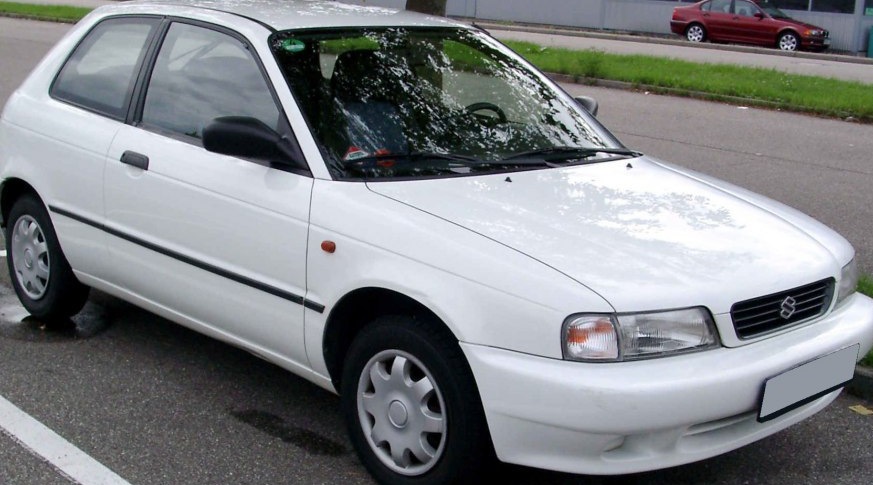
The Suzuki Baleno Hatchback (EG series), launched in 1995, represented a significant step forward for Suzuki in the compact hatchback segment. Produced from 1996 to 2001, the Baleno aimed to offer a blend of practicality, affordability, and a degree of sporting appeal. Within the EG range, the 1.8 GT variant, producing 121 horsepower, occupied a position as the performance-oriented trim level, sitting above the base models and offering a more engaging driving experience. It was designed to appeal to buyers seeking a compact car with a bit more zest than the standard offerings.
Suzuki Baleno 1.8 GT (EG) – An Overview
The Baleno EG series was a collaborative effort with General Motors, sharing platforms and components with the Opel/Vauxhall Astra and the Chevrolet Astra. This partnership allowed Suzuki to enter the European market with a more competitive product. The 1.8 GT specifically targeted drivers who desired a responsive engine and a more dynamic driving experience within the confines of a practical hatchback. It was marketed as a stylish and capable vehicle for both urban commutes and longer journeys.
Powertrain & Engine Architecture
At the heart of the 1.8 GT lay the J18A engine, a 1.8-liter inline-four cylinder gasoline engine. This engine featured a double overhead camshaft (DOHC) valvetrain and multi-port fuel injection, contributing to its relatively high output for its displacement. The J18A produced 121 hp at 6200 rpm and 152 Nm (112.11 lb-ft) of torque at 3400 rpm. The engine’s design prioritized a balance between power and fuel efficiency, although the GT model leaned more towards performance. The compression ratio was set at 9.8:1. The engine utilized a transverse front-engine layout, common for front-wheel-drive vehicles.
The 1.8 GT was exclusively offered with a 5-speed manual transmission. This gearbox was chosen to complement the engine’s power output and provide drivers with greater control over the vehicle’s performance. The transmission’s gear ratios were tuned to maximize acceleration and provide a reasonably comfortable cruising experience. The lack of an automatic transmission option for the 1.8 GT underscored its focus on driver engagement.
Driving Characteristics
The Suzuki Baleno 1.8 GT offered a noticeably more spirited driving experience compared to the lower-powered variants. The 121 hp engine provided brisk acceleration, allowing for confident overtaking maneuvers and enjoyable driving on winding roads. While not a dedicated sports car, the 1.8 GT’s power-to-weight ratio of 7.7 kg/hp contributed to its responsive feel. The 5-speed manual transmission allowed drivers to keep the engine in its optimal power band, maximizing performance. The steering, utilizing a hydraulic rack and pinion system, provided decent feedback and precision. The suspension, featuring wishbone setups both front and rear, offered a reasonable compromise between comfort and handling, though it wasn’t particularly sporty. Compared to the base models, the 1.8 GT felt significantly more capable and engaging.
Equipment & Trim Levels
The 1.8 GT trim level came standard with several features designed to enhance both comfort and style. Interior appointments typically included upgraded cloth upholstery, a sporty steering wheel, and a more comprehensive instrument cluster. Power steering was standard, making maneuvering easier, particularly in urban environments. While not lavishly equipped by modern standards, the 1.8 GT offered a reasonable level of convenience features for its time. Optional extras could include air conditioning, a radio/cassette player, and power windows. The exterior styling of the 1.8 GT was often distinguished by subtle body-colored accents and alloy wheels, differentiating it from the more basic Baleno models.
Chassis & Braking
The Baleno 1.8 GT utilized a front-wheel-drive chassis with a wheelbase of 2380 mm (93.7 inches). The front suspension employed a wishbone configuration, while the rear also featured a wishbone setup. This suspension design aimed to provide a balance between ride comfort and handling stability. The braking system consisted of ventilated discs on the front wheels and solid discs on the rear, providing adequate stopping power for the vehicle’s weight and performance. An Anti-lock Braking System (ABS) was included as a standard safety feature, enhancing braking performance in adverse conditions. The tires were typically sized 185/60 R14, mounted on 14-inch alloy wheels.
Market Reception & Comparison
The Suzuki Baleno 1.8 GT was generally well-received by automotive critics as a competent and enjoyable compact hatchback. It was praised for its responsive engine, engaging driving dynamics, and relatively affordable price point. However, some reviewers noted that the interior quality wasn’t quite on par with some of its competitors, such as the Volkswagen Golf or Opel/Vauxhall Astra. In terms of fuel economy, the 1.8 GT offered reasonable figures for its class, with urban consumption around 10.2 l/100 km (23.1 US mpg) and extra-urban consumption around 6.1 l/100 km (38.6 US mpg). Compared to the lower-powered Baleno variants, the 1.8 GT offered significantly improved performance, but at the cost of slightly increased fuel consumption. Its reliability was generally considered good, benefiting from Suzuki’s reputation for building durable vehicles.
Technical Specifications
| Brand | Suzuki |
| Model | Baleno |
| Generation | Baleno Hatchback (EG, 1995) |
| Type | 1.8 GT (121 Hp) |
| Start of production | 1996 |
| End of production | 2001 |
| Engine Model/Code | J18A |
| Engine displacement | 1840 cm3 (112.28 cu. in.) |
| Number of cylinders | 4 |
| Engine configuration | Inline |
| Cylinder Bore | 84 mm (3.31 in.) |
| Piston Stroke | 83 mm (3.27 in.) |
| Compression ratio | 9.8:1 |
| Power | 121 Hp @ 6200 rpm |
| Torque | 152 Nm @ 3400 rpm (112.11 lb.-ft. @ 3400 rpm) |
| Fuel injection system | Multi-port manifold injection |
| Engine oil capacity | 4.7 l (4.97 US qt | 4.14 UK qt) |
| Coolant capacity | 4.7 l (4.97 US qt | 4.14 UK qt) |
| Kerb Weight | 935 kg (2061.32 lbs.) |
| Max. weight | 1440 kg (3174.66 lbs.) |
| Max load | 505 kg (1113.33 lbs.) |
| Trunk (boot) space – minimum | 210 l (7.42 cu. ft.) |
| Trunk (boot) space – maximum | 495 l (17.48 cu. ft.) |
| Fuel tank capacity | 51 l (13.47 US gal | 11.22 UK gal) |
| Length | 3870 mm (152.36 in.) |
| Width | 1690 mm (66.54 in.) |
| Height | 1390 mm (54.72 in.) |
| Wheelbase | 2380 mm (93.7 in.) |
| Drive wheel | Front wheel drive |
| Number of gears and type of gearbox | 5 gears, manual transmission |
| Front brakes | Ventilated discs |
| Rear brakes | Disc |
| Tires size | 185/60 R14 |
Legacy
The Suzuki Baleno 1.8 GT, while not a high-volume seller, has developed a modest following among enthusiasts. The J18A engine is generally considered reliable, and parts availability remains reasonable. Today, well-maintained examples of the 1.8 GT are sought after by those looking for a classic compact hatchback with a bit of character. The car’s relatively simple mechanical design makes it appealing to DIY mechanics. While rust can be an issue on older examples, the Baleno 1.8 GT remains a viable and enjoyable option for those seeking an affordable and engaging driving experience. Its collaborative development with GM also means a wider network of parts compatibility with Opel/Vauxhall and Chevrolet models.