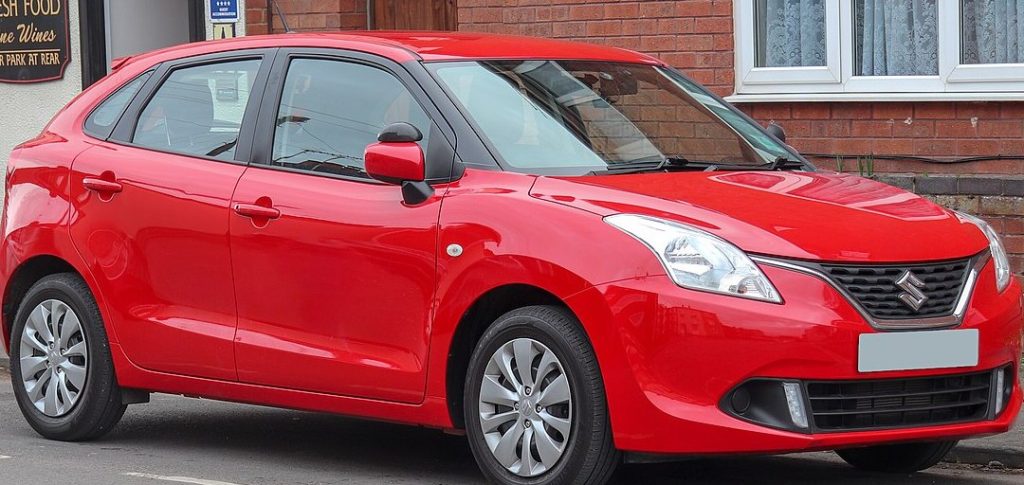
The Suzuki Baleno I (WB) 1.0 Boosterjet, produced from October 2015 to January 2019, represented a significant entry in the subcompact hatchback segment. This variant, powered by the K10C 1.0-liter turbocharged three-cylinder engine producing 111 horsepower, was positioned as a fuel-efficient and modern option within the Baleno lineup. The Baleno itself, designated the WB series, marked Suzuki’s return to the European B-segment after a hiatus, aiming to offer a compelling blend of practicality, technology, and affordability. It was built on Suzuki’s Heartect platform, designed for lightweight construction and improved safety.
Suzuki Baleno I (WB) 1.0 Boosterjet: Overview
The Baleno I (WB) 1.0 Boosterjet was designed to appeal to buyers seeking a stylish and economical hatchback. It offered a step up in performance and refinement compared to the naturally aspirated 1.2-liter DualJet engine also available in the Baleno range, while remaining more accessible than potential future performance-oriented trims. The vehicle’s focus was on providing a comfortable driving experience with reasonable fuel economy, making it suitable for both urban commuting and longer journeys. The 1.0 Boosterjet trim aimed to attract a younger demographic and those prioritizing modern features and a slightly more engaging driving experience.
Powertrain & Engine Architecture
At the heart of the Baleno 1.0 Boosterjet lies the K10C engine, a 998cc inline-three cylinder gasoline engine. This engine utilizes direct fuel injection and a small turbocharger with an intercooler to boost power and efficiency. The engine’s architecture is notable for its lightweight construction, contributing to the Baleno’s overall low kerb weight. The K10C produces 111 hp at 5500 rpm and 170 Nm (125.39 lb-ft) of torque between 2000 and 3500 rpm. This torque curve provides a usable amount of power across a broad range of engine speeds. The engine features a compression ratio of 10:1 and 4 valves per cylinder. The engine oil capacity is 2.8 liters (2.96 US qt / 2.46 UK qt) and requires a specification adhering to Suzuki’s recommendations.
Driving Characteristics
The Baleno 1.0 Boosterjet offered a noticeable improvement in performance compared to the base 1.2-liter model. While not a sports car, the turbocharger provides a responsive power delivery, making overtaking and merging onto highways easier. Acceleration from 0 to 100 km/h (0-62 mph) takes approximately 11.4 seconds, and 0-60 mph is achieved in around 10.8 seconds. The five-speed manual transmission, standard on this variant, is well-matched to the engine’s characteristics, offering smooth gear changes. The relatively low weight of the vehicle (980 kg / 2160.53 lbs) further enhances its agility. The turbo lag is minimal, providing a linear power delivery that is predictable and easy to manage. Compared to a potential future diesel variant, the 1.0 Boosterjet offered a quieter and smoother driving experience, albeit with slightly lower fuel economy.
Equipment & Trim Levels
The 1.0 Boosterjet trim typically included a higher level of standard equipment compared to the base Baleno models. Standard features often included air conditioning, power windows, central locking, and a basic audio system with USB connectivity. Higher trim levels within the 1.0 Boosterjet range added features such as alloy wheels, a touchscreen infotainment system with smartphone integration (Apple CarPlay and Android Auto), rear parking sensors, and a leather-wrapped steering wheel. Interior upholstery was typically cloth, with options for upgraded materials on higher trims. Safety features included ABS (Anti-lock Braking System), airbags, and stability control. Optional extras could include a navigation system, climate control, and a panoramic sunroof.
Chassis & Braking
The Baleno I (WB) utilized a McPherson strut front suspension with a coil spring and anti-roll bar, providing a comfortable and controlled ride. The rear suspension employed a semi-independent coil spring setup. This configuration balanced ride comfort with handling stability. The braking system consisted of ventilated discs on the front wheels and discs on the rear wheels, providing adequate stopping power for the vehicle’s weight class. Electric power steering offered light and precise steering feel, making it easy to maneuver in urban environments. Tire sizes typically ranged from 175/65 R15 to 185/55 R16, depending on the trim level. Wheel rim sizes were correspondingly 5J x 15 or 6J x 16.
Market Reception & Comparison
The Suzuki Baleno 1.0 Boosterjet received generally positive reviews from automotive critics. It was praised for its fuel efficiency (4.5 l/100 km combined, 52.3 US mpg, 62.8 UK mpg), stylish design, and surprisingly spacious interior. Critics noted that the 1.0 Boosterjet engine provided a good balance of performance and economy, making it a practical choice for everyday driving. Compared to the 1.2-liter DualJet engine, the Boosterjet offered a more engaging driving experience and better acceleration. However, some reviewers found the interior materials to be somewhat basic. In terms of reliability, the Baleno generally enjoys a good reputation, with the K10C engine proving to be a robust and dependable unit. Compared to competitors like the Volkswagen Polo, Ford Fiesta, and Hyundai i20, the Baleno offered a competitive price point and a generous level of standard equipment.
Technical Specifications
| Brand | Suzuki |
| Model | Baleno |
| Generation | Baleno I (WB) |
| Type (Engine) | 1.0 BOOSTERJET (111 Hp) |
| Start of production | October, 2015 |
| End of production | January, 2019 |
| Powertrain Architecture | Internal Combustion engine |
| Body type | Hatchback |
| Seats | 5 |
| Doors | 5 |
| Fuel consumption (urban) | 5.4 l/100 km (43.6 US mpg, 52.3 UK mpg) |
| Fuel consumption (extra urban) | 4 l/100 km (58.8 US mpg, 70.6 UK mpg) |
| Fuel consumption (combined) | 4.5 l/100 km (52.3 US mpg, 62.8 UK mpg) |
| CO2 emissions | 105 g/km |
| Fuel Type | Petrol (Gasoline) |
| Acceleration 0 – 100 km/h | 11.4 sec |
| Acceleration 0 – 62 mph | 11.4 sec |
| Acceleration 0 – 60 mph | 10.8 sec |
| Maximum speed | 200 km/h (124.27 mph) |
| Emission standard | Euro 6 |
| Weight-to-power ratio | 8.8 kg/Hp |
| Weight-to-torque ratio | 5.8 kg/Nm |
| Power | 111 Hp @ 5500 rpm |
| Torque | 170 Nm @ 2000-3500 rpm (125.39 lb.-ft.) |
| Engine layout | Front, Transverse |
| Engine Model/Code | K10C |
| Engine displacement | 998 cm3 (60.9 cu. in.) |
| Number of cylinders | 3 |
| Engine configuration | Inline |
| Cylinder Bore | 73 mm (2.87 in.) |
| Piston Stroke | 79.5 mm (3.13 in.) |
| Compression ratio | 10:1 |
| Number of valves per cylinder | 4 |
| Fuel injection system | Direct injection |
| Engine aspiration | Turbocharger, Intercooler |
| Engine oil capacity | 2.8 l (2.96 US qt | 2.46 UK qt) |
| Coolant | 4.4 l (4.65 US qt | 3.87 UK qt) |
| Kerb Weight | 980 kg (2160.53 lbs.) |
| Max. weight | 1430 kg (3152.61 lbs.) |
| Max load | 450 kg (992.08 lbs.) |
| Trunk (boot) space – minimum | 355 l (12.54 cu. ft.) |
| Trunk (boot) space – maximum | 1085 l (38.32 cu. ft.) |
| Fuel tank capacity | 37 l (9.77 US gal | 8.14 UK gal) |
| Length | 3995 mm (157.28 in.) |
| Width | 1745 mm (68.7 in.) |
| Height | 1470 mm (57.87 in.) |
| Wheelbase | 2520 mm (99.21 in.) |
| Drivetrain Architecture | Front wheel drive |
| Number of gears and type of gearbox | 5 gears, manual transmission |
Legacy
The Suzuki Baleno 1.0 Boosterjet, while no longer in production, remains a popular choice in the used car market. Its combination of fuel efficiency, practicality, and modern features continues to appeal to budget-conscious buyers. The K10C engine has proven to be a reliable unit, with few reported major issues. Regular maintenance, including oil changes and timing chain inspections, is crucial for long-term reliability. The Baleno’s relatively simple design and readily available parts contribute to its affordability and ease of repair. As a result, the 1.0 Boosterjet variant represents a sensible and economical option for those seeking a dependable subcompact hatchback.