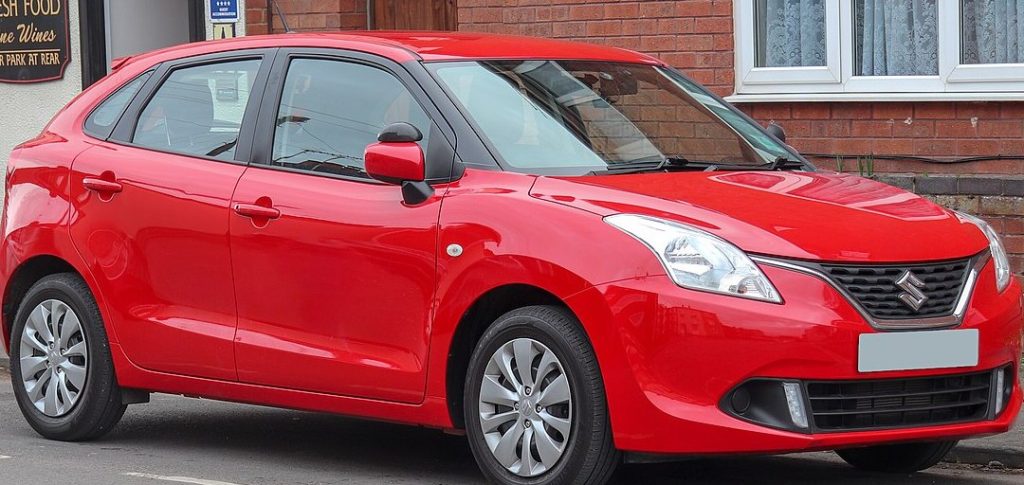
The Suzuki Baleno I (WB) 1.0 Boosterjet Automatic, produced from October 2015 to January 2019, represented a significant entry in Suzuki’s subcompact hatchback lineup. Part of the WB series (the first generation of the modern Baleno), this variant aimed to offer a balance of fuel efficiency, modern technology, and affordability. Positioned as a mid-range offering within the Baleno range, it slotted above the base 1.2-liter naturally aspirated models and below any potential higher-performance or specialized trims. The Baleno WB itself was a key model for Suzuki, designed to appeal to a broader international market, particularly in Europe and Asia, and represented a departure from previous Baleno generations.
Suzuki Baleno I (WB) 1.0 Boosterjet Automatic: Powertrain & Engine Architecture
At the heart of the Baleno 1.0 Boosterjet Automatic lies the K10C engine, a 998cc, inline-three cylinder gasoline engine. This engine is notable for its direct injection and turbocharging with an intercooler, technologies that allow it to produce a respectable 111 horsepower at 5500 rpm and 160 Nm (118.01 lb-ft) of torque between 1500 and 4000 rpm. The direct injection system, a key feature, improves combustion efficiency and contributes to both power output and fuel economy. The turbocharger, a small unit optimized for responsiveness, minimizes turbo lag and provides a broader torque curve than naturally aspirated engines of similar displacement.
The engine’s valvetrain utilizes four valves per cylinder (DOHC – Dual Overhead Camshaft), further enhancing breathing and contributing to its performance characteristics. The compression ratio is set at 10:1, a common figure for turbocharged gasoline engines. The engine is transversely mounted in the front of the vehicle, driving the front wheels.
Paired with the K10C engine is a six-speed automatic transmission. This transmission was chosen for its smooth operation and convenience, appealing to buyers prioritizing ease of driving over outright performance. While not a dual-clutch transmission (DCT), it offered a reasonable level of responsiveness and contributed to the Baleno’s overall refinement. The transmission’s gear ratios were tuned to maximize fuel efficiency while still providing adequate acceleration.
Engine Specifications (K10C)
- Displacement: 998 cm³ (60.9 cu. in.)
- Configuration: Inline-3
- Bore x Stroke: 73 mm x 79.5 mm (2.87 in x 3.13 in)
- Compression Ratio: 10:1
- Valves per Cylinder: 4
- Fuel Injection: Direct Injection
- Aspiration: Turbocharged, Intercooled
Driving Characteristics
The Baleno 1.0 Boosterjet Automatic offered a surprisingly sprightly driving experience for a subcompact hatchback. While not a performance-oriented vehicle, the turbocharger provided a noticeable boost in power, making overtaking and merging onto highways relatively effortless. Acceleration from 0 to 100 km/h (0-62 mph) took approximately 11 seconds, and 0-60 mph was achieved in around 10.5 seconds. Top speed was rated at 190 km/h (118.06 mph).
The automatic transmission, while smooth, wasn’t particularly quick to downshift, meaning the engine sometimes felt slightly strained during hard acceleration. Compared to the manual transmission versions of the 1.0 Boosterjet, the automatic offered slightly slower acceleration due to the transmission’s inherent efficiency losses. However, the convenience of the automatic outweighed the performance difference for many buyers. The relatively light weight of the Baleno (1010 kg / 2226.67 lbs) helped to mitigate the impact of the 111 hp output, resulting in a reasonably engaging driving experience.
Equipment & Trim Levels
The Baleno 1.0 Boosterjet Automatic typically came equipped with a reasonable level of standard features. These generally included air conditioning, power windows, power door locks, a basic audio system with USB connectivity, and alloy wheels. Safety features such as ABS (Anti-lock Braking System) and dual front airbags were also standard. Higher trim levels, often denoted by specific packages or names, added features like a touchscreen infotainment system with Apple CarPlay and Android Auto compatibility, rear parking sensors, a rearview camera, and automatic climate control. Interior upholstery was typically cloth, with options for different color schemes. Optional extras often included a panoramic sunroof, keyless entry, and upgraded audio systems.
Chassis & Braking
The Baleno 1.0 Boosterjet Automatic utilized a McPherson strut front suspension with a coil spring and anti-roll bar, providing a comfortable and predictable ride. The rear suspension was a semi-independent coil spring setup, which was a cost-effective solution for this class of vehicle. The front brakes were ventilated discs, offering good stopping power, while the rear brakes were discs. The steering system was an electric power steering rack and pinion, providing light and easy steering feel. Tire sizes varied depending on the trim level, with 175/65 R15 and 185/55 R16 being common options.
Market Reception & Comparison
The Suzuki Baleno 1.0 Boosterjet Automatic was generally well-received by automotive critics. It was praised for its fuel efficiency (4.9 l/100 km combined, 48 US mpg, 57.6 UK mpg), its comfortable ride, and its relatively spacious interior for a subcompact hatchback. However, some critics noted that the engine could be a bit noisy under hard acceleration and that the automatic transmission wasn’t the most responsive on the market. Compared to other trims in the Baleno lineup, the 1.0 Boosterjet Automatic offered a better balance of performance and fuel economy than the base 1.2-liter models, but it wasn’t as sporty as any potential higher-performance variants. Competitors in this segment included the Honda Jazz/Fit, Toyota Yaris, and Volkswagen Polo.
Technical Specifications
| Body Type | Hatchback, 5 Doors, 5 Seats |
| Fuel Economy (Urban) | 6.3 l/100 km (37.3 US mpg, 44.8 UK mpg, 15.9 km/l) |
| Fuel Economy (Extra Urban) | 4.1 l/100 km (57.4 US mpg, 68.9 UK mpg, 24.4 km/l) |
| Fuel Economy (Combined) | 4.9 l/100 km (48 US mpg, 57.6 UK mpg, 20.4 km/l) |
| CO2 Emissions | 115 g/km |
| Fuel Type | Petrol (Gasoline) |
| Acceleration 0-100 km/h | 11 sec |
| Acceleration 0-62 mph | 11 sec |
| Acceleration 0-60 mph | 10.5 sec |
| Maximum Speed | 190 km/h (118.06 mph) |
| Emission Standard | Euro 6 |
| Weight-to-Power Ratio | 9.1 kg/Hp |
| Weight-to-Torque Ratio | 6.3 kg/Nm |
| Engine Model/Code | K10C |
| Engine Displacement | 998 cm³ (60.9 cu. in.) |
| Number of Cylinders | 3 |
| Engine Configuration | Inline |
| Cylinder Bore | 73 mm (2.87 in) |
| Piston Stroke | 79.5 mm (3.13 in) |
| Compression Ratio | 10:1 |
| Fuel Injection System | Direct Injection |
| Engine Oil Capacity | 2.8 l (2.96 US qt | 2.46 UK qt) |
| Coolant Capacity | 4.4 l (4.65 US qt | 3.87 UK qt) |
| Kerb Weight | 1010 kg (2226.67 lbs) |
| Max. Weight | 1430 kg (3152.61 lbs) |
| Trunk (Boot) Space (Minimum) | 355 l (12.54 cu. ft.) |
| Trunk (Boot) Space (Maximum) | 1085 l (38.32 cu. ft.) |
| Fuel Tank Capacity | 37 l (9.77 US gal | 8.14 UK gal) |
| Length | 3995 mm (157.28 in) |
| Width | 1745 mm (68.7 in) |
| Height | 1470 mm (57.87 in) |
| Wheelbase | 2520 mm (99.21 in) |
| Number of Gears | 6 |
| Gearbox Type | Automatic Transmission |
Legacy
The Suzuki Baleno 1.0 Boosterjet Automatic, while not without its minor shortcomings, proved to be a reliable and economical subcompact hatchback. The K10C engine, despite being a three-cylinder unit, demonstrated good durability and relatively low running costs. On the used car market, these Balenos are generally considered a good value proposition, offering a decent level of equipment and fuel efficiency at an affordable price. Maintenance is relatively straightforward, and parts availability is generally good. However, as with any turbocharged engine, regular oil changes and proper maintenance are crucial to ensure long-term reliability. The Baleno WB, and specifically this 1.0 Boosterjet Automatic variant, helped solidify Suzuki’s reputation for building practical, affordable, and fuel-efficient vehicles.