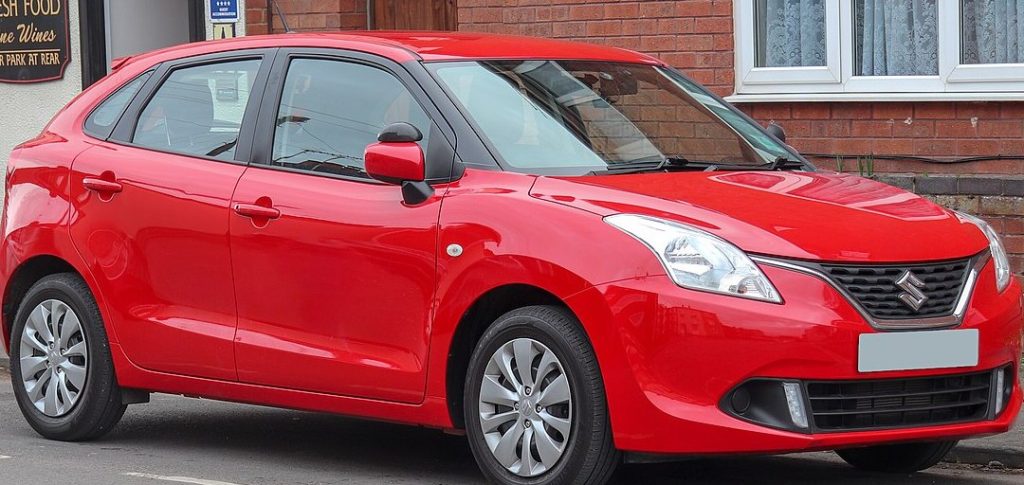
The Suzuki Baleno I (WB) 1.2 DUALJET (90 hp) is a subcompact hatchback produced by Suzuki from October 2015 to January 2019. This variant occupied the entry-level to mid-range position within the first generation (WB) Baleno lineup, offering a balance of fuel efficiency and affordability. It was positioned below the more powerful 1.0 Boosterjet turbocharged engine option and served as the primary offering for buyers prioritizing economy and practicality. The Baleno I (WB) series itself represented Suzuki’s return to the European subcompact hatchback segment after a 13-year absence, built upon the Heartect platform, emphasizing lightweight construction and rigidity.
Powertrain & Engine Architecture
The heart of the Baleno 1.2 DUALJET (90 hp) is the K12C engine, a 1.2-liter (1242 cm3 or 75.79 cu. in.) inline-four cylinder gasoline engine. This engine is characterized by its DualJet direct injection system, which utilizes two injectors per cylinder to improve fuel atomization and combustion efficiency. This contributes significantly to the model’s impressive fuel economy figures. The engine produces a maximum power output of 90 hp (67 kW) at 6000 rpm and a peak torque of 120 Nm (88.51 lb-ft) at 4400 rpm. The engine features a compression ratio of 12.5:1 and utilizes a multi-port manifold fuel injection system. The valvetrain consists of four valves per cylinder (DOHC – Double Overhead Camshaft).
The 1.2 DUALJET engine was typically paired with a five-speed manual transmission, however, a four-speed automatic transmission was also offered, and is the focus of this article. This automatic transmission, while providing ease of use, was a relatively conventional hydraulic automatic, lacking the efficiency of more modern continuously variable transmissions (CVTs) or dual-clutch transmissions (DCTs). The gear ratios were optimized for fuel economy and smooth, if not particularly brisk, acceleration. The automatic transmission was a key selling point for drivers seeking a convenient and easy-to-drive urban vehicle.
Engine Code & Specifics
The K12C engine code designates this specific iteration of the 1.2-liter engine. Suzuki’s DualJet technology, implemented in this engine, was a significant advancement in fuel efficiency for naturally aspirated gasoline engines. The engine oil capacity is 3.1 liters (3.28 US qt | 2.73 UK qt), and the coolant capacity is 4.3 liters (4.54 US qt | 3.78 UK qt). The engine is front-mounted and transversely positioned within the engine bay.
Driving Characteristics
The Baleno 1.2 DUALJET (90 hp) with the four-speed automatic transmission delivers a driving experience geared towards practicality and fuel efficiency rather than outright performance. Acceleration from 0 to 100 km/h (0-62 mph) takes approximately 12.3 seconds, and 0 to 60 mph is achieved in around 11.7 seconds. The top speed is rated at 180 km/h (111.85 mph). The automatic transmission’s gear ratios are spaced to prioritize fuel economy, resulting in a somewhat leisurely acceleration feel. Compared to the manual transmission version, the automatic typically exhibits slightly slower acceleration due to the inherent efficiency losses within the torque converter and transmission itself.
In real-world driving conditions, the Baleno 1.2 DUALJET automatic feels adequate for urban commutes and highway cruising, but struggles with quick overtaking maneuvers or steep inclines. The engine’s peak torque is relatively low, requiring the driver to utilize the full rev range to extract maximum performance. The automatic transmission shifts smoothly, but can sometimes feel hesitant or ‘hunt’ for gears on undulating roads. Compared to the more powerful 1.0 Boosterjet variant, the 1.2 DUALJET automatic offers significantly less performance, but compensates with superior fuel economy.
Equipment & Trim Levels
The Baleno 1.2 DUALJET (90 hp) automatic typically came equipped with a reasonable level of standard features, though specific equipment levels varied depending on the market and optional packages selected. Standard features generally included air conditioning, power steering, electric front windows, central locking, and an audio system with USB connectivity. Safety features typically included ABS (Anti-lock Braking System), airbags, and seatbelt pre-tensioners. Higher trim levels offered additional features such as alloy wheels, a touchscreen infotainment system with smartphone integration (Apple CarPlay and Android Auto), rear parking sensors, and climate control.
Interior upholstery was typically cloth, with a relatively simple and functional dashboard layout. Optional extras included a navigation system, a rearview camera, and various cosmetic enhancements. The Baleno’s interior was designed with practicality in mind, offering ample space for passengers and luggage. Trunk space ranged from 355 liters (12.54 cu. ft.) with the rear seats up to 1085 liters (38.32 cu. ft.) with the rear seats folded down.
Chassis & Braking
The Baleno I (WB) utilizes a McPherson strut front suspension with a coil spring and anti-roll bar, providing a comfortable and predictable ride. The rear suspension is a semi-independent coil spring setup. This suspension configuration is typical for vehicles in this class, prioritizing ride comfort and cost-effectiveness. The front brakes are ventilated discs, while the rear brakes are drums. This combination provides adequate stopping power for everyday driving, although the rear drum brakes are less effective than disc brakes in demanding situations.
The steering system is an electric power steering rack and pinion, offering light and easy steering feel. Tire sizes typically ranged from 175/65 R15 to 185/55 R16, depending on the trim level. The curb weight of the Baleno 1.2 DUALJET automatic is approximately 940 kg (2072.35 lbs), contributing to its relatively good fuel economy.
Market Reception & Comparison
The Suzuki Baleno I (WB) 1.2 DUALJET (90 hp) automatic was generally well-received by critics for its fuel efficiency, affordability, and practicality. However, the automatic transmission was often criticized for its lack of responsiveness and relatively slow shift times. Compared to other subcompact hatchbacks in the European market, such as the Volkswagen Polo, Ford Fiesta, and Renault Clio, the Baleno offered a compelling value proposition, particularly for buyers prioritizing fuel economy and low running costs.
Fuel consumption figures are impressive, with a combined fuel economy of 4.2 l/100 km (56 US mpg, 67.3 UK mpg, 23.8 km/l) and CO2 emissions of 98 g/km (Euro 6 emission standard). The 1.0 Boosterjet variant offered more performance, but at the expense of fuel economy. The manual transmission version of the 1.2 DUALJET offered slightly better fuel economy and acceleration than the automatic.
Technical Specifications
| Brand | Suzuki |
| Model | Baleno |
| Generation | Baleno I (WB) |
| Type (Engine) | 1.2 DUALJET (90 Hp) |
| Start of production | October, 2015 |
| End of production | January, 2019 |
| Powertrain Architecture | Internal Combustion engine |
| Body type | Hatchback |
| Seats | 5 |
| Doors | 5 |
| Fuel consumption (urban) | 5.3 l/100 km (44.4 US mpg, 53.3 UK mpg, 18.9 km/l) |
| Fuel consumption (extra urban) | 3.6 l/100 km (65.3 US mpg, 78.5 UK mpg, 27.8 km/l) |
| Fuel consumption (combined) | 4.2 l/100 km (56 US mpg, 67.3 UK mpg, 23.8 km/l) |
| CO2 emissions | 98 g/km |
| Fuel Type | Petrol (Gasoline) |
| Acceleration 0 – 100 km/h | 12.3 sec |
| Acceleration 0 – 62 mph | 12.3 sec |
| Acceleration 0 – 60 mph | 11.7 sec |
| Maximum speed | 180 km/h (111.85 mph) |
| Emission standard | Euro 6 |
| Weight-to-power ratio | 10.4 kg/Hp |
| Power | 90 Hp @ 6000 rpm |
| Torque | 120 Nm @ 4400 rpm (88.51 lb.-ft. @ 4400 rpm) |
| Engine layout | Front, Transverse |
| Engine Model/Code | K12C |
| Engine displacement | 1242 cm3 (75.79 cu. in.) |
| Number of cylinders | 4 |
| Engine configuration | Inline |
| Cylinder Bore | 73 mm (2.87 in.) |
| Piston Stroke | 74.2 mm (2.92 in.) |
| Compression ratio | 12.5:1 |
| Number of valves per cylinder | 4 |
| Fuel injection system | Multi-port manifold injection |
| Engine oil capacity | 3.1 l (3.28 US qt | 2.73 UK qt) |
| Coolant capacity | 4.3 l (4.54 US qt | 3.78 UK qt) |
| Kerb Weight | 940 kg (2072.35 lbs.) |
| Max. weight | 1405 kg (3097.49 lbs.) |
| Trunk (boot) space – minimum | 355 l (12.54 cu. ft.) |
| Trunk (boot) space – maximum | 1085 l (38.32 cu. ft.) |
| Fuel tank capacity | 37 l (9.77 US gal | 8.14 UK gal) |
| Length | 3995 mm (157.28 in.) |
| Width | 1745 mm (68.7 in.) |
| Height | 1470 mm (57.87 in.) |
| Wheelbase | 2520 mm (99.21 in.) |
Legacy
The Suzuki Baleno I (WB) 1.2 DUALJET (90 hp) automatic, while not a performance icon, has proven to be a reliable and economical choice in the used car market. The K12C engine is generally regarded as a durable unit, with few major reported issues. The four-speed automatic transmission, while not the most sophisticated, is also relatively reliable, provided it receives regular fluid changes. Today, these Balenos represent an affordable and practical option for buyers seeking a fuel-efficient and easy-to-maintain subcompact hatchback. Their continued presence on the road is a testament to Suzuki’s reputation for building dependable vehicles.