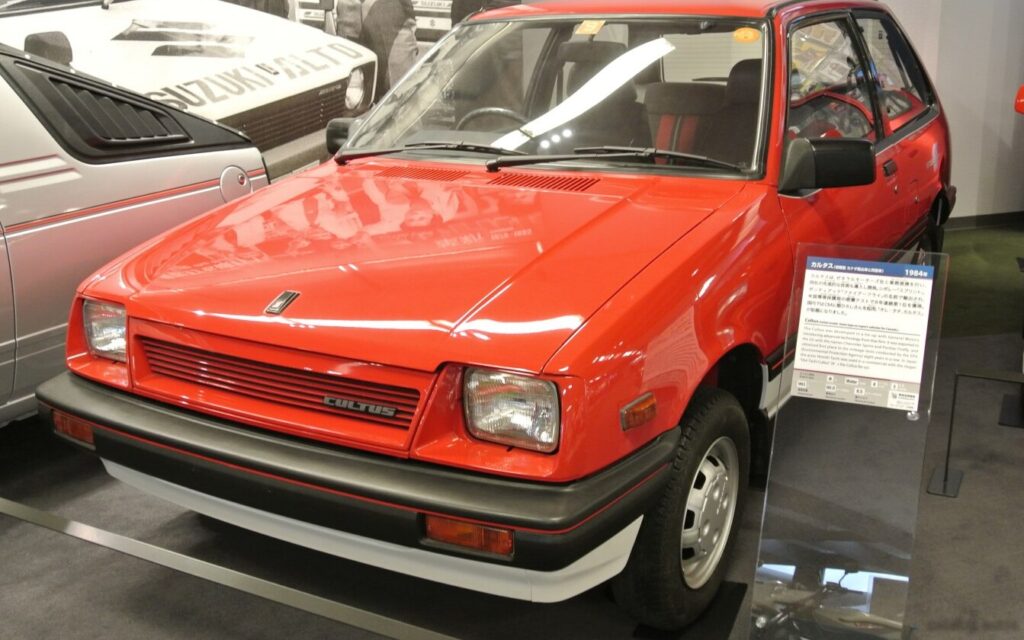
The Suzuki Cultus, known as the Suzuki Swift in many export markets, was a supermini car produced by Suzuki from 1983 to 1989. The first generation, designated the Cultus I (SA310, AA41/43 series), represented Suzuki’s entry into the increasingly popular front-wheel-drive hatchback segment. This generation was produced between 1983 and 1988, and was available with a range of engine and transmission options, including the 1.0-liter, 50 horsepower variant detailed here. The Cultus I was significant for being one of the first front-wheel-drive vehicles produced by Suzuki, marking a shift away from their traditionally rear-wheel-drive offerings.
Suzuki Cultus I 1.0 (SA310, AA41/43) Overview
The 1.0-liter Cultus I, powered by the G10 engine, served as the entry-level model in the Cultus lineup. It was designed to provide affordable and economical transportation, targeting first-time car buyers, city commuters, and those seeking a practical and fuel-efficient vehicle. While not offering the performance of larger-engined variants, the 1.0L model prioritized fuel economy and ease of driving. It was available in both 3-door and 5-door body styles, offering varying degrees of practicality. This variant was particularly popular in markets where smaller, more economical cars were favored.
Powertrain & Engine Architecture
The heart of the Cultus I 1.0 is the G10 engine, a 993cc (60.6 cubic inches) inline-three cylinder petrol engine. This engine, designated SA310 and AA41/43 depending on specific market and emissions regulations, produces 50 horsepower at 5100 rpm and 77 Nm (56.79 lb-ft) of torque at 3200 rpm. The engine features a compression ratio of 9.5:1 and utilizes a single overhead camshaft (SOHC) valvetrain with two valves per cylinder. Fuel delivery is managed by a carburetor, a common feature for engines of this era, prioritizing simplicity and cost-effectiveness over the more advanced fuel injection systems. The engine is longitudinally mounted in the front of the vehicle, driving the front wheels.
The standard transmission for the 1.0-liter Cultus I was a 5-speed manual gearbox. While an automatic transmission was offered in some markets, it was not commonly paired with the base 1.0L engine due to the limited power output. The manual transmission was chosen to maximize fuel efficiency and provide a more engaging driving experience, given the engine’s modest power.
Driving Characteristics
The driving experience in the Cultus I 1.0 is characterized by its light weight and nimble handling. With only 50 horsepower, acceleration is modest, and the vehicle is best suited for urban driving and shorter trips. The 5-speed manual transmission allows drivers to keep the engine in its optimal power band, maximizing performance. The gear ratios are relatively short, aiding in acceleration but also resulting in higher engine speeds at highway cruising speeds. The engine is relatively smooth for a three-cylinder unit, but noticeable vibrations are present, particularly at idle. The steering is light and responsive, making it easy to maneuver in tight spaces. Overall, the driving experience is focused on practicality and efficiency rather than outright performance.
Equipment & Trim Levels
The Cultus I 1.0, as the entry-level model, typically featured a relatively basic level of equipment. Standard features generally included cloth upholstery, vinyl floor covering, and a simple dashboard layout. The instrument cluster typically consisted of a speedometer, fuel gauge, and temperature gauge. Power steering and air conditioning were generally not standard, but were available as optional extras in some markets. The 3-door model often featured a more spartan interior compared to the 5-door version. Optional extras could include upgraded audio systems, hubcaps, and body-colored bumpers. Trim levels varied depending on the market, with some offering slightly more luxurious features such as upgraded seat fabrics and additional interior trim.
Chassis & Braking
The Cultus I utilizes a front-wheel-drive chassis with an independent front suspension featuring MacPherson struts and a torsion beam rear suspension. This suspension setup provides a comfortable ride quality, particularly on smoother roads. The steering is rack and pinion, contributing to the vehicle’s responsive handling. Braking is typically accomplished with disc brakes on the front wheels and drum brakes on the rear wheels. The brake system is hydraulically operated, providing adequate stopping power for the vehicle’s weight and performance. Stabilizer bars were not typically fitted to the base 1.0L model, further emphasizing its focus on affordability.
Market Reception & Comparison
The Suzuki Cultus I 1.0 was generally well-received as an affordable and economical city car. Critics praised its fuel efficiency, nimble handling, and compact size. However, the limited power output was often cited as a drawback, particularly when compared to larger-engined rivals. Compared to other small hatchbacks of the era, such as the Fiat Uno and the Renault 5, the Cultus I offered a competitive level of fuel economy and practicality. Within the Cultus lineup, the 1.0L model was positioned as the most accessible option, appealing to budget-conscious buyers. Higher-spec Cultus models, equipped with larger engines (typically 1.3L) and more features, offered improved performance and comfort but came at a higher price point.
Technical Specifications
| Engine Model/Code | G10 (SA310, AA41/43) |
| Engine Displacement | 993 cm3 (60.6 cu. in.) |
| Number of Cylinders | 3 (Inline) |
| Cylinder Bore | 73.9 mm (2.91 in.) |
| Piston Stroke | 77 mm (3.03 in.) |
| Compression Ratio | 9.5:1 |
| Valves per Cylinder | 2 |
| Fuel Injection System | Carburetor |
| Engine Aspiration | Naturally Aspirated |
| Maximum Power | 50 hp @ 5100 rpm |
| Maximum Torque | 77 Nm (56.79 lb-ft) @ 3200 rpm |
| Length | 3585 mm (141.14 in.) |
| Width | 1530 mm (60.24 in.) |
| Height | 1350 mm (53.15 in.) |
| Wheelbase | 2245 mm (88.39 in.) |
| Drivetrain | Front-Wheel Drive |
| Transmission | 5-speed Manual |
Legacy
The Suzuki Cultus I 1.0, while not a performance icon, remains a popular choice among enthusiasts and collectors seeking a simple, reliable, and affordable classic car. The G10 engine is known for its durability and relatively straightforward maintenance requirements. Parts availability can be a challenge in some markets, but many components are still readily available or can be sourced from other Suzuki models. In the used car market, the Cultus I 1.0 typically commands modest prices, making it an accessible entry point into classic car ownership. The vehicle’s enduring appeal lies in its practicality, fuel efficiency, and nostalgic charm, representing a significant chapter in Suzuki’s automotive history.