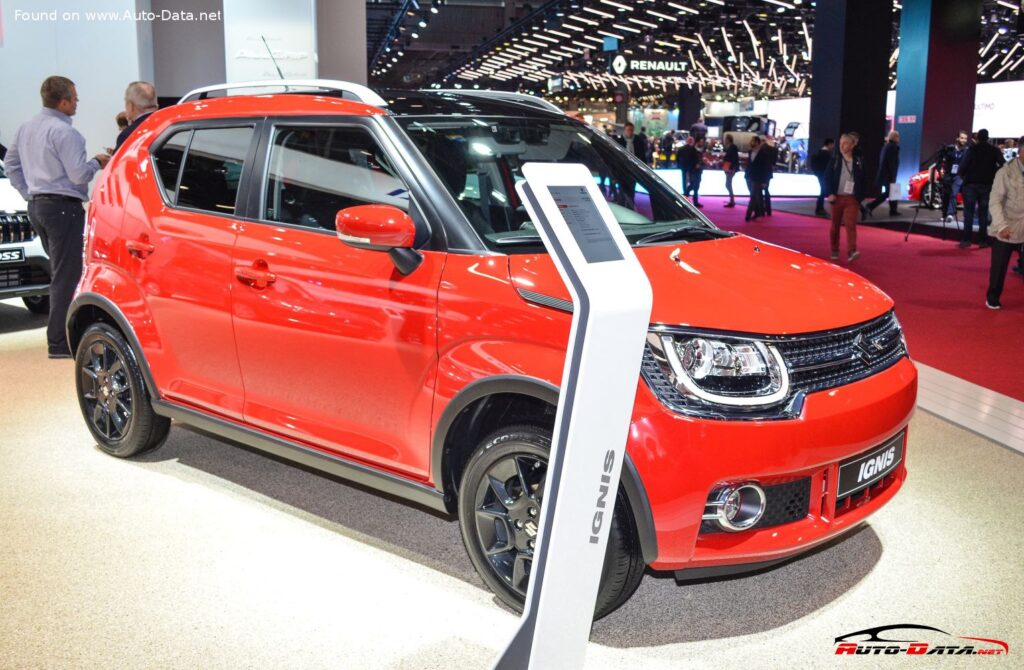
The Suzuki Ignis II 1.2 DualJet (90 Hp) AGS represents the second generation of Suzuki’s distinctive “micro-SUV” or “city SUV” offering. Launched in 2016 and produced until December 2019, this iteration of the Ignis carved out a unique niche in markets primarily across Europe, Asia, and other global regions where compact, fuel-efficient, and versatile vehicles are highly prized. While not officially sold in the United States, the Ignis showcases Suzuki’s expertise in developing small, capable vehicles that blend urban maneuverability with a rugged, SUV-inspired aesthetic. This particular variant, equipped with the 1.2-liter DualJet engine and Suzuki’s Auto Gear Shift (AGS) transmission, was positioned as an economical and practical choice for drivers seeking a compact vehicle with a commanding view of the road and a touch of off-road styling.
The Ignis II built upon its predecessor’s legacy by adopting Suzuki’s new-generation lightweight platform, aiming for enhanced rigidity, improved safety, and significant weight reduction. Its design philosophy focused on maximizing interior space within a minimal footprint, making it an ideal candidate for congested city environments while offering enough versatility for light adventurous excursions. The 1.2 DualJet engine, known for its efficiency, combined with the automated manual AGS transmission, provided a compelling package for consumers prioritizing low running costs and ease of driving.
Engine & Performance: The Heart of the Suzuki Ignis II 1.2 DualJet (90 Hp) AGS
Powering the Suzuki Ignis II 1.2 DualJet (90 Hp) AGS is Suzuki’s K12C engine, a 1.2-liter (1242 cm³ or 75.79 cu. in.) naturally aspirated inline-four gasoline (petrol) unit. This engine is a prime example of Suzuki’s DualJet technology, which optimizes fuel injection by placing two injectors per cylinder, positioned close to the intake valves. This design improves fuel atomization and combustion efficiency, contributing significantly to the Ignis’s impressive fuel economy and lower emissions. The engine produces a respectable 90 horsepower (Hp) at 6000 revolutions per minute (rpm) and 88.51 lb.-ft. of torque at 4400 rpm. With a high compression ratio of 12.5:1 and four valves per cylinder, the K12C engine delivers a lively performance for its size.
The powertrain architecture features a front, transverse engine layout driving the front wheels, a common and efficient setup for compact vehicles. Mated to this engine is a 5-speed Auto Gear Shift (AGS) automatic transmission. Unlike a conventional torque-converter automatic or a continuously variable transmission (CVT), the AGS system is essentially an automated manual gearbox. It uses an electronic control unit (ECU) and an actuator to automatically operate the clutch and shift gears, providing the convenience of an automatic without the weight and complexity penalties, further aiding fuel efficiency.
In terms of performance, the Ignis II 1.2 DualJet (90 Hp) AGS is designed for practicality rather than outright speed. It accelerates from 0 to 60 mph in a calculated 11.6 seconds, with a top speed of 105.63 mph (170 km/h). Where it truly shines is in its fuel economy. The vehicle boasts a combined fuel consumption of 51.1 US mpg (4.6 l/100 km), with urban figures reaching 42.8 US mpg (5.5 l/100 km) and extra-urban figures soaring to 57.4 US mpg (4.1 l/100 km). These figures, coupled with CO2 emissions of 104 g/km, allowed the Ignis to meet the stringent Euro 6 emission standard, making it an environmentally conscious choice in its segment. Its lightweight construction, with a curb weight ranging from 1829.84 to 1907 lbs., contributes to an excellent weight-to-power ratio of 9.2 kg/Hp, enhancing its nimble feel.
Design & Features
The Suzuki Ignis II is instantly recognizable by its distinctive and somewhat polarizing design, which Suzuki dubbed a “mini-SUV” or “urban crossover.” It features a compact 5-door SUV body type, accommodating four occupants comfortably. Measuring 145.67 inches in length, 65.35 to 66.54 inches in width, and 62.8 inches in height, the Ignis strikes a balance between a compact city car and a more robust SUV. Its relatively high ground clearance of 7.09 inches (180 mm) and short overhangs give it a confident stance, further accentuated by design cues like its clamshell hood, prominent grille, and unique C-pillar design with three distinctive slashes. This styling not only provides a strong visual identity but also contributes to practical aspects like approach (20°), departure (38.8°), and ramp-over (18°) angles, hinting at its light off-road capabilities.
Inside, the Ignis II offers a surprisingly spacious cabin for its exterior dimensions. The 95.87-inch wheelbase allows for decent passenger room, particularly for a vehicle of its size. The trunk space is versatile, offering a minimum of 9.18 cu. ft. (260 liters) with the rear seats in place, which can expand significantly to 38.85 cu. ft. (1100 liters) when the rear seats are folded down, making it highly practical for hauling cargo. The interior design is modern and functional, often featuring contrasting color accents to add a youthful appeal.
Standard features for this generation typically included amenities focused on convenience and safety. The vehicle comes equipped with essential safety systems such as ABS (Anti-lock Braking System), which enhances braking control. The steering system is a rack and pinion type with electric power steering, making it light and easy to maneuver, especially in urban settings with a tight minimum turning circle of 30.84 feet (9.4 meters). The suspension setup consists of an independent McPherson strut system at the front and a semi-independent, coil spring system at the rear, providing a comfortable ride quality suitable for varied road conditions. Braking is handled by ventilated discs at the front and drum brakes at the rear, a common and cost-effective solution for vehicles in this segment. The Ignis typically rode on 15-inch or 16-inch wheels, shod with tires sized 175/65 R15 or 175/60 R16, respectively.
Technical Specifications
| Category | Specification |
| General Information | |
| Brand | Suzuki |
| Model | Ignis |
| Generation | Ignis II |
| Type (Engine) | 1.2 DualJet (90 Hp) AGS |
| Production Start | 2016 |
| Production End | December, 2019 |
| Powertrain Architecture | Internal Combustion Engine |
| Body type | SUV |
| Seats | 4 |
| Doors | 5 |
| Performance Specs | |
| Fuel Consumption (Urban) | 5.5 l/100 km (42.8 US mpg) |
| Fuel Consumption (Extra Urban) | 4.1 l/100 km (57.4 US mpg) |
| Fuel Consumption (Combined) | 4.6 l/100 km (51.1 US mpg) |
| CO2 Emissions | 104 g/km |
| Fuel Type | Petrol (Gasoline) |
| Acceleration 0 – 60 mph | 11.6 seconds |
| Maximum Speed | 105.63 mph (170 km/h) |
| Emission Standard | Euro 6 |
| Weight-to-Power Ratio | 9.2 kg/Hp (108.4 Hp/tonne) |
| Weight-to-Torque Ratio | 6.9 kg/Nm (144.6 Nm/tonne) |
| Engine Specs | |
| Power | 90 Hp @ 6000 rpm |
| Power per liter | 72.5 Hp/l |
| Torque | 120 Nm @ 4400 rpm (88.51 lb.-ft.) |
| Engine Layout | Front, Transverse |
| Engine Model/Code | K12C |
| Engine Displacement | 1242 cm³ (75.79 cu. in.) |
| Number of Cylinders | 4 |
| Engine Configuration | Inline |
| Cylinder Bore | 73 mm (2.87 in.) |
| Piston Stroke | 74.2 mm (2.92 in.) |
| Compression Ratio | 12.5:1 |
| Valves per Cylinder | 4 |
| Fuel Injection System | Multi-port manifold injection |
| Engine Aspiration | Naturally aspirated |
| Engine Oil Capacity | 3.3 l (3.49 US qt) |
| Coolant Capacity | 4.2 l (4.44 US qt) |
| Space, Volume and Weights | |
| Kerb Weight | 830-865 kg (1829.84 – 1907 lbs.) |
| Max. Weight (GVWR) | 1330 kg (2932.15 lbs.) |
| Max Load | 465-500 kg (1025.15 – 1102.31 lbs.) |
| Trunk (Boot) Space – Minimum | 260 l (9.18 cu. ft.) |
| Trunk (Boot) Space – Maximum | 1100 l (38.85 cu. ft.) |
| Fuel Tank Capacity | 32 l (8.45 US gal) |
| Permitted Trailer Load with Brakes (12%) | 1000 kg (2204.62 lbs.) |
| Permitted Trailer Load without Brakes | 400 kg (881.85 lbs.) |
| Permitted Towbar Download | 50 kg (110.23 lbs.) |
| Dimensions | |
| Length | 3700 mm (145.67 in.) |
| Width | 1660-1690 mm (65.35 – 66.54 in.) |
| Height | 1595 mm (62.8 in.) |
| Wheelbase | 2435 mm (95.87 in.) |
| Front Track | 1460 mm (57.48 in.) |
| Rear (Back) Track | 1470 mm (57.87 in.) |
| Ride Height (Ground Clearance) | 180 mm (7.09 in.) |
| Minimum Turning Circle | 9.4 m (30.84 ft.) |
| Approach Angle | 20° |
| Departure Angle | 38.8° |
| Ramp-over (Brakeover) Angle | 18° |
| Drivetrain, Brakes and Suspension Specs | |
| Drivetrain Architecture | Front-wheel drive, Internal Combustion Engine |
| Drive Wheel | Front-wheel drive |
| Number of Gears and Gearbox Type | 5 gears, automatic transmission (AGS) |
| Front Suspension | Independent type McPherson |
| Rear Suspension | Semi-independent, coil spring |
| Front Brakes | Ventilated discs |
| Rear Brakes | Drum |
| Assisting Systems | ABS (Anti-lock braking system) |
| Steering Type | Steering rack and pinion |
| Power Steering | Electric Steering |
| Tire Sizes | 175/65 R15; 175/60 R16 |
| Wheel Rim Sizes | 15; 16 |
Legacy and Market Impact
The Suzuki Ignis II 1.2 DualJet (90 Hp) AGS, despite its absence from the North American market, played a significant role in Suzuki’s global strategy, particularly in regions where compact, affordable, and fuel-efficient vehicles are essential. It successfully carved out a niche as a “micro-SUV,” appealing to buyers who desired the practicality and higher driving position of an SUV without the associated larger footprint, higher running costs, or challenging maneuverability in urban environments. Its distinctive styling set it apart from more conventional city cars and hatchbacks, giving it a unique identity in a crowded market.
In Europe and Asia, the Ignis competed with a variety of vehicles, ranging from traditional city cars like the Fiat Panda (especially the Panda 4×4 variant, which offered similar rugged styling) and Hyundai i10, to other budget-friendly crossovers such as the Dacia Sandero Stepway. What made the Ignis stand out was its combination of genuine SUV-like ground clearance and approach/departure angles (even in its 2WD front-wheel-drive configuration), its remarkably lightweight construction, and the proven reliability and efficiency of Suzuki’s DualJet engine technology. The AGS transmission, while sometimes seen as a compromise compared to a full automatic, offered a cost-effective solution for clutch-free driving, further enhancing its appeal in markets sensitive to price and maintenance.
The Ignis contributed to a growing trend of smaller, more stylized crossovers, demonstrating that utility and a distinctive aesthetic could be achieved in a highly compact package. Its reputation was built on its practicality, ease of driving, and low ownership costs, making it a popular choice for urban dwellers and those seeking a second family car. Suzuki’s commitment to lightweight platforms and efficient powertrains, as exemplified by the Ignis, underscored its engineering philosophy and resonated with consumers globally. While the American market largely favors larger SUVs and trucks, the Ignis serves as a testament to the diverse and innovative automotive landscape thriving in other parts of the world, where its blend of charm, capability, and economy made it a notable and impactful model in its segment.