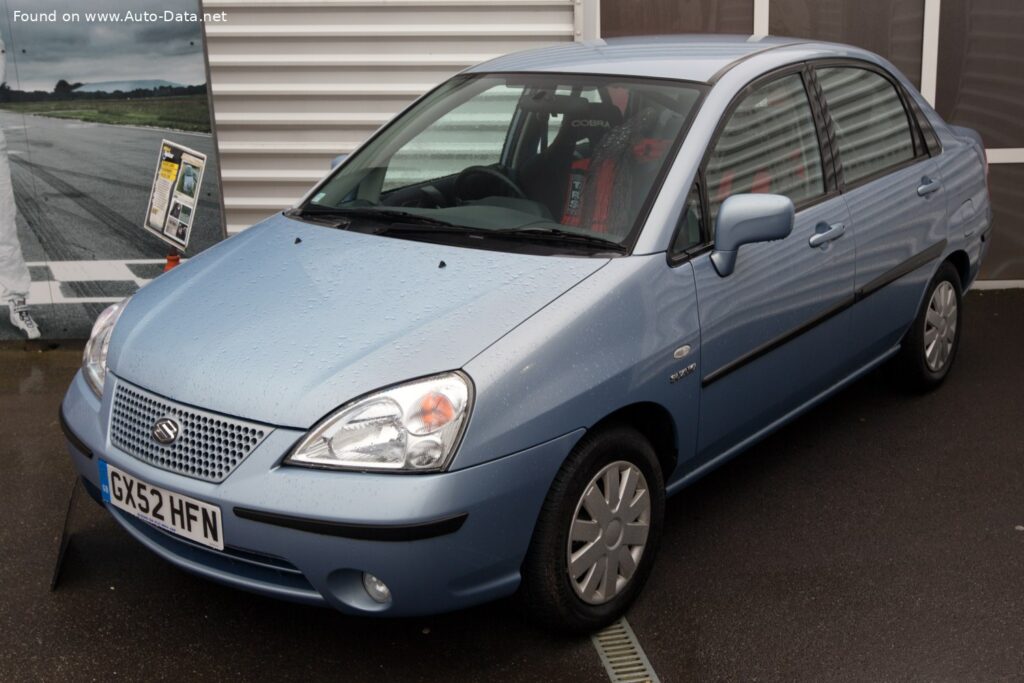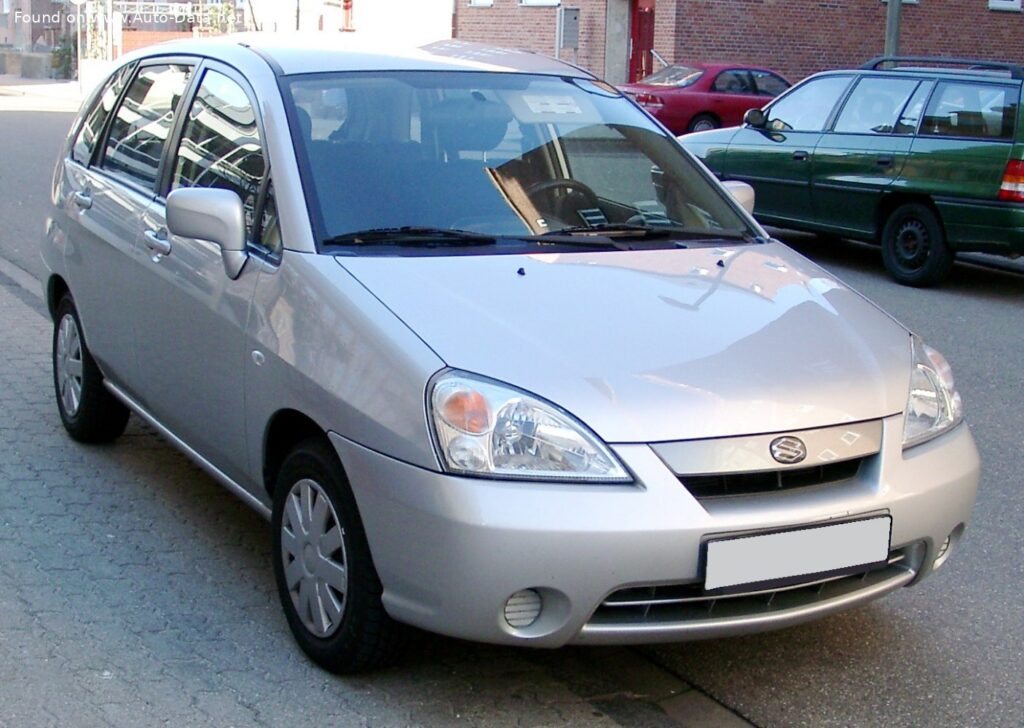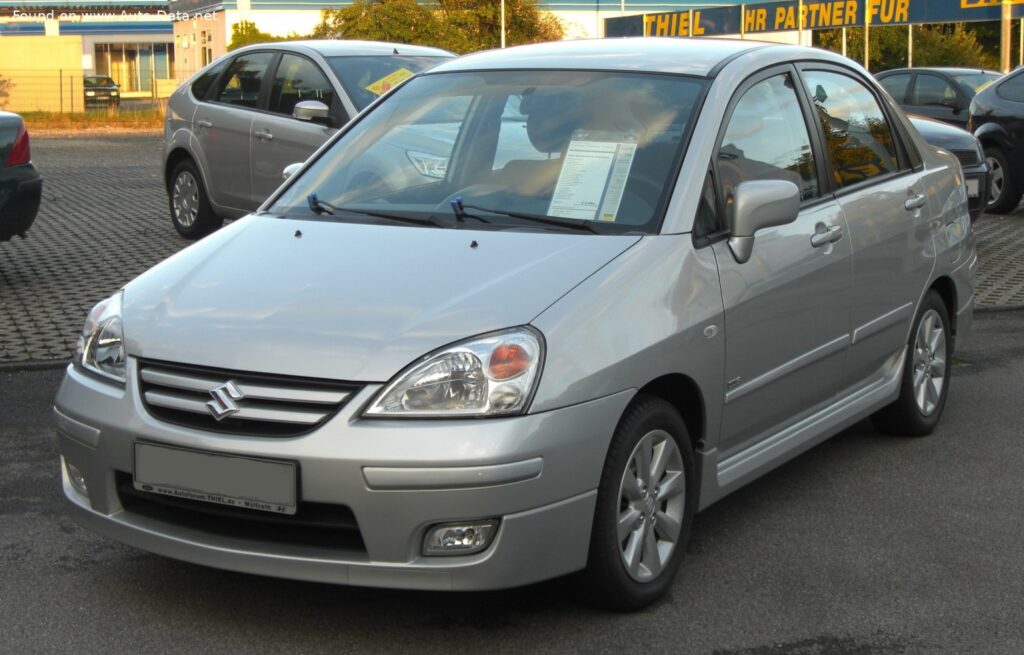
The Suzuki Liana Sedan I (facelift 2004), also known as the Suzuki Aerio in some markets, was Suzuki’s entry into the globally competitive compact car segment during the early 2000s. The first generation, launched in 2001, aimed to provide a practical, reliable, and affordable vehicle for families and individuals. This article focuses on the facelifted version of the Suzuki Liana Sedan I (facelift 2004) 1.6i, producing 107 horsepower, manufactured from 2004 to 2007. This refresh brought subtle but important updates to improve its appeal in its primary markets, particularly Europe and Asia, where it competed with established brands by offering a value-oriented proposition and leveraging Suzuki’s reputation for robust engineering.
Suzuki Liana Sedan I (facelift 2004): A Global Compact
While the Suzuki Liana was not officially sold in the United States, its presence in other global markets demonstrates Suzuki’s strategy of offering a diverse range of vehicles tailored to regional demands. The sedan variant specifically emphasized practicality, featuring a traditional three-box design that appealed to consumers seeking conventional aesthetics and generous trunk space. The 2004 facelift aimed to modernize the vehicle’s appearance and refine its mechanical package, ensuring it remained competitive in a rapidly evolving automotive landscape.
Engine & Performance
The Suzuki Liana Sedan I (facelift 2004) 1.6i was powered by the M16A engine, a naturally aspirated, inline-four-cylinder gasoline unit. This engine was a core component of Suzuki’s global powertrain lineup, known for its balance of efficiency and performance within its class. Displacing 1,586 cubic centimeters (96.78 cubic inches), the M16A generated 107 horsepower at 5,500 revolutions per minute (rpm). Peak torque of 144 Newton meters (106.21 lb.-ft.) was delivered at 4,000 rpm, providing sufficient acceleration and responsiveness for everyday driving in both urban and highway conditions.
The engine featured a Double Overhead Camshaft (DOHC) valvetrain with 4 valves per cylinder, optimizing airflow for improved combustion and efficiency. Fuel was delivered through a multi-port fuel injection system, ensuring precise fuel metering. With a compression ratio of 9.7:1, the engine was designed to run on gasoline and met the Euro 4 emission standard, indicating a relatively clean exhaust output for its time. Power was transferred to the front wheels via a 5-speed manual transmission, a common and reliable setup offering drivers direct control over the vehicle’s dynamics. This drivetrain contributed to the Liana’s reputation for straightforward mechanics and ease of maintenance. The vehicle’s top speed was rated at 170 kilometers per hour (105.63 mph).
Fuel economy figures for the 1.6i model demonstrated its efficiency, achieving approximately 7 liters per 100 kilometers (33.6 US mpg) in combined driving cycles. In extra-urban conditions, it could reach 5.8 liters per 100 kilometers (40.6 US mpg), making it an economical choice for longer trips. Urban fuel consumption was 8.8 liters per 100 kilometers (26.7 US mpg). These figures reinforced the Liana’s appeal as a cost-effective vehicle to operate, a crucial factor in its target markets.
Design & Features
The Suzuki Liana Sedan I (facelift 2004) maintained the practical and understated design of the original model, with the facelift introducing subtle aesthetic enhancements. As a four-door sedan, it offered seating for five passengers, prioritizing functionality and family-friendliness. The exterior dimensions were compact, yet provided a surprisingly spacious interior. Measuring 4,350 millimeters (171.26 inches) in length, 1,690 millimeters (66.54 inches) in width, and 1,454 millimeters (57.24 inches) in height, the Liana was maneuverable in city traffic while maintaining a stable stance on the road. Its 2,480-millimeter (97.64-inch) wheelbase contributed to a comfortable ride and adequate cabin space.
The facelift included revised headlights, a subtly redesigned grille, and updated taillights, giving the Liana a more contemporary appearance without drastically altering its core design. Inside, Suzuki focused on practicality and ergonomics. While specific features varied by market and trim level, common elements included a functional dashboard layout, reasonable material quality for its segment, and a focus on essential amenities. In terms of safety, the Liana Sedan I (facelift 2004) was equipped with an Anti-lock Braking System (ABS), an important active safety feature that helped drivers maintain steering control during emergency braking, enhancing overall vehicle safety for its era.
The sedan body style provided a secure and ample trunk space, a significant advantage for families or those needing substantial cargo capacity. This design choice differentiated it from the hatchback version (available in some markets), appealing to consumers who preferred the classic sedan form factor for its perceived elegance and practicality.
Technical Specifications
| Category | Specification |
| General Information | |
| Brand | Suzuki |
| Model | Liana |
| Generation | Liana Sedan I (facelift 2004) |
| Type (Engine) | 1.6i (107 Hp) |
| Start of Production | 2004 |
| End of Production | 2007 |
| Powertrain Architecture | Internal Combustion engine |
| Body Type | Sedan (4 Doors, 5 Seats) |
| Performance Specs | |
| Fuel Consumption (Urban) | 8.8 l/100 km (26.7 US mpg) |
| Fuel Consumption (Extra Urban) | 5.8 l/100 km (40.6 US mpg) |
| Fuel Consumption (Combined) | 7 l/100 km (33.6 US mpg) |
| Fuel Type | Petrol (Gasoline) |
| Maximum Speed | 170 km/h (105.63 mph) |
| Emission Standard | Euro 4 |
| Weight-to-Power Ratio | 10.7 kg/Hp (93 Hp/tonne) |
| Weight-to-Torque Ratio | 8 kg/Nm (125.2 Nm/tonne) |
| Engine Specs | |
| Power | 107 Hp @ 5500 rpm |
| Power per Liter | 67.5 Hp/l |
| Torque | 144 Nm @ 4000 rpm (106.21 lb.-ft. @ 4000 rpm) |
| Engine Layout | Front, Transverse |
| Engine Model/Code | M16A |
| Engine Displacement | 1586 cm3 (96.78 cu. in.) |
| Number of Cylinders | 4 (Inline) |
| Cylinder Bore | 78 mm (3.07 in.) |
| Piston Stroke | 83 mm (3.27 in.) |
| Compression Ratio | 9.7:1 |
| Valves per Cylinder | 4 |
| Fuel Injection System | Multi-port manifold injection |
| Engine Aspiration | Naturally aspirated |
| Valvetrain | DOHC |
| Engine Oil Capacity | 4.1 l (4.33 US qt) |
| Coolant Capacity | 6.9 l (7.29 US qt) |
| Space, Volume, and Weights | |
| Kerb Weight | 1150 kg (2535.32 lbs.) |
| Dimensions | |
| Length | 4350 mm (171.26 in.) |
| Width | 1690 mm (66.54 in.) |
| Height | 1454 mm (57.24 in.) |
| Wheelbase | 2480 mm (97.64 in.) |
| Drivetrain, Brakes, and Suspension Specs | |
| Drivetrain Architecture | ICE drives front wheels |
| Drive Wheel | Front wheel drive |
| Number of Gears & Gearbox Type | 5 gears, manual transmission |
| Assisting Systems | ABS (Anti-lock braking system) |
Legacy and Market Impact
The Suzuki Liana Sedan I (facelift 2004) 1.6i established a niche for itself in international markets, particularly in Europe and Asia. It was often positioned as a practical, affordable alternative to mainstream compact sedans like the Toyota Corolla, Honda Civic, and European models. Its appeal stemmed from its affordability, reliability, and low running costs, consistent with the Suzuki brand.
While not achieving the sales figures of its competitors, the Liana gained a reputation as a dependable vehicle. Its robust M16A engine, shared with other Suzuki models, contributed to its mechanical longevity. For budget-conscious buyers seeking a straightforward and spacious compact sedan, the Liana offered a compelling value. Its conventional sedan styling suited traditional automotive preferences in many Asian and Eastern European countries.
The Liana’s legacy is one of quiet competence rather than innovation. It effectively provided reliable transportation for many families. Its presence in international markets highlighted Suzuki’s global reach and ability to adapt vehicles to diverse needs outside North America. Though it didn’t receive significant critical acclaim, its practical design, efficient powertrain, and durable construction made it a sensible choice for its target demographic. The Liana reinforced Suzuki’s image as a manufacturer of honest, reliable, and economical vehicles, a reputation that continues today.