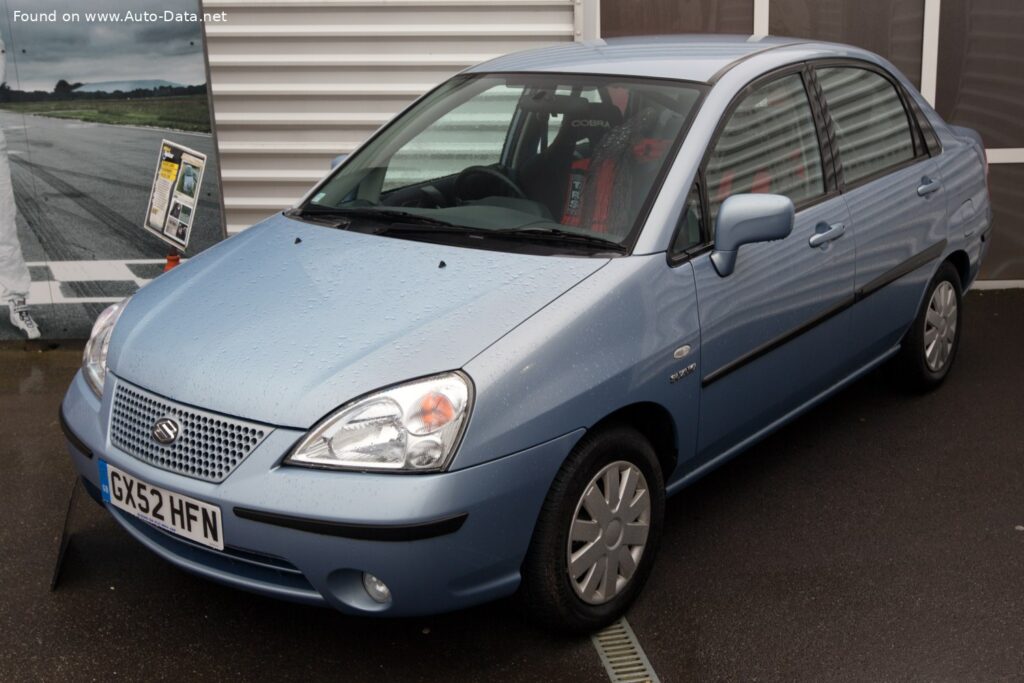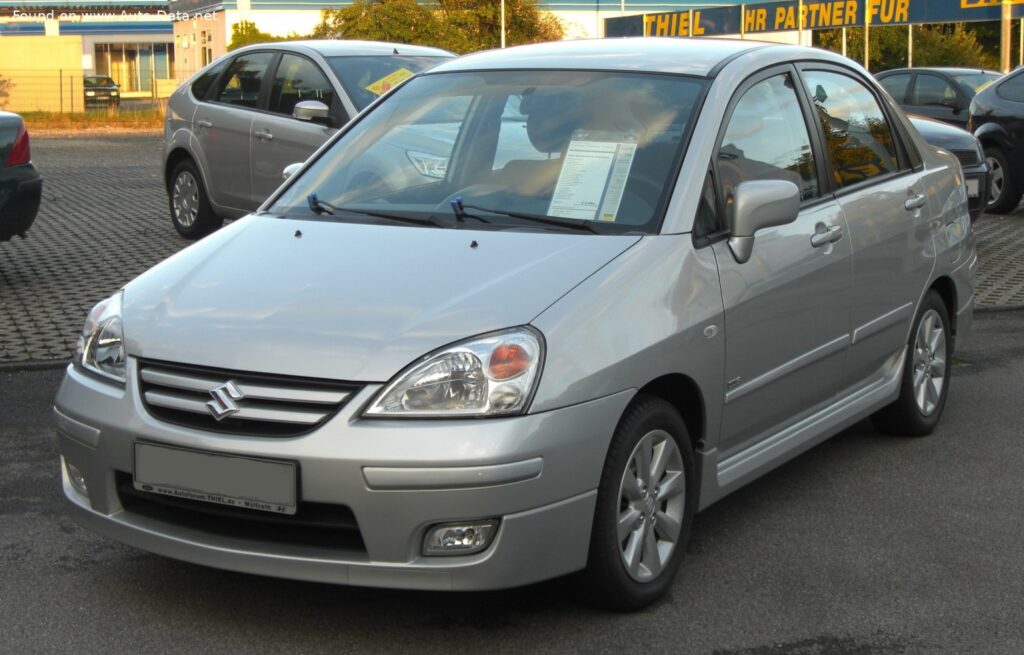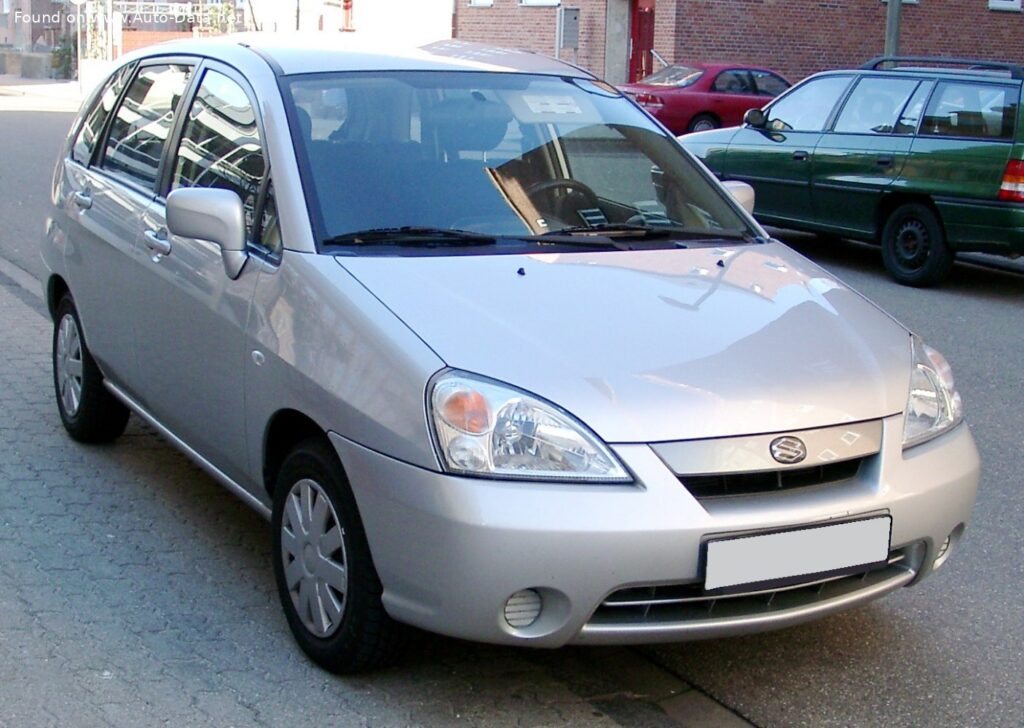
The Suzuki Liana Wagon I, specifically the 1.6 i 16V 2WD with 103 horsepower and an automatic transmission, represents a significant offering from the Japanese automaker in the compact car segment during the early 2000s. Produced from 2001 to 2004, this first-generation Liana (known as the Aerio in some markets, including North America, though the Wagon variant was less prominent there) was designed with practicality, economy, and versatility at its core. Primarily targeting European and Asian markets where compact station wagons, or estates, held considerable appeal, the Liana Wagon I aimed to provide a spacious and user-friendly vehicle for families and individuals seeking a blend of urban maneuverability and cargo capacity. Its conservative yet functional design, coupled with Suzuki’s reputation for reliability, positioned it as a sensible choice in a competitive class.
Suzuki Liana Wagon I: An Overview
The Suzuki Liana Wagon I was part of a broader effort by Suzuki to expand its presence in the global compact car market. It was conceived as a versatile vehicle capable of fulfilling multiple roles, from daily commuting to family outings and light commercial use. The Wagon body style, in particular, was chosen to cater to markets where the practicality of a station wagon was highly valued. While the Liana was sold in various configurations and under different names (Aerio being the most common in North America), the 1.6-liter automatic wagon represented a key variant focused on ease of use and fuel efficiency.
Engine & Performance
The Suzuki Liana Wagon I 1.6 i 16V 2WD model is powered by a 1.6-liter (1586 cm³ or 96.78 cu. in.) M16A inline-four engine. This naturally aspirated gasoline engine utilizes a Double Overhead Camshaft (DOHC) valvetrain with four valves per cylinder, a design known for its efficient power delivery. The engine produces 103 horsepower at 5500 rpm and 106.21 lb.-ft. (144 Nm) of torque at 4000 rpm. This provides adequate power for everyday driving situations.
Power is transmitted to the front wheels through a conventional 4-speed automatic transmission, prioritizing ease of operation. Acceleration from 0 to 60 mph takes approximately 11.1 seconds, while 0 to 100 km/h is achieved in 11.7 seconds. The vehicle has a maximum speed of 105.63 mph (170 km/h). Fuel economy is a strong point, with estimated figures of 25.6 US mpg (9.2 l/100 km) in the city, 39.9 US mpg (5.9 l/100 km) on the highway, and a combined average of 33.1 US mpg (7.1 l/100 km). Its 13.21 US gallon (50 liter) fuel tank provides a reasonable driving range.
Design & Features
The Liana Wagon I features a distinct station wagon body style, emphasizing interior space and cargo capacity. Its dimensions – 166.54 inches (4230 mm) in length, 66.54 inches (1690 mm) in width, and 61.02 inches (1550 mm) in height – result in a relatively compact vehicle that is easy to maneuver. The 97.64-inch (2480 mm) wheelbase contributes to a stable ride and a surprisingly spacious cabin.
The interior comfortably accommodates five passengers. The wagon configuration provides a minimum of 12.29 cubic feet (348 liters) of trunk space with the rear seats up. Folding the rear seats expands the cargo area to a generous 37.5 cubic feet (1062 liters). The four-door layout ensures easy access for both passengers and cargo. The chassis features a front suspension with wishbones for a balance of comfort and handling, and a coil spring rear suspension for a smooth ride. Ventilated front disc brakes and rear drum brakes provide stopping power, with ABS available as an option for enhanced safety. Hydraulic power steering with a rack and pinion system delivers responsive control. The vehicle is equipped with 185/65 R14 T tires, offering a balance between grip and ride comfort.
Technical Specifications
| Category | Specification |
| Brand | Suzuki |
| Model | Liana |
| Generation | Liana Wagon I |
| Type (Engine) | 1.6 i 16V 2WD (103 Hp) Automatic |
| Production Start | 2001 year |
| Production End | 2004 year |
| Powertrain Architecture | Internal Combustion engine |
| Body Type | Station wagon (estate) |
| Seats | 5 |
| Doors | 4 |
| Fuel Consumption – Urban | 9.2 l/100 km |
| Fuel Consumption – Extra Urban | 5.9 l/100 km |
| Fuel Consumption – Combined | 7.1 l/100 km |
| Fuel Type | Petrol (Gasoline) |
| Acceleration 0 – 60 mph | 11.1 sec |
| Acceleration 0 – 100 km/h | 11.7 sec |
| Maximum Speed | 170 km/h |
| Weight-to-Power Ratio | 11.8 kg/Hp |
| Power | 103 Hp @ 5500 rpm |
| Power per Liter | 64.9 Hp/l |
| Torque | 144 Nm @ 4000 rpm |
| Engine Layout | Front, Transverse |
| Engine Model/Code | M16A |
| Engine Displacement | 1586 cm³ |
| Number of Cylinders | 4 |
| Engine Configuration | Inline |
| Cylinder Bore | 78 mm |
| Piston Stroke | 83 mm |
| Compression Ratio | 9.7:1 |
| Valves per Cylinder | 4 |
| Fuel Injection System | Multi-port manifold injection |
| Engine Aspiration | Naturally aspirated |
| Valvetrain | DOHC |
| Engine Oil Capacity | 4.1 l |
| Coolant Capacity | 6.5 l |
| Kerb Weight | 1215 kg |
| Max. Weight | 1640 kg |
| Max Load | 425 kg |
| Trunk Space – Minimum | 348 l |
| Trunk Space – Maximum | 1062 l |
| Fuel Tank Capacity | 50 l |
| Length | 4230 mm |
| Width | 1690 mm |
| Height | 1550 mm |
| Wheelbase | 2480 mm |
| Front Suspension | Wishbone |
| Rear Suspension | Coil spring |
| Front Brakes | Ventilated discs |
| Rear Brakes | Drum |
| Steering Type | Steering rack and pinion |
| Power Steering | Hydraulic Steering |
| Tires Size | 185/65 R14 T |
Legacy and Market Impact
The Suzuki Liana Wagon I established itself in the competitive compact car market, particularly in Europe and Asia, by offering a practical and affordable solution for families and individuals. While not a performance-oriented vehicle, its reliability, fuel efficiency, and spacious interior made it a sensible choice. The M16A engine proved to be a durable and efficient powerplant, continuing in use in subsequent Suzuki models. Although the wagon variant didn’t achieve significant sales in North America, the Liana, as a whole, contributed to Suzuki’s global expansion and reinforced the brand’s reputation for building dependable and versatile vehicles.