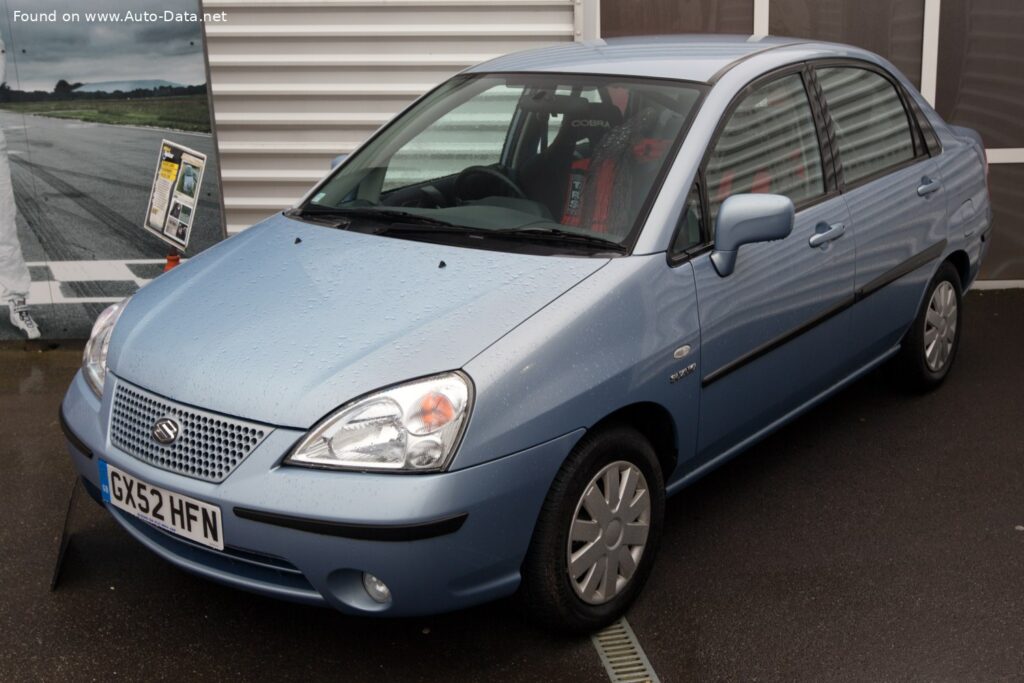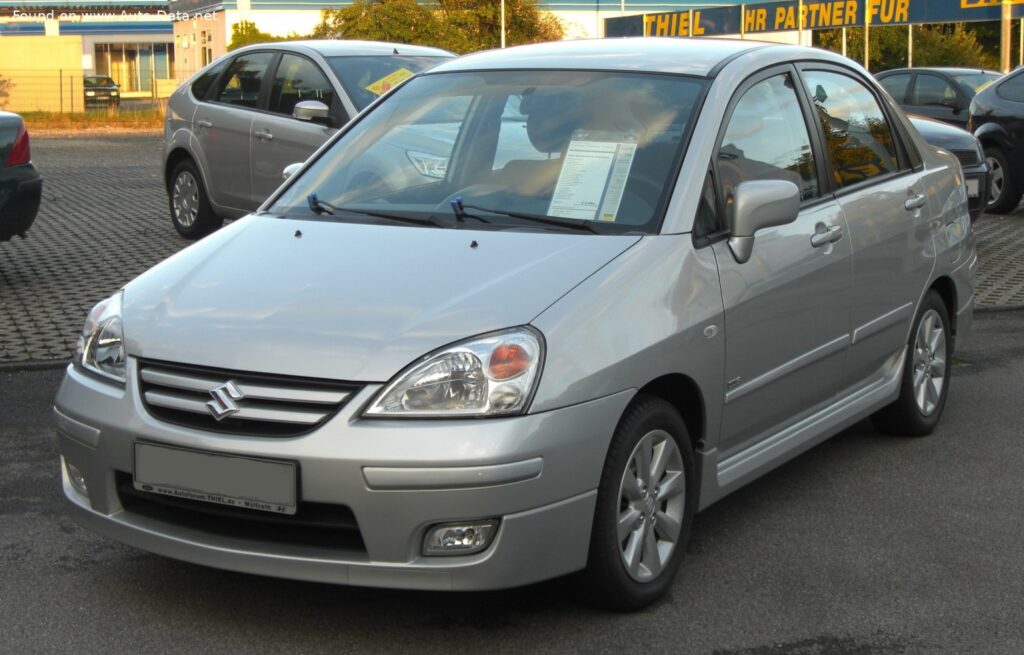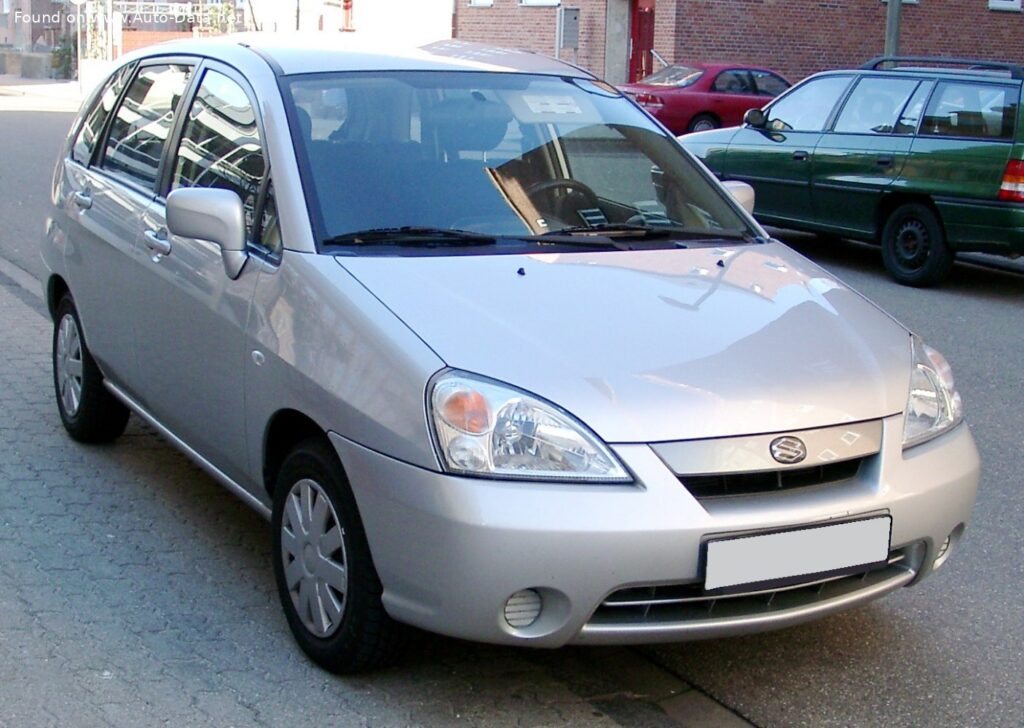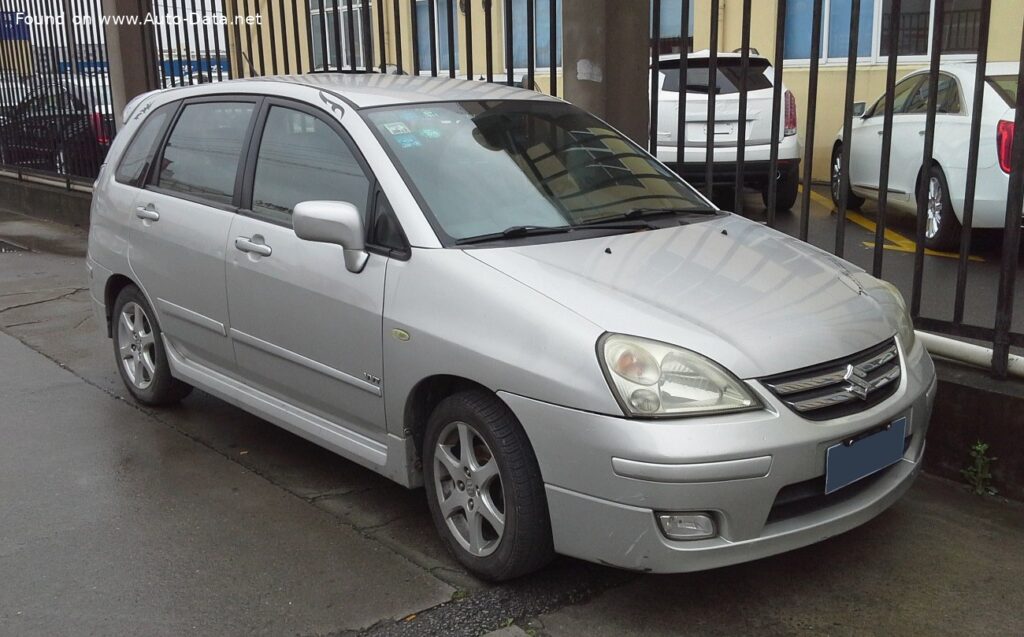
The Suzuki Liana, marketed as the Aerio in North America, was Suzuki’s entry into the competitive compact car segment in the early 2000s. The name “Liana” stands for “Life In A New Age,” reflecting the manufacturer’s ambition for a modern, versatile vehicle. The Suzuki Liana Wagon I (facelift 2004) denotes the updated version of the first-generation Liana station wagon, produced from 2004 to 2007. This variant, equipped with the 1.6-liter (1.6i) engine and a 4-speed automatic transmission, was primarily aimed at European and Asian markets, appealing to families and urban commuters seeking a reliable and affordable daily driver.
The Suzuki Liana Wagon I: A Practical Compact
Positioned as a practical and economical choice, the Liana Wagon offered a more spacious and versatile alternative to traditional sedans and hatchbacks. While sedan and hatchback versions were available globally, the station wagon, or “estate” in European terminology, provided increased cargo capacity without significantly increasing the vehicle’s size. The 2004 facelift brought subtle styling and feature updates, maintaining its competitiveness against strong offerings from Japanese and European manufacturers. The design prioritized maximizing interior space and ease of use, making it a pragmatic choice for those valuing utility over luxury or performance.
Engine & Performance
The Suzuki Liana Wagon I (facelift 2004) 1.6i was powered by Suzuki’s M16A engine, a naturally aspirated 1.6-liter inline-four gasoline engine. Displacing 1586 cubic centimeters (96.78 cubic inches), the engine was designed for a balance of efficiency and adequate power for everyday driving. It featured a Double Overhead Camshaft (DOHC) valvetrain with four valves per cylinder, known for its efficient breathing and power delivery. Fuel was delivered via a multi-port fuel injection system, ensuring precise fuel metering for optimal combustion.
The M16A engine produced 107 horsepower at 5500 revolutions per minute (rpm) and 144 Newton-meters (106.21 lb.-ft.) of peak torque at 4000 rpm. This torque, available at a relatively low engine speed, contributed to the vehicle’s ease of driving in urban environments and provided sufficient responsiveness for highway cruising. The engine was mounted front-transverse, driving the front wheels through a 4-speed automatic transmission – a common and cost-effective setup for compact, front-wheel-drive vehicles.
Fuel economy was a key strength, with a combined fuel consumption of 7.5 liters per 100 kilometers (approximately 31.4 US miles per gallon). Urban driving yielded 9.6 liters per 100 kilometers (24.5 US mpg), while highway driving achieved 6.3 liters per 100 kilometers (37.3 US mpg). These figures were competitive for its class and production period, highlighting Suzuki’s focus on economical operation. The vehicle complied with the Euro 4 emission standard, indicating relatively clean emissions for the mid-2000s, a crucial factor in European markets.
The Liana Wagon 1.6i automatic had a top speed of 170 kilometers per hour (105.63 mph). While not a performance car, its acceleration and top speed were adequate for family use and highway travel. A weight-to-power ratio of 10.8 kilograms per horsepower (92.2 Hp per tonne) and a weight-to-torque ratio of 8.1 kilograms per Newton-meter (124.1 Nm per tonne) emphasize its practical, rather than sporty, character.
Design & Features
The Suzuki Liana Wagon I (facelift 2004) featured a 5-door station wagon body style, prioritizing practicality and cargo versatility. The exterior design was clean and functional, reflecting a vehicle designed for everyday use. The facelift included minor enhancements to the front fascia, such as revised headlights, grille, and bumper designs, to align with contemporary automotive trends. Its compact dimensions – 4230 mm (166.54 inches) in length, 1690 mm (66.54 inches) in width, and 1550 mm (61.02 inches) in height – combined with a 2480 mm (97.64 inches) wheelbase, provided easy maneuverability in urban environments.
The interior comfortably seated five occupants, prioritizing ergonomics and functionality with a straightforward dashboard layout and easily accessible controls. The station wagon body style provided a significantly larger and more flexible cargo area compared to sedan or hatchback versions, making it ideal for families needing space for groceries, luggage, or sporting equipment. Standard amenities included essential comfort and convenience features, though luxury options varied by market.
Safety features included Anti-lock Braking System (ABS) as a standard assisting system. While modern vehicles offer more advanced safety technologies, ABS was a crucial safety enhancement at the time, helping drivers maintain steering control during emergency braking. The vehicle’s robust construction and standard safety equipment aimed to provide a secure environment for occupants, aligning with expectations for family-oriented vehicles.
Technical Specifications
| Category | Specification |
| General Information | |
| Brand | Suzuki |
| Model | Liana |
| Generation | Liana Wagon I (facelift 2004) |
| Type (Engine) | 1.6i (107 Hp) 2WD Automatic |
| Start of Production | 2004 |
| End of Production | 2007 |
| Powertrain Architecture | Internal Combustion engine |
| Body Type | Station wagon (estate) |
| Seats | 5 |
| Doors | 5 |
| Performance Specifications | |
| Fuel Consumption (Economy) – Urban | 9.6 l/100 km (24.5 US mpg) |
| Fuel Consumption (Economy) – Extra Urban | 6.3 l/100 km (37.3 US mpg) |
| Fuel Consumption (Economy) – Combined | 7.5 l/100 km (31.4 US mpg) |
| Fuel Type | Petrol (Gasoline) |
| Maximum Speed | 170 km/h (105.63 mph) |
| Emission Standard | Euro 4 |
| Weight-to-Power Ratio | 10.8 kg/Hp (92.2 Hp/tonne) |
| Weight-to-Torque Ratio | 8.1 kg/Nm (124.1 Nm/tonne) |
| Engine Specifications | |
| Power | 107 Hp @ 5500 rpm |
| Power per Liter | 67.5 Hp/l |
| Torque | 144 Nm @ 4000 rpm (106.21 lb.-ft. @ 4000 rpm) |
| Engine Layout | Front, Transverse |
| Engine Model/Code | M16A |
| Engine Displacement | 1586 cm3 (1.6 Liters, 96.78 cu. in.) |
| Number of Cylinders | 4 |
| Engine Configuration | Inline |
| Cylinder Bore | 78 mm (3.07 in.) |
| Piston Stroke | 83 mm (3.27 in.) |
| Compression Ratio | 9.7:1 |
| Number of Valves per Cylinder | 4 |
| Fuel Injection System | Multi-port manifold injection |
| Engine Aspiration | Naturally aspirated engine |
| Valvetrain | DOHC |
| Engine Oil Capacity | 4.1 l (4.33 US qt) |
| Coolant Capacity | 6.9 l (7.29 US qt) |
| Space, Volume and Weights | |
| Kerb Weight (Curb Weight) | 1160 kg (2557.36 lbs.) |
| Dimensions | |
| Length | 4230 mm (166.54 in.) |
| Width | 1690 mm (66.54 in.) |
| Height | 1550 mm (61.02 in.) |
| Wheelbase | 2480 mm (97.64 in.) |
| Drivetrain, Brakes and Suspension Specs | |
| Drivetrain Architecture | The Internal combustion engine (ICE) drives the front wheels of the vehicle. |
| Drive Wheel | Front wheel drive |
| Number of Gears and Type of Gearbox | 4 gears, automatic transmission |
| Assisting Systems | ABS (Anti-lock braking system) |
The Suzuki Liana Wagon, particularly the facelifted 2004 model, established itself as a reliable, practical, and affordable compact car. While the Aerio name was used in the US, the 1.6-liter wagon with automatic transmission was more prominent in Europe and Asia, where its size and fuel efficiency were highly valued. Competitors included the Opel Astra Wagon, Ford Focus Wagon, and Toyota Corolla Wagon. The Liana’s reputation was built on Suzuki’s tradition of dependable and cost-effective vehicles, praised for its low running costs, straightforward mechanics, and surprising interior space. Its legacy is one of quiet competence, providing reliable transportation for countless families and individuals who valued utility, economy, and dependability.