
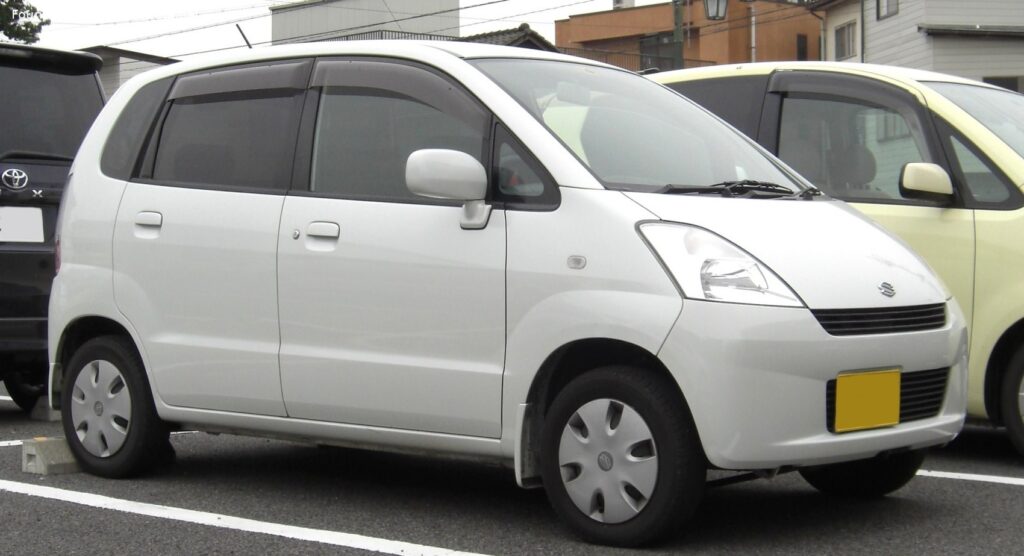
The Suzuki MR Wagon, specifically the 0.7 i 12V (54 Hp) 2WD model, represents a significant entry in the highly competitive and uniquely Japanese Kei car segment. Introduced in 2001, the first-generation MR Wagon (codenamed MF21S) quickly established itself as a practical, efficient, and surprisingly versatile urban commuter. Designed to comply with Japan’s stringent Kei (light automobile) regulations, which dictate maximum dimensions, engine displacement, and power output, the MR Wagon offered a compelling package for drivers seeking nimble maneuverability, low running costs, and optimized interior space within a compact footprint. While never officially imported to the United States, its design philosophy and engineering ethos are reflective of a global trend towards smaller, more efficient vehicles, making it a fascinating case study for automotive enthusiasts and urban planners alike. Its core mission was to provide reliable, no-frills transportation, a role it fulfilled admirably throughout its production run from 2001 to 2006.
Engine & Performance: The K6A Powertrain
Underpinning the first-generation Suzuki MR Wagon was a powertrain meticulously engineered to meet the demanding Kei car standards while delivering adequate performance for its intended urban environment. The 0.7 i 12V (54 Hp) 2WD variant featured Suzuki’s K6A engine. This powerplant was a naturally aspirated, 0.66-liter (658 cm³ or 40.15 cu. in.) inline three-cylinder unit, a configuration common among Kei cars for its balance of compactness and efficiency.
The K6A engine was a sophisticated design for its class, featuring a Double Overhead Camshaft (DOHC) valvetrain with 12 valves (four per cylinder), which contributed to its ability to breathe efficiently and produce its peak power. Fuel delivery was handled by a multi-port manifold injection system, ensuring precise fuel metering and combustion. With a compression ratio of 10.5:1, the engine was tuned for efficiency and smooth operation.
Performance figures, while modest by American standards, were perfectly suited for the MR Wagon’s role. It generated 54 horsepower at 6500 rpm, indicative of its eager, rev-happy nature. Torque output stood at 61 Nm, or approximately 44.99 lb.-ft., delivered at 4000 rpm. This power and torque, coupled with the vehicle’s light curb weight of 1851.88 lbs. (840 kg), resulted in a respectable weight-to-power ratio of 15.6 kg/Hp (64.3 Hp/tonne) and a weight-to-torque ratio of 13.8 kg/Nm (72.6 Nm/tonne). Power was sent to the front wheels via a 4-speed automatic transmission, a common choice for urban vehicles in Japan, prioritizing ease of driving in stop-and-go traffic over outright performance. The front-engine, transverse layout of the K6A engine, combined with front-wheel drive, allowed for maximum interior packaging efficiency and predictable handling characteristics. Despite its small displacement, the engine was known for its reliability and fuel economy, crucial attributes for a vehicle designed for daily commuting.
Design & Features: Maximizing Space in a Small Package
The design of the first-generation Suzuki MR Wagon was a masterclass in maximizing utility within the confines of Kei car regulations. It adopted a tall, boxy, five-door hatchback body style, a common and effective approach for creating spacious interiors in extremely compact vehicles. With a length of just 133.66 inches (3395 mm), a width of 58.07 inches (1475 mm), and a height of 62.6 inches (1590 mm), the MR Wagon was incredibly maneuverable, making it ideal for navigating crowded city streets and tight parking spaces. Its relatively long wheelbase of 92.91 inches (2360 mm) for its overall length contributed to a stable ride and allowed for a surprisingly roomy cabin for its four occupants.
The exterior styling was characterized by its clean lines and functional aesthetic. Large windows provided excellent visibility, a key safety feature in urban environments. The five-door configuration ensured easy access for both front and rear passengers, as well as simplified loading and unloading of cargo. Despite its small size, the MR Wagon featured a practical interior, often lauded for its clever storage solutions and adaptable seating arrangements. The rear seats could typically slide and fold, offering flexibility between passenger comfort and cargo capacity.
In terms of features, the MR Wagon was equipped with essentials for comfortable and safe urban driving. Standard safety equipment included an Anti-lock Braking System (ABS), a crucial feature for maintaining control during sudden braking. The vehicle utilized a hydraulic power steering system with a rack and pinion setup, providing light and responsive steering, which further enhanced its city driving prowess. Suspension duties were handled by coil springs at both the front and rear, tuned for a comfortable ride over varied urban surfaces. Braking was managed by disc brakes at the front and disc brakes at the rear, offering reliable stopping power for a vehicle of its weight and performance. The MR Wagon rode on 13-inch wheels fitted with 155/65 R13 tires, a common size for Kei cars, balancing grip, ride comfort, and low rolling resistance. The overall design prioritized functionality, efficiency, and ease of use, making it a highly appealing option in its home market.
Technical Specifications
| Category | Specification |
| General Information | |
| Brand | Suzuki |
| Model | MR Wagon |
| Generation | MR Wagon (First Generation) |
| Type (Engine) | 0.7 i 12V (54 Hp) 2WD |
| Start of Production | 2001 |
| End of Production | 2006 |
| Powertrain Architecture | Internal Combustion engine |
| Body type | Hatchback |
| Seats | 4 |
| Doors | 5 |
| Performance Specifications | |
| Fuel Type | Petrol (Gasoline) |
| Weight-to-power ratio | 15.6 kg/Hp, 64.3 Hp/tonne |
| Weight-to-torque ratio | 13.8 kg/Nm, 72.6 Nm/tonne |
| Engine Specifications | |
| Power | 54 Hp @ 6500 rpm |
| Power per liter | 82.1 Hp/l |
| Torque | 61 Nm @ 4000 rpm (44.99 lb.-ft. @ 4000 rpm) |
| Engine layout | Front, Transverse |
| Engine Model/Code | K6A |
| Engine displacement | 658 cm³ (0.66 Liters / 40.15 cu. in.) |
| Number of cylinders | 3 |
| Engine configuration | Inline |
| Cylinder Bore | 68 mm (2.68 in.) |
| Piston Stroke | 60.4 mm (2.38 in.) |
| Compression ratio | 10.5:1 |
| Number of valves per cylinder | 4 |
| Fuel injection system | Multi-port manifold injection |
| Engine aspiration | Naturally aspirated engine |
| Valvetrain | DOHC |
| Engine oil capacity | 3 l (3.17 US qt | 2.64 UK qt) |
| Space, Volume and Weights | |
| Kerb Weight | 840 kg (1851.88 lbs.) |
| Max. weight | 1060 kg (2336.9 lbs.) |
| Max load | 220 kg (485.02 lbs.) |
| Fuel tank capacity | 30 l (7.93 US gal | 6.6 UK gal) |
| Dimensions | |
| Length | 3395 mm (133.66 in.) |
| Width | 1475 mm (58.07 in.) |
| Height | 1590 mm (62.6 in.) |
| Wheelbase | 2360 mm (92.91 in.) |
| Front track | 1295 mm (50.98 in.) |
| Rear (Back) track | 1290 mm (50.79 in.) |
| Drivetrain, Brakes and Suspension Specifications | |
| Drivetrain Architecture | The Internal combustion engine (ICE) drives the front wheels of the vehicle. |
| Drive wheel | Front wheel drive |
| Number of gears and type of gearbox | 4 gears, automatic transmission |
| Front suspension | Coil spring |
| Rear suspension | Coil spring |
| Front brakes | Disc |
| Rear brakes | Disc |
| Assisting systems | ABS (Anti-lock braking system) |
| Steering type | Steering rack and pinion |
| Power steering | Hydraulic Steering |
| Tires size | 155/65 R13 |
| Wheel rims size | 13 |
Legacy and Market Impact
The first-generation Suzuki MR Wagon, produced from 2001 to 2006, carved out a significant niche for itself in the highly specialized Japanese Kei car market. Its legacy is one of practicality, efficiency, and smart packaging, embodying the core principles of the Kei car segment. The MR Wagon quickly gained a reputation as a reliable and economical vehicle, perfectly suited for the urban landscapes of Japan and other Asian markets where similar vehicle classes or preferences for compact cars exist.
In its primary market, the MR Wagon faced stiff competition from a host of well-established rivals, all vying for dominance in the Kei segment. Key competitors included the Honda Life, known for its strong engine and comfortable ride; the Daihatsu Move, a long-standing segment leader celebrated for its spaciousness; and the Mitsubishi eK Wagon, another strong contender focused on utility. Suzuki’s strategy with the MR Wagon was to offer a compelling blend of stylish design (for a Kei car), a comfortable interior, and user-friendly features, often appealing to younger drivers and small families.
Beyond direct competition, the MR Wagon also played a crucial role in Suzuki’s broader automotive strategy. Suzuki has long been a master of small car engineering, and the MR Wagon further solidified this reputation, showcasing the company’s ability to innovate within strict regulatory frameworks. Its success led to a rebadged version, the Nissan Moco, which was manufactured by Suzuki and sold through Nissan dealerships, expanding its market reach and demonstrating its fundamental soundness as a design. This cross-branding was a testament to the MR Wagon’s well-regarded platform and its ability to meet diverse market demands.
The MR Wagon’s historical significance lies in its contribution to the evolution of the modern Kei car. It demonstrated that even with stringent size and engine limitations, it was possible to create a vehicle that was not only practical and fuel-efficient but also offered a degree of comfort and modern features. Its enduring design principles, such as the tall-boy architecture and focus on interior flexibility, have influenced subsequent generations of Kei cars and compact urban vehicles globally. While it may not be a familiar sight on American roads, the Suzuki MR Wagon stands as an excellent example of automotive engineering tailored to specific market needs, leaving a lasting impact on the landscape of urban mobility in Japan and beyond. Its blend of compact dimensions, efficient powertrain, and clever interior design made it a significant player in its segment and a testament to Suzuki’s expertise in small vehicle development.
