
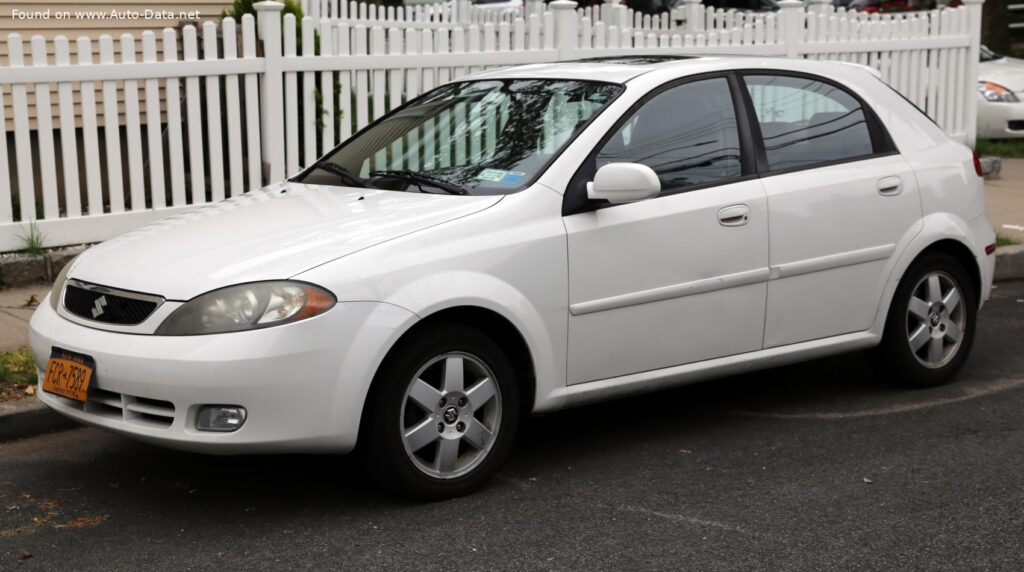
The Suzuki Reno 2.0i (128 Hp) represents a noteworthy, though often overlooked, chapter in Suzuki’s history within the North American automotive market. Launched in 2004 and produced until 2008, the Reno was Suzuki’s entry into the highly competitive compact hatchback segment. Unlike many Suzuki models developed in-house, the Reno was a rebadged version of the Daewoo Lacetti, a product of GM Daewoo Auto & Technology (GMDAT) in South Korea. This strategic decision allowed Suzuki to quickly expand its product portfolio in the United States, offering consumers a practical, five-door hatchback focused on value and utility.
Positioned as an affordable and versatile option, the Suzuki Reno aimed to attract buyers seeking a spacious interior, a comfortable ride, and a comprehensive list of standard features for its price point. It served as a more youthful and dynamic alternative to Suzuki’s existing sedan offerings, providing enhanced cargo flexibility typical of a hatchback design. While it didn’t achieve the widespread recognition of its Japanese or European rivals, the Reno played a crucial role in Suzuki’s strategy to build a broader presence in the U.S. market during the mid-2000s, offering a compelling package for budget-conscious consumers.
Suzuki Reno 2.0i: Engine & Performance
At the heart of the Suzuki Reno 2.0i (128 Hp) was a 2.0-liter inline-four gasoline engine, designed to deliver a balance of usable power and reasonable efficiency. This naturally aspirated unit featured multi-port fuel injection, a reliable fuel delivery system for its time. With a displacement of 1998 cubic centimeters (121.93 cubic inches), the engine boasted four cylinders in an inline arrangement, with four valves per cylinder for improved breathing and efficiency.
The engine produced a peak output of 128 horsepower at 6000 rpm, resulting in a power-per-liter ratio of 64.1 Hp/l – a respectable figure for a non-turbocharged compact engine of this era. More importantly for everyday driving, the engine delivered 128.34 lb.-ft. of torque at 2900 rpm. This low-end torque characteristic made the Reno responsive in city driving and provided adequate thrust for highway cruising, minimizing the need for frequent downshifts. The engine was front-mounted, longitudinal, driving the front wheels through a standard 5-speed manual transmission. This front-wheel-drive architecture was typical for compact cars of the era, offering predictable handling and efficient packaging. The compression ratio stood at 9.3:1, contributing to its performance characteristics.
Routine maintenance for the engine required 4 liters (4.23 US quarts) of engine oil, and the cooling system had a capacity of 7.4 liters (7.82 US quarts). These specifications underscored its conventional and user-friendly design, making it a practical choice for owners.
Design & Features
The Suzuki Reno adopted a practical and unpretentious design, characteristic of compact hatchbacks aimed at the mainstream market. Its body type was a 5-door hatchback, offering significant versatility over its sedan counterparts. The exterior dimensions were well-proportioned for city maneuverability and interior space: a length of 169.09 inches (4295 mm), a width of 67.91 inches (1725 mm), and a height of 56.89 inches (1445 mm). The wheelbase measured 102.36 inches (2600 mm), which was generous for its class and contributed to a stable ride and a surprisingly spacious cabin. Both the front and rear tracks were identical at 58.27 inches (1480 mm), providing a balanced stance.
Inside, the Reno was designed to accommodate five occupants comfortably, with attention paid to ergonomics and storage solutions. The hatchback configuration meant a flexible cargo area, easily expandable by folding down the rear seats, making it suitable for varying cargo needs. While specific interior trim levels and infotainment features varied, typical compact cars of this era offered basic amenities such as air conditioning, power windows, and a decent audio system, often with CD playback capabilities.
Safety and Chassis
Safety features for the Suzuki Reno included an Anti-lock Braking System (ABS), enhancing braking performance and control during emergency stops. The braking system comprised disc brakes at both the front and rear, providing confident stopping power. The vehicle rode on 15-inch wheel rims, fitted with 195/55 R15 tires. This tire and wheel combination offered a good balance between ride comfort and handling responsiveness, suitable for everyday driving conditions. The suspension setup, while not explicitly detailed, likely consisted of a conventional MacPherson strut front suspension and a multi-link rear suspension, common for vehicles in this segment.
Technical Specifications
| Engine Type | 2.0L Inline-4 Gasoline |
| Displacement | 1998 cc (121.93 cu in) |
| Horsepower | 128 hp @ 6000 rpm |
| Torque | 128.34 lb.-ft @ 2900 rpm |
| Compression Ratio | 9.3:1 |
| Fuel Injection | Multi-Port |
| Engine Oil Capacity | 4 liters (4.23 US quarts) |
| Coolant Capacity | 7.4 liters (7.82 US quarts) |
| Transmission | 5-Speed Manual |
| Drivetrain | Front-Wheel Drive |
| Length | 169.09 inches (4295 mm) |
| Width | 67.91 inches (1725 mm) |
| Height | 56.89 inches (1445 mm) |
| Wheelbase | 102.36 inches (2600 mm) |
| Front Track | 58.27 inches (1480 mm) |
| Rear Track | 58.27 inches (1480 mm) |
| Wheels | 15-inch |
| Tires | 195/55 R15 |
| Brakes (Front/Rear) | Disc / Disc |
| ABS | Standard |
