
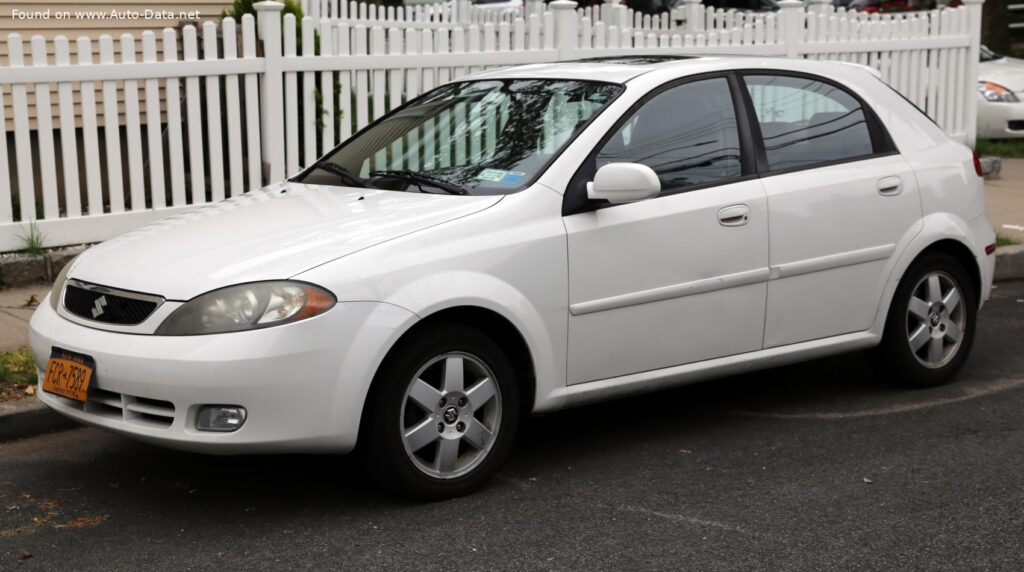
The Suzuki Reno 2.0i (128 Hp) Automatic represents a significant, albeit often overlooked, chapter in Suzuki’s efforts to establish a stronger foothold in the North American automotive market during the mid-2000s. Introduced in 2004 and produced until 2008, the Reno was a compact five-door hatchback, essentially a rebadged version of the Daewoo Lacetti, which was also marketed globally under various names such as the Chevrolet Optra and Suzuki Forenza. Positioned as an economical and practical option, the Reno aimed to attract buyers seeking affordability and utility in the highly competitive compact segment. Its design offered a blend of European styling cues, owing to its Daewoo origins and Giorgetto Giugiaro’s Italdesign studio involvement, while Suzuki focused on providing a value-driven package for the American consumer.
The Reno was part of Suzuki’s strategy to broaden its lineup beyond SUVs and niche vehicles, offering a more conventional passenger car to compete with established players. The 2.0i (128 Hp) Automatic variant, in particular, was a core offering, providing a balance of sufficient power for daily driving and the convenience of an automatic transmission, making it an accessible choice for a wide range of drivers looking for reliable, no-frills transportation.
Suzuki Reno 2.0i: Powertrain and Performance
Under the hood, the Suzuki Reno 2.0i (128 Hp) Automatic was equipped with a 2.0-liter (1998 cm3 or 121.93 cu. in.) naturally aspirated inline-four gasoline engine. This powerplant was designed for reliability and everyday performance, producing a respectable 128 horsepower at 6000 rpm. Its power-per-liter ratio stood at 64.1 Hp/l, a competitive figure for a non-turbocharged engine in its class during that era. Torque output was equally pragmatic, delivering 174 Nm (128.34 lb.-ft.) at a relatively low 2900 rpm. This low-end torque delivery was a key characteristic, ensuring responsive acceleration from a standstill and ample power for city driving and merging onto highways, even with the automatic transmission.
The engine featured a robust inline configuration with four cylinders, each boasting four valves, totaling 16 valves for efficient breathing. Its cylinder bore measured 84 mm (3.31 in.) and piston stroke was 90 mm (3.54 in.), indicating an oversquare design favoring higher revs. A compression ratio of 9.3:1 further optimized combustion efficiency. Fuel delivery was managed by a multi-port manifold injection system, a standard and reliable technology for the time, ensuring precise fuel metering and combustion. The engine’s layout was front-mounted and longitudinal, driving the front wheels through a conventional 4-speed automatic transmission. This drivetrain architecture prioritized ease of use and manufacturing simplicity, contributing to the vehicle’s overall affordability. With an engine oil capacity of 4 liters (4.23 US quarts) and a coolant capacity of 7.4 liters (7.82 US quarts), the Reno was engineered for straightforward maintenance, an appealing factor for budget-conscious owners.
Engine Specifications
The engine utilized a timing belt, requiring periodic replacement as part of scheduled maintenance. The engine management system was a standard electronic control unit (ECU), optimizing fuel injection and ignition timing for both performance and emissions control. While not a high-performance engine, the 2.0-liter unit provided adequate power for the Reno’s intended purpose – providing reliable and economical transportation.
Design and Features of the Suzuki Reno
The Suzuki Reno adopted a five-door hatchback body type, a practical choice offering versatility and cargo space. Its exterior design, influenced by Italdesign, presented a clean, somewhat understated aesthetic that aimed for broad appeal rather than bold statements. The vehicle’s dimensions were typical for the compact segment of its time: a length of 4295 mm (169.09 in.), a width of 1725 mm (67.91 in.), and a height of 1445 mm (56.89 in.). A wheelbase of 2600 mm (102.36 in.) contributed to a stable ride and allowed for a reasonably spacious interior for its class. Both the front and rear tracks measured 1480 mm (58.27 in.), providing a balanced stance on the road.
Inside, the Reno was designed to accommodate five occupants comfortably. The hatchback configuration meant easy access to the cargo area, making it suitable for small families or individuals needing versatile hauling capabilities. While not luxurious, the interior was functional and ergonomic, with controls placed intuitively. The focus was on practicality and durability, reflecting its value-oriented positioning in the market. Standard features for the era often included air conditioning, power windows, and a basic audio system, providing the necessities without excessive frills.
Safety and Chassis
In terms of safety, the Suzuki Reno 2.0i (128 Hp) Automatic came equipped with essential features for its era, including an Anti-lock Braking System (ABS). This crucial assisting system improved braking control, especially in emergency situations or on slippery surfaces, enhancing overall vehicle safety. The braking system utilized disc brakes at both the front and rear, a beneficial feature providing consistent stopping power. The car rode on 195/55 R15 tires, a common size for compact cars, offering a balance of grip and ride comfort. The suspension system consisted of MacPherson struts at the front and a multi-link setup at the rear, providing a reasonably comfortable and controlled ride. The steering system was a rack-and-pinion type, offering precise and responsive handling.
Technical Specifications
| Engine Type | 2.0L Inline-4 |
| Displacement | 1998 cc (121.93 cu in) |
| Horsepower | 128 hp @ 6000 rpm |
| Torque | 174 Nm (128.34 lb-ft) @ 2900 rpm |
| Compression Ratio | 9.3:1 |
| Fuel System | Multi-port Fuel Injection |
| Transmission | 4-speed Automatic |
| Drivetrain | Front-Wheel Drive |
| Engine Oil Capacity | 4.0 L (4.23 US qt) |
| Coolant Capacity | 7.4 L (7.82 US qt) |
| Length | 4295 mm (169.09 in) |
| Width | 1725 mm (67.91 in) |
| Height | 1445 mm (56.89 in) |
| Wheelbase | 2600 mm (102.36 in) |
| Front Track | 1480 mm (58.27 in) |
| Rear Track | 1480 mm (58.27 in) |
| Tire Size | 195/55 R15 |
| Brakes (Front/Rear) | Disc / Disc |
| ABS | Standard |
The Suzuki Reno, while not a groundbreaking vehicle, offered a practical and affordable option for consumers in the mid-2000s. Its blend of European styling, reliable powertrain, and functional design made it a competitive contender in the compact hatchback segment, particularly for those seeking a value-driven alternative to more established brands. Despite its relatively short production run in North America, the Reno remains a noteworthy example of Suzuki’s attempt to broaden its appeal in the US market.
