
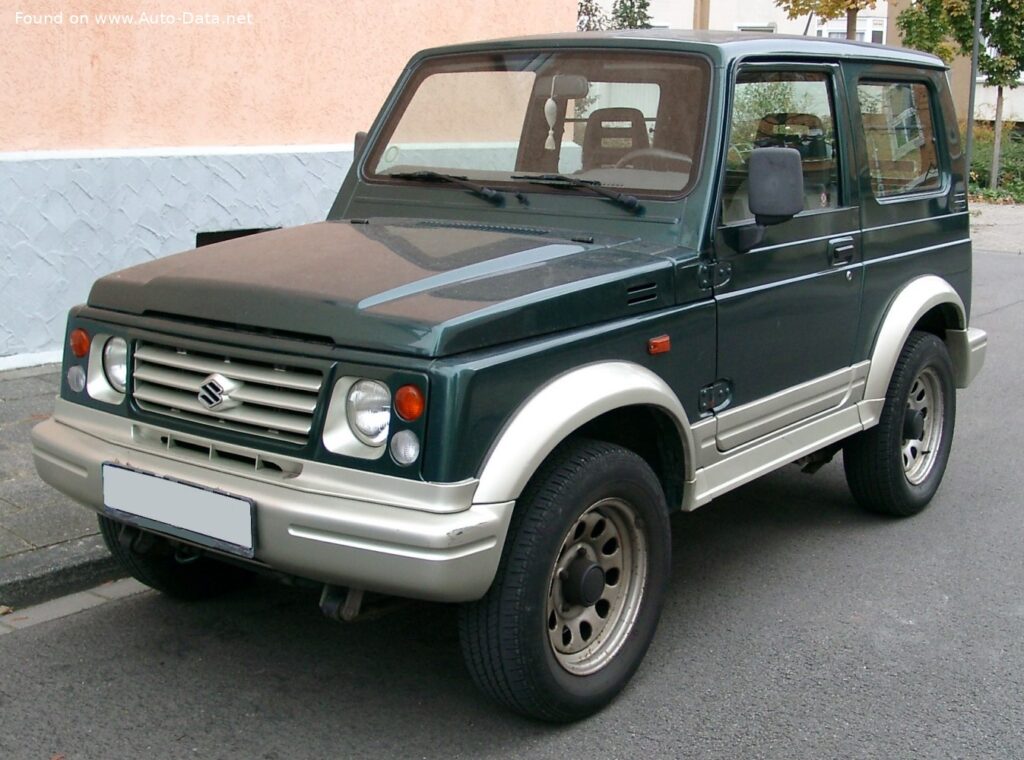
The Suzuki Samurai, known as the Suzuki Jimny in many international markets, is a series of small, lightweight four-wheel drive off-road vehicles manufactured from 1970 to 1998. The second generation, designated the SJ30/SJ40/SJ410/SJ413, and commonly referred to as the Samurai in the United States, was produced from 1981 to 1988. This iteration gained significant popularity for its affordability, simplicity, and remarkable off-road capability, becoming a cult favorite among enthusiasts. While relatively underpowered by modern standards, the Samurai’s compact size and light weight contributed to its agility and ability to traverse challenging terrain. In the US market, it occupied a unique niche, offering a genuine off-road experience at a price point significantly lower than larger, more conventional SUVs.
Suzuki Samurai (SJ): A Detailed Overview
The Suzuki Samurai (SJ) 1.0, specifically the SJ410 variant, represents a pivotal point in the model’s evolution. Introduced as a successor to the earlier LJ series, the SJ40 and subsequent SJ410 aimed to broaden the Jimny/Samurai’s appeal with improved refinement and a slightly larger engine. The SJ410, with its 1.0-liter engine producing 45 horsepower, was primarily intended for markets where tax regulations favored smaller displacement engines. While the US market received a 1.3-liter version, the 1.0-liter SJ410 was significant in Europe, Australia, and other regions. The Samurai’s design philosophy centered around providing a utilitarian and robust vehicle capable of handling both on-road and off-road duties, prioritizing functionality over luxury.
Origins and Market Positioning
The Samurai’s roots lie in Japan’s “Kei car” class, a segment of vehicles with strict limitations on size and engine displacement designed to provide affordable transportation. The SJ series evolved from these Kei car origins, gradually increasing in size and capability. The SJ410, while not strictly a Kei car due to its dimensions, benefited from the engineering principles developed for that class – lightweight construction, efficient engine design, and a focus on practicality. In Europe, the Samurai competed with vehicles like the Fiat Panda 4×4 and the Renault 4×4, offering a more dedicated off-road experience. It quickly gained a reputation for being a capable and reliable workhorse, particularly in rural areas.
Engine & Performance
The heart of the Suzuki Samurai (SJ) 1.0 (SJ 410) is a naturally aspirated 970cc (59 cubic inch) inline-four cylinder gasoline engine. This engine, designated the F10A, produced 45 horsepower at approximately 6,000 rpm and 58 lb-ft of torque at 3,500 rpm. While these figures may seem modest by today’s standards, the engine’s compact size and relatively low weight contributed to the Samurai’s nimble handling. The engine featured a single overhead camshaft and a two-barrel carburetor. Power was delivered to all four wheels through a part-time four-wheel drive system, selectable via a lever located within the cabin. This system allowed the driver to switch between two-wheel drive (rear-wheel drive) for on-road efficiency and four-wheel drive for enhanced traction in off-road conditions. A four-speed manual transmission was standard, providing a direct and engaging driving experience. The Samurai’s relatively low curb weight – around 1,850 lbs – meant that the 45 horsepower was sufficient for reasonable acceleration and highway cruising, although it was certainly not a performance vehicle. Its strength lay in its ability to crawl over obstacles and maintain traction on loose surfaces.
Design & Features
The Suzuki Samurai (SJ) 1.0 (SJ 410) is characterized by its simple, boxy design. The body is constructed on a ladder frame chassis, providing exceptional durability and off-road capability. The vehicle features a three-door configuration with seating for four passengers, although rear seat space is limited. The exterior design is utilitarian, with minimal ornamentation. Round headlights, a simple grille, and flat body panels contribute to its rugged aesthetic. The Samurai’s short wheelbase (approximately 90 inches) and high ground clearance (around 8.3 inches) are key factors in its off-road prowess. The interior is equally spartan, with basic instrumentation and minimal creature comforts. Features typically included vinyl or cloth upholstery, a basic heater, and a simple dashboard layout. Safety features were limited by the standards of the time, typically consisting of seatbelts and a basic steering column. The Samurai’s removable hardtop or soft top provided open-air driving enjoyment, further enhancing its appeal to outdoor enthusiasts. The vehicle’s simplicity also made it relatively easy to maintain and repair, contributing to its long-term popularity among DIY mechanics.
Impact and Legacy
Despite its relatively short production run in the US market, the Suzuki Samurai left a lasting impression. Its affordability and off-road capability made it a popular choice for recreational enthusiasts and those seeking a practical, no-frills vehicle. However, the Samurai also faced scrutiny regarding its stability, leading to safety concerns and ultimately contributing to its discontinuation in the US in 1988. Nevertheless, the Samurai remains a beloved vehicle among off-road enthusiasts, and its legacy continues to influence the design of small, capable SUVs today. The SJ series continued to be produced in other markets for many years, evolving into the modern Suzuki Jimny, which retains the spirit of the original Samurai – a small, lightweight, and incredibly capable off-road vehicle.
Technical Specifications
| Specification | Value |
| Brand | Suzuki |
| Model | Samurai (SJ) |
| Generation | Samurai (SJ) |
| Type (Engine) | 1.0 (SJ 410) (45 Hp) |
| Start of production | 1981 |
| End of production | 1988 |
| Powertrain Architecture | Internal Combustion engine |
| Body type | Off-road vehicle |
| Seats | 4 |
| Doors | 3 |
| Fuel Type | Petrol (Gasoline) |
| Power | 45 Hp |
| Engine aspiration | Naturally aspirated engine |
| Engine Displacement | 0.97 Liters |
