
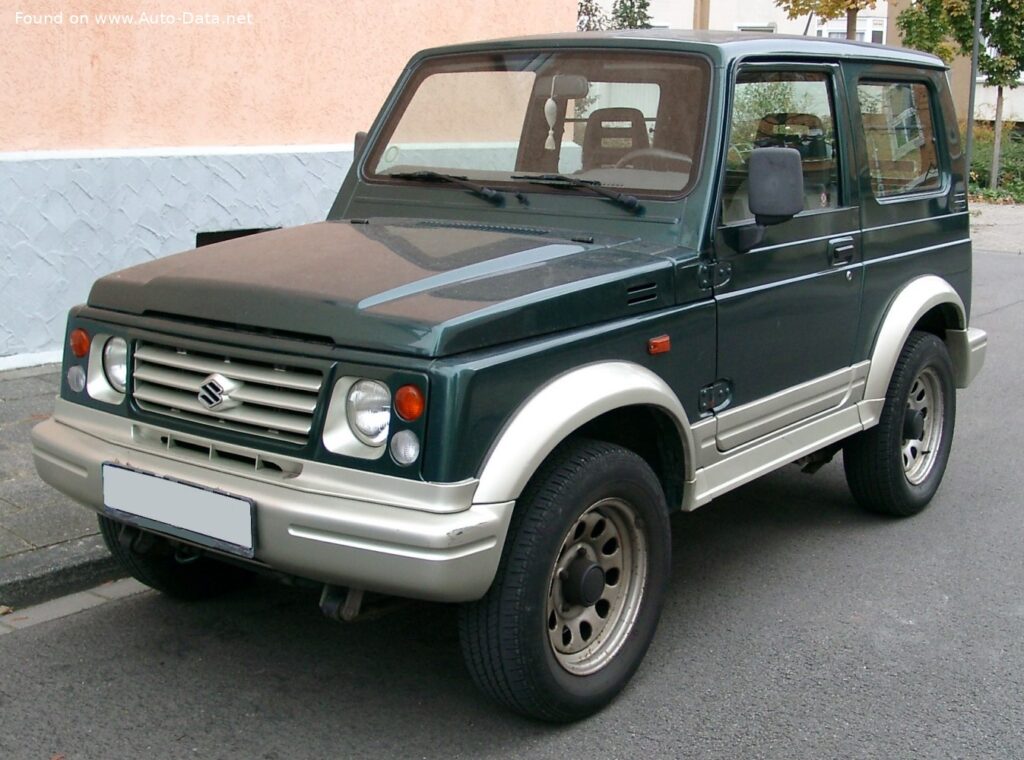
The Suzuki Samurai (SJ) 1.3, a compact four-wheel drive off-road vehicle, represents the final iteration of the long-running SJ series, a lineage tracing back to 1970. Produced from 1995 to 2003, this version was primarily aimed at markets outside of North America, where the Samurai had previously been sold in the 1980s and early 1990s. While the original North American Samurai faced criticism regarding its stability, the SJ series continued to be popular globally for its affordability, ruggedness, and exceptional off-road capability. The 1.3-liter variant, producing 70 horsepower, offered a balance between fuel efficiency and sufficient power for tackling challenging terrain. This model cemented the Samurai’s reputation as a capable and reliable workhorse, particularly in regions where a lightweight, durable 4×4 was highly valued.
Suzuki Samurai (SJ) 1.3: A Global Off-Roader
The Suzuki Samurai (SJ) 1.3 occupied a unique niche in the global automotive landscape. While larger, more luxurious SUVs began to dominate the market in North America and Europe, the Samurai remained a popular choice for those seeking a simple, affordable, and highly capable off-road vehicle. It wasn’t designed for highway cruising or family comfort; its strengths lay in navigating rough terrain, providing utility for rural communities, and serving as a recreational vehicle for enthusiasts. In many parts of the world, it became synonymous with accessible four-wheel drive, offering a level of mobility previously unavailable to a wider segment of the population. The SJ series, and particularly the 1.3 variant, found significant success in Latin America, Asia, and parts of Europe where its compact size and robust construction were highly advantageous.
Engine & Performance
The heart of the Suzuki Samurai (SJ) 1.3 is the G13BA 1.3-liter, naturally aspirated four-cylinder gasoline engine. This engine, while not particularly powerful by modern standards, provided a respectable 70 horsepower. The engine’s design prioritized durability and ease of maintenance over outright performance. It featured a simple overhead valve (OHV) configuration and a carburetor fuel delivery system in many markets, contributing to its reliability and straightforward repair procedures. The engine’s torque characteristics were well-suited to off-road driving, providing sufficient low-end grunt to overcome obstacles.
Power is delivered to all four wheels through a part-time four-wheel drive system, typically engaged via a lever. This system allowed the driver to switch between two-wheel drive (for on-road fuel efficiency) and four-wheel drive (for enhanced traction in challenging conditions). A low-range gear selection further enhanced the Samurai’s off-road prowess, providing increased torque multiplication for steep climbs and difficult terrain. The transmission options generally included a five-speed manual gearbox, although a three-speed automatic was sometimes available depending on the market. The Samurai’s relatively light weight – typically around 2,200 to 2,400 pounds – contributed significantly to its agility and off-road performance, allowing it to navigate obstacles that would challenge heavier vehicles.
Design & Features
The Suzuki Samurai (SJ) 1.3 retained the classic, boxy design that characterized the SJ series throughout its history. Its three-door body style and compact dimensions made it easily maneuverable in tight spaces, both on and off the road. The vehicle’s body-on-frame construction provided a robust and durable platform, capable of withstanding the stresses of off-road use. The exterior styling was functional rather than flamboyant, with a focus on practicality and durability. Round headlights, simple body lines, and minimal chrome trim were hallmarks of the design.
Inside, the Samurai 1.3 offered a spartan but functional interior. The seats, typically covered in vinyl or cloth, provided basic comfort for four occupants. Amenities were limited, reflecting the vehicle’s focus on affordability and utility. Features such as power windows and air conditioning were often optional or unavailable, depending on the market. Safety features were also relatively basic by modern standards, typically including seatbelts and a collapsible steering column. However, the Samurai’s small size and light weight contributed to its inherent safety characteristics. The vehicle’s simplicity also made it relatively easy to repair and maintain, a significant advantage in regions with limited access to specialized automotive services.
The Samurai’s appeal wasn’t based on luxury or advanced technology; it was about providing a reliable, capable, and affordable means of transportation, particularly in challenging environments. Its enduring popularity is a testament to its simple, effective design and its ability to fulfill a specific need in the global automotive market.
Technical Specifications
| Brand | Suzuki |
| Model | Samurai |
| Generation | Samurai (SJ) |
| Type (Engine) | 1.3 (70 Hp) |
| Start of production | 1995 |
| End of production | 2003 |
| Powertrain Architecture | Internal Combustion engine |
| Body type | Off-road vehicle |
| Seats | 4 |
| Doors | 3 |
| Fuel Type | Petrol (Gasoline) |
| Power | 70 Hp |
| Engine Model/Code | G13BA |
| Engine aspiration | Naturally aspirated engine |
