
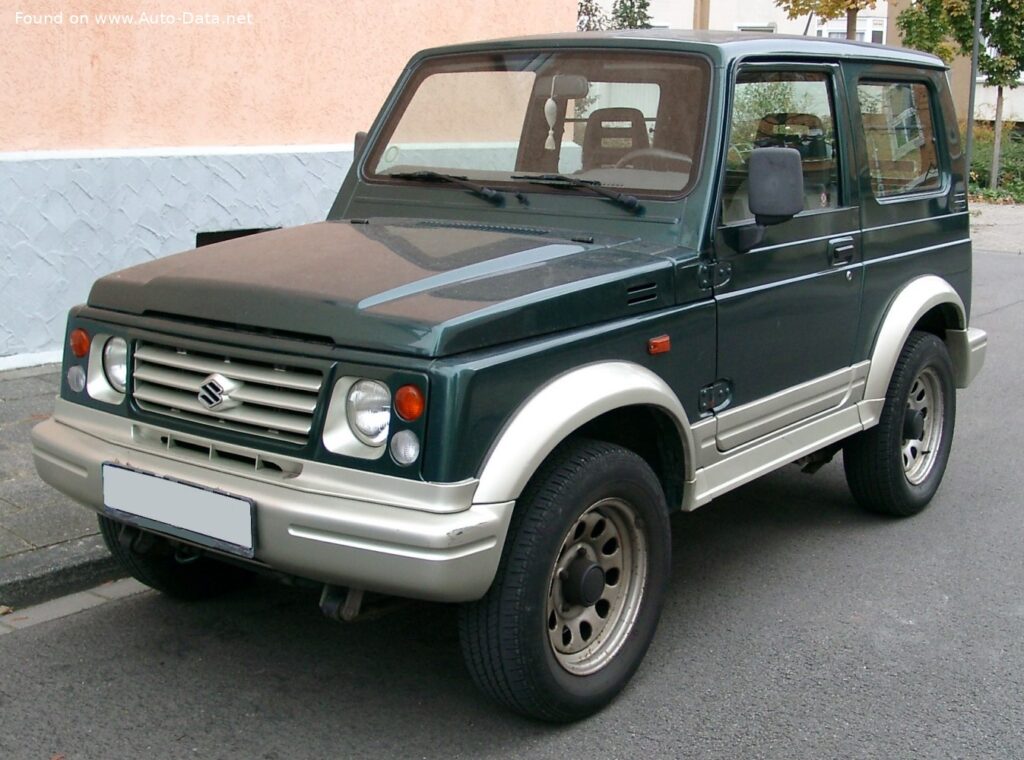
The Suzuki Samurai (SJ) is a series of small, lightweight four-wheel drive off-road vehicles manufactured by Suzuki from 1981 to 1998. The second generation, known as the SJ30/40 series, and later the Samurai in many export markets, represented a significant evolution of the original LJ series. This article focuses on the 1.3-liter (SJ413) version produced between 1988 and 1995, a model that gained popularity for its affordability, simplicity, and remarkable off-road capability. While never officially sold in large numbers in the United States due to safety concerns and import restrictions, the Suzuki Samurai became a cult classic among off-road enthusiasts, known for its ruggedness and potential for modification.
Suzuki Samurai (SJ) 1.3 (SJ 413): A Detailed Overview
The SJ413, powered by a 1.3-liter engine, was a key variant within the Samurai lineage. It built upon the foundation of earlier SJ models, offering improved performance and features while retaining the core characteristics that defined the vehicle: a lightweight body, a robust chassis, and a capable four-wheel drive system. The Samurai’s appeal lay in its simplicity; it was a vehicle designed for functionality rather than luxury, making it accessible to a wide range of buyers, particularly in markets outside of North America.
Engine & Performance
The heart of the SJ413 is a 1.3-liter (1324 cm3 or 80.8 cu. in.) inline four-cylinder gasoline engine. This naturally aspirated engine produces 60 horsepower at 5700 rpm and 96 Nm (70.81 lb.-ft.) of torque at 3550 rpm. While these figures may seem modest by modern standards, the Samurai’s light weight – a kerb weight of just 950 kg (2094.39 lbs.) – results in a respectable weight-to-power ratio of 15.8 kg/Hp. The engine utilizes a carburettor fuel injection system and an overhead camshaft (OHC) valvetrain with two valves per cylinder. The longitudinal engine layout contributes to the vehicle’s compact dimensions and aids in weight distribution. Maximum speed is rated at 140 km/h (86.99 mph). Fuel consumption is rated at 8.4 l/100 km combined, equating to approximately 28 US mpg or 33.6 UK mpg.
Design & Features
The Suzuki Samurai (SJ) 1.3 (SJ 413) is a three-door, four-seat off-road vehicle. Its body-on-frame construction provides exceptional durability and torsional rigidity, essential for tackling challenging terrain. The design is distinctly utilitarian, prioritizing functionality over aesthetics. The short wheelbase of 2030 mm (79.92 in.) contributes to the Samurai’s excellent maneuverability in tight spaces and its impressive approach and departure angles.
The Samurai’s suspension system is equally robust, employing leaf springs at both the front and rear axles. This setup, while not offering the most refined ride quality, provides exceptional articulation and durability, allowing the vehicle to maintain contact with the ground even over extremely uneven surfaces. Braking duties are handled by disc brakes at the front and drum brakes at the rear. The steering system utilizes a worm-reduction unit. The vehicle is equipped with 205/70 R15 tires mounted on 15-inch wheel rims.
Safety features were relatively basic for the era, reflecting the vehicle’s focus on affordability and simplicity. Later models saw some improvements, but the original Samurai lacked many of the safety features now considered standard, which contributed to its limited success in the US market. The Samurai’s appeal rested on its off-road prowess and its potential for customization, rather than its comfort or safety amenities.
Technical Specifications
| Brand | Suzuki |
| Model | Samurai |
| Generation | Samurai (SJ) |
| Type (Engine) | 1.3 (SJ 413) (60 Hp) |
| Start of production | 1988 year |
| End of production | 1995 year |
| Powertrain Architecture | Internal Combustion engine |
| Body type | Off-road vehicle |
| Seats | 4 |
| Doors | 3 |
| Fuel consumption (economy) – combined | 8.4 l/100 km |
| Fuel consumption (economy) – US mpg | 28 US mpg |
| Fuel consumption (economy) – UK mpg | 33.6 UK mpg |
| Fuel consumption (economy) – km/l | 11.9 km/l |
| Fuel Type | Petrol (Gasoline) |
| Maximum speed | 140 km/h |
| Maximum speed – mph | 86.99 mph |
| Weight-to-power ratio | 15.8 kg/Hp |
| Weight-to-torque ratio | 9.9 kg/Nm |
| Power | 60 Hp @ 5700 rpm |
| Power per litre | 45.3 Hp/l |
| Torque | 96 Nm @ 3550 rpm |
| Torque – lb.-ft. | 70.81 lb.-ft. @ 3550 rpm |
| Engine layout | Front, Longitudinal |
| Engine displacement | 1324 cm3 |
| Engine displacement – cu. in. | 80.8 cu. in. |
| Number of cylinders | 4 |
| Engine configuration | Inline |
| Cylinder Bore | 74 mm |
| Cylinder Bore – in. | 2.91 in. |
| Piston Stroke | 77 mm |
| Piston Stroke – in. | 3.03 in. |
| Compression ratio | 8.9:1 |
| Number of valves per cylinder | 2 |
| Fuel injection system | Carburettor |
| Engine aspiration | Naturally aspirated engine |
| Valvetrain | OHC |
| Engine oil capacity | 3.5 l |
| Engine oil capacity – US qt | 3.7 US qt |
| Engine oil capacity – UK qt | 3.08 UK qt |
| Kerb Weight | 950 kg |
| Kerb Weight – lbs. | 2094.39 lbs. |
| Max. weight | 1100 kg |
| Max. weight – lbs. | 2425.08 lbs. |
| Max load | 150 kg |
| Max load – lbs. | 330.69 lbs. |
| Length | 3440 mm |
| Length – in. | 135.43 in. |
| Width | 1530 mm |
| Width – in. | 60.24 in. |
| Height | 1680 mm |
| Height – in. | 66.14 in. |
| Wheelbase | 2030 mm |
| Wheelbase – in. | 79.92 in. |
| Minimum turning circle (turning diameter) | 9.8 m |
| Minimum turning circle (turning diameter) – ft. | 32.15 ft. |
| Drive wheel | All wheel drive (4×4) |
| Front suspension | Leaf spring |
| Rear suspension | Leaf spring |
| Front brakes | Disc |
| Rear brakes | Drum |
| Steering type | Worm-reduction unit |
| Tires size | 205/70 R15 |
| Wheel rims size | 15 |
