
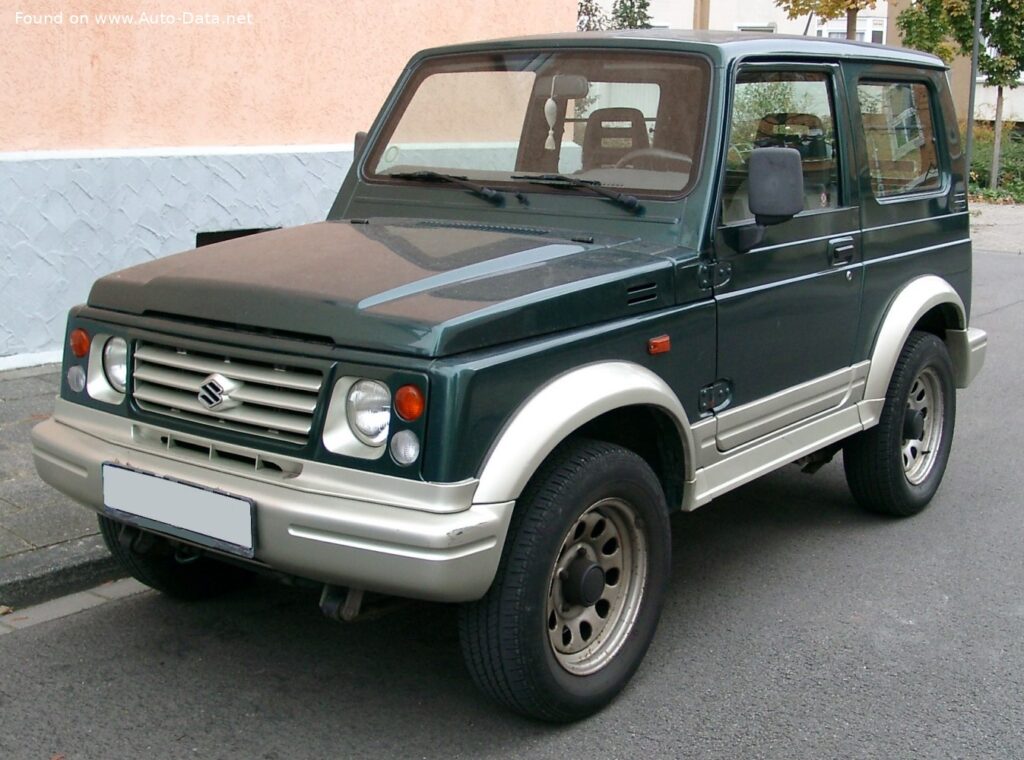
The Suzuki Samurai (SJ) 1.3, designated as the SJ413, represents a pivotal model in Suzuki’s history, particularly renowned for its exceptional off-road capability in a compact and affordable package. Produced from 1984 to 1991, the Samurai was a direct descendant of the earlier LJ series, evolving into a globally recognized nameplate, though its presence in the United States was relatively short-lived due to safety concerns. While not initially conceived as a mainstream vehicle for paved roads, the Samurai’s robust construction and four-wheel-drive system made it a favorite among off-road enthusiasts and a practical transportation solution in many rural areas. This article details the technical aspects, design, and legacy of the Suzuki Samurai (SJ) 1.3 (SJ 413) with its 70 horsepower engine.
Suzuki Samurai (SJ) 1.3: A Legacy of Off-Road Prowess
The Suzuki Samurai, known internally as the SJ413, was a significant upgrade over its predecessors, offering improved performance and features. It was primarily marketed as a light off-road vehicle, designed to tackle challenging terrain. While sold in numerous international markets, including Europe, Asia, and Latin America, its introduction to the United States in 1986 was met with both enthusiasm and controversy. The Samurai’s low price point and impressive off-road abilities quickly gained it a following, but concerns regarding its stability during turning maneuvers led to negative safety reports and ultimately, a limited production run in the US market. Despite this, the Samurai remains a highly sought-after vehicle among collectors and off-road aficionados.
Engine & Performance
The heart of the Suzuki Samurai (SJ) 1.3 (SJ 413) is a 1.3-liter, naturally aspirated four-cylinder gasoline engine. This engine produced 70 horsepower, which, while modest by modern standards, was sufficient to propel the lightweight Samurai across a variety of terrains. The engine’s simplicity and durability were key strengths, contributing to the vehicle’s reliability. The engine featured a single overhead camshaft (SOHC) configuration and a two-barrel carburetor. Power was delivered to all four wheels through a part-time four-wheel-drive system, selectable via a lever located within the cabin. This system allowed the driver to switch between two-wheel drive (rear-wheel drive) for on-road use and four-wheel drive for enhanced traction in off-road conditions. A low-range gear selection further enhanced the Samurai’s off-road capabilities, providing increased torque for navigating steep inclines and challenging obstacles. The transmission options typically included a five-speed manual and, in some markets, a three-speed automatic. The Samurai’s relatively low weight – around 2,200 to 2,400 pounds – contributed significantly to its nimble handling and respectable acceleration, despite the modest horsepower output.
Design & Features
The Suzuki Samurai (SJ) 1.3 (SJ 413) is characterized by its compact, boxy design. It’s a three-door vehicle with seating for four passengers, although rear seat space is limited. The body-on-frame construction provided exceptional durability and torsional rigidity, essential for off-road performance. The exterior styling was functional rather than luxurious, prioritizing practicality and robustness. The Samurai featured a short wheelbase, contributing to its excellent maneuverability in tight spaces and over uneven terrain. The vehicle’s high ground clearance further enhanced its off-road prowess, allowing it to clear obstacles with ease. Interior features were basic, reflecting the Samurai’s utilitarian purpose. Typically, the interior included vinyl or cloth upholstery, simple instrumentation, and minimal creature comforts. Safety features were limited by the standards of the era, with seatbelts being the primary safety equipment. The Samurai’s design emphasized simplicity and ease of maintenance, making it a popular choice for those who preferred to perform their own repairs. The removable hardtop or soft top options provided versatility, allowing owners to enjoy open-air driving during favorable weather conditions. The overall aesthetic of the Samurai is one of rugged functionality, embodying the spirit of adventure and off-road exploration.
Technical Specifications
| Brand | Suzuki |
| Model | Samurai |
| Generation | Samurai (SJ) |
| Type (Engine) | 1.3 (SJ 413) (70 Hp) |
| Start of production | 1984 |
| End of production | 1991 |
| Powertrain Architecture | Internal Combustion engine |
| Body type | Off-road vehicle |
| Seats | 4 |
| Doors | 3 |
| Fuel Type | Petrol (Gasoline) |
| Power | 70 Hp |
| Engine aspiration | Naturally aspirated engine |
| Engine oil capacity | 3.5 l / 3.7 US qt / 3.08 UK qt |
| Coolant capacity | 4.8 l / 5.07 US qt / 4.22 UK qt |
| Fuel tank capacity | 40 l / 10.57 US gal / 8.8 UK gal |
The Suzuki Samurai (SJ) 1.3 (SJ 413) remains a significant vehicle in automotive history, particularly for its impact on the off-road vehicle segment. Its combination of affordability, durability, and exceptional off-road capability made it a popular choice for enthusiasts and practical transportation in challenging environments. While its time in the US market was curtailed, the Samurai’s legacy endures, and it continues to be celebrated as a classic example of a rugged and capable off-road vehicle. The SJ series, in general, played a crucial role in establishing Suzuki as a major player in the global automotive industry, paving the way for future models like the Jimny, which continues the tradition of compact, capable off-roaders. The Samurai’s simple design and robust construction also make it a relatively easy vehicle to maintain and modify, ensuring its continued popularity among those who appreciate its unique character and off-road prowess.
