
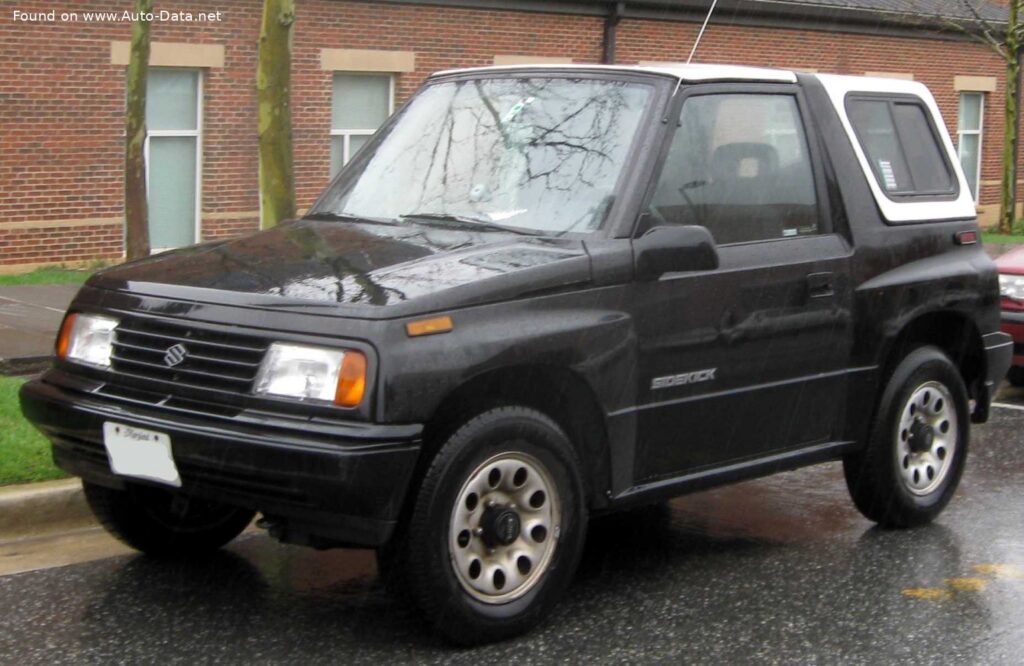
The Suzuki Sidekick, known as the Suzuki Escudo in Japan and other markets, was a subcompact SUV produced by Suzuki from 1988 to 1998, with the 1.6-liter variant being a significant offering from 1992-1998. Initially developed as a collaborative effort with General Motors, the Sidekick was sold under various brands including Geo and Chevrolet in North America. It occupied a unique niche as one of the earliest and most affordable SUVs, appealing to buyers seeking a small, fuel-efficient, and capable vehicle for both on-road and light off-road use. The Sidekick played a key role in popularizing the subcompact SUV segment, paving the way for future models like the Honda CR-V and Toyota RAV4. This article focuses on the 1.6-liter version of the Suzuki Sidekick produced between 1992 and 1998, detailing its technical specifications, design, and impact.
Suzuki Sidekick 1.6: A Pioneer in the Subcompact SUV Segment
The 1.6-liter Suzuki Sidekick represented a refinement of the original Sidekick design, offering a balance of affordability, practicality, and off-road capability. While not a high-performance vehicle, its compact size and relatively lightweight construction contributed to decent fuel economy and maneuverability. The Sidekick’s success stemmed from its ability to meet the growing demand for versatile vehicles that could handle daily commutes and weekend adventures. Its partnership with General Motors allowed Suzuki to expand its reach in the North American market, while GM benefited from a competitively priced SUV offering.
Engine & Performance
The heart of the 1992-1998 Suzuki Sidekick 1.6 is the G16 engine, a 1.6-liter naturally aspirated inline-four cylinder gasoline engine. This engine produced 95 horsepower, providing adequate power for its intended purpose. While not exceptionally powerful, the G16 engine was known for its reliability and relatively simple maintenance requirements. The engine featured a single overhead camshaft (SOHC) design and utilized multi-point fuel injection, contributing to improved fuel efficiency compared to earlier carburetor-equipped engines.
Power was delivered to the wheels through either a five-speed manual transmission or a four-speed automatic transmission. The Sidekick was available in both two-wheel drive (2WD) and four-wheel drive (4WD) configurations. The 4WD system, typically a part-time system, allowed drivers to engage four-wheel drive when needed for improved traction in challenging conditions such as snow, mud, or gravel. The 4WD system generally included a low-range gear for more demanding off-road situations. Acceleration was modest, with 0-60 mph times estimated to be around 11-13 seconds, depending on the transmission and drivetrain configuration. The focus was not on outright speed, but rather on providing sufficient power for everyday driving and light off-road exploration.
Design & Features
The Suzuki Sidekick 1.6 featured a classic SUV body style of the early 1990s – a compact, boxy shape with a relatively high ground clearance. It was available in both a two-door and a four-door configuration, with the two-door model being particularly popular for its sporty appearance and nimble handling. The body-on-frame construction, a common practice for SUVs at the time, provided durability and off-road capability.
Interior features were basic but functional, reflecting the Sidekick’s affordable price point. Standard equipment typically included cloth upholstery, manual windows and locks, and a basic audio system. Air conditioning was often an optional extra. Safety features were limited by the standards of the early 1990s, generally consisting of seatbelts and a basic anti-theft system. Later models may have included driver-side airbags, depending on the market and trim level. Cargo space was adequate for a subcompact SUV, with the rear seats folding down to provide additional storage capacity. The Sidekick’s relatively small size made it easy to park and maneuver in urban environments. The design prioritized practicality and durability over luxury and refinement.
The Sidekick’s aesthetic was functional and utilitarian, with a focus on maximizing interior space and off-road capability. Exterior styling cues included prominent wheel arches, a simple front grille, and rugged bumpers. The overall design conveyed a sense of adventure and capability, appealing to buyers who enjoyed outdoor activities. The vehicle’s compact dimensions and relatively lightweight construction contributed to its fuel efficiency, making it an attractive option for budget-conscious buyers.
Technical Specifications
| Brand | Suzuki |
| Model | Sidekick |
| Generation | Sidekick |
| Type (Engine) | 1.6 (95 Hp) |
| Start of production | 1992 |
| End of production | 1998 |
| Powertrain Architecture | Internal Combustion engine |
| Body type | SUV |
| Fuel Type | Petrol (Gasoline) |
| Power | 95 Hp |
| Engine Model/Code | G16 |
| Engine aspiration | Naturally aspirated engine |
| Engine oil capacity | 4.2 l |
| Engine oil capacity (US qt) | 4.44 US qt |
| Engine oil capacity (UK qt) | 3.7 UK qt |
The Suzuki Sidekick 1.6, despite its relatively simple design, left a lasting impact on the automotive landscape. It demonstrated that a small, affordable SUV could be both practical and capable, paving the way for the proliferation of subcompact SUVs that dominate the market today. Its collaboration with General Motors proved to be a successful partnership, expanding Suzuki’s reach and providing GM with a competitive offering in a growing segment. While no longer in production, the Sidekick remains a popular choice among enthusiasts seeking a reliable, affordable, and capable off-road vehicle.
