
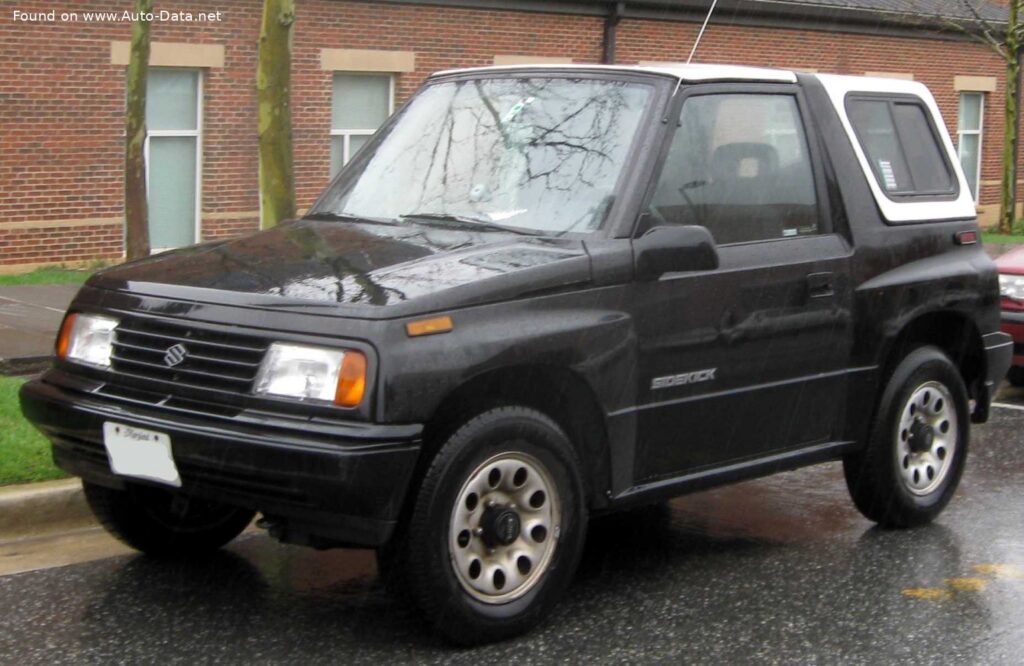
The Suzuki Sidekick, known as the Suzuki Escudo in Japan and other markets, was a subcompact SUV produced by Suzuki from 1989 to 1998. The model underwent several revisions during its production run, with the 1.8-liter variant introduced in 1996 representing a significant update to the original design. This generation Sidekick aimed to provide an affordable and capable off-road vehicle in a rapidly growing SUV market. While not a major sales success in the United States compared to larger SUVs, the Sidekick carved out a niche for itself among buyers seeking a small, fuel-efficient, and surprisingly capable four-wheel-drive vehicle. The 1.8-liter engine offered a modest power increase over earlier models, enhancing its on-road performance while retaining its off-road prowess. This article details the 1996-1998 Suzuki Sidekick 1.8, focusing on its technical specifications, design, and place within the automotive landscape.
The Suzuki Sidekick 1.8: A Compact SUV
The 1996-1998 Suzuki Sidekick 1.8 represented the final iteration of the first-generation model. It was primarily sold in North America, alongside international markets where it was known under different names. The Sidekick was initially developed as a joint venture with General Motors, resulting in the Chevrolet Tracker and GMC Tracker being nearly identical vehicles. The 1.8-liter engine was introduced to address criticisms of the earlier, smaller engines, providing a more refined driving experience and improved acceleration. The Sidekick’s appeal lay in its combination of affordability, compact size, and available four-wheel drive, making it a popular choice for those needing a versatile vehicle for both daily commuting and light off-road adventures.
Engine & Performance
The heart of the 1996-1998 Suzuki Sidekick 1.8 is the J18 engine, a 1.8-liter naturally aspirated inline-four cylinder gasoline engine. This engine produces 120 horsepower. While not a powerhouse, the J18 provided a noticeable improvement in performance compared to the earlier 1.6-liter engine offered in previous Sidekick models. The engine utilizes a single overhead camshaft (SOHC) design and multi-point fuel injection. The engine’s relatively simple design contributed to its reliability and ease of maintenance.
Power is delivered to the wheels through either a five-speed manual transmission or a four-speed automatic transmission. The Sidekick was available in both two-wheel drive (2WD) and four-wheel drive (4WD) configurations. The 4WD system was typically a part-time system, allowing the driver to engage four-wheel drive when needed for improved traction in challenging conditions. The 4WD system generally featured a low-range gear for more demanding off-road situations. Acceleration from 0 to 60 mph was typically in the 10-12 second range, depending on the transmission and drivetrain configuration. Fuel economy was a strong point for the Sidekick, with EPA estimates ranging from 20-22 mpg city and 23-26 mpg highway.
Design & Features
The 1996-1998 Suzuki Sidekick 1.8 maintained the boxy, utilitarian styling of the original model, though with some minor cosmetic updates. The body is a classic SUV shape, a two-door configuration with a removable hardtop or a soft top option. This design maximized interior space within a compact footprint. The Sidekick’s relatively short wheelbase and high ground clearance contributed to its off-road capability.
Inside, the Sidekick offered a basic but functional interior. Seating was typically for four passengers, although the rear seats could be somewhat cramped for adults. Standard features included air conditioning, a basic audio system, and cloth upholstery. Higher trim levels might have included features such as power windows and locks, and upgraded audio systems. Safety features for the time included front disc brakes and rear drum brakes, and seatbelts. However, it’s important to note that safety standards were significantly lower in the 1990s compared to modern vehicles, and the Sidekick lacked many of the advanced safety features found in contemporary SUVs. The Sidekick’s appeal wasn’t based on luxury or advanced technology, but rather on its practicality, affordability, and off-road capability. The removable top options added to its versatility, allowing for open-air driving during favorable weather conditions.
Technical Specifications
| Brand | Suzuki |
| Model | Sidekick |
| Generation | Sidekick |
| Type (Engine) | 1.8 (120 Hp) |
| Start of production | 1996 |
| End of production | 1998 |
| Powertrain Architecture | Internal Combustion engine |
| Body type | SUV |
| Fuel Type | Petrol (Gasoline) |
| Power | 120 Hp |
| Engine Model/Code | J18 |
| Engine aspiration | Naturally aspirated engine |
The Suzuki Sidekick 1.8, despite its relatively short production run in this specific configuration, remains a fondly remembered vehicle for those who appreciated its unique blend of affordability, capability, and compact size. It served as a gateway to off-road adventures for many, and its simple, reliable design continues to appeal to enthusiasts today. While it may not have been a mainstream success, the Sidekick left a lasting impression on the subcompact SUV segment and demonstrated Suzuki’s ability to produce capable and versatile vehicles.
