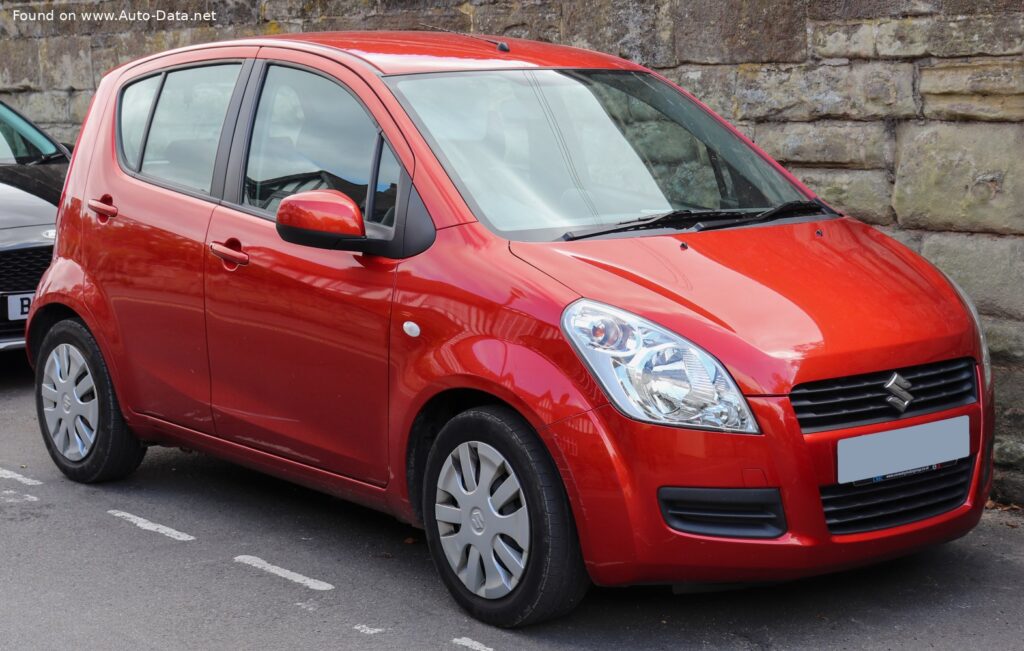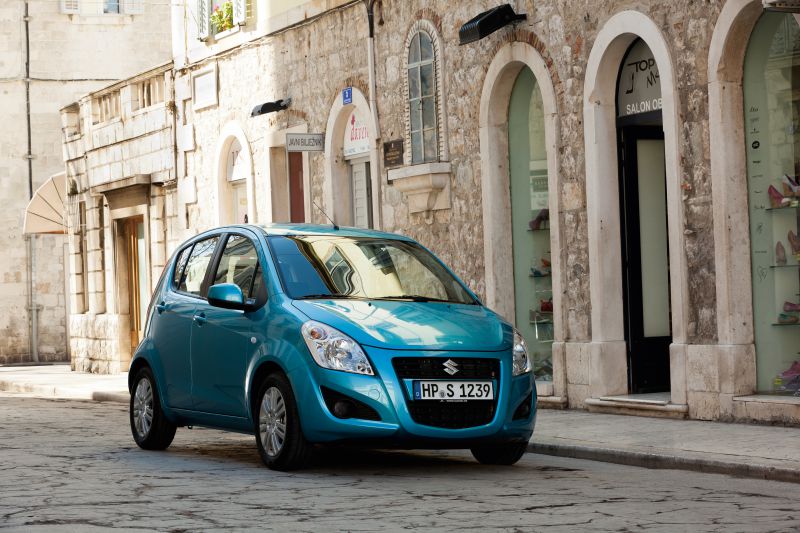
The Suzuki Splash, particularly the facelifted version introduced in 2012, is a supermini hatchback primarily aimed at the European market. While not officially sold in the United States, it represents a significant offering in the compact, fuel-efficient vehicle segment. Positioned below the Swift in Suzuki’s lineup, the Splash was designed to provide practical transportation with a focus on affordability and ease of use. The 2012 facelift brought styling updates and refinements to the original model, enhancing its appeal to budget-conscious buyers seeking a versatile city car. This article details the specifications and characteristics of the 2012-2014 Suzuki Splash 1.2-liter automatic variant.
Suzuki Splash (Facelift 2012) 1.2: An Overview
The Splash, developed in collaboration with Fiat (resulting in the closely related Fiat Panda), was intended to fill a gap in Suzuki’s European range. It offered a higher roofline than many competitors, maximizing interior space within its small footprint. The 1.2-liter engine, paired with an automatic transmission, was a popular choice for drivers prioritizing convenience and fuel economy. The facelifted model featured revised front and rear styling, along with interior enhancements, to maintain its competitiveness in a rapidly evolving market. The Splash was discontinued in 2014, but remains a common sight on European roads.
Engine & Performance
The 2012 Suzuki Splash 1.2 Automatic is powered by Suzuki’s K12B inline-four cylinder, naturally aspirated gasoline engine. This 1242cc (75.79 cubic inch) engine produces 94 horsepower at 6000 rpm and 118 Nm (87.03 lb-ft) of torque at 4800 rpm. While not a performance-oriented vehicle, the engine provides adequate power for urban driving and highway cruising. The four-speed automatic transmission offers smooth gear changes, enhancing the driving experience. Acceleration from 0 to 100 km/h (0-62 mph) takes approximately 14 seconds, and 0 to 60 mph is achieved in around 13.3 seconds. The Splash has a maximum speed of 175 km/h (108.74 mph). The engine’s power-to-weight ratio is 11.9 kg/Hp, and its torque-to-weight ratio is 9.4 kg/Nm. Fuel economy is a key strength, with combined fuel consumption rated at 5.7 l/100 km (41.3 US mpg, 49.6 UK mpg), and CO2 emissions of 131 g/km, meeting Euro 5 emission standards.
Design & Features
The Suzuki Splash is a five-door hatchback with a practical and functional design. Its relatively tall body provides ample headroom for passengers, and the rear seats can be folded down to increase cargo capacity. The 2012 facelift brought a more modern appearance, with a revised front grille, headlights, and bumper. Inside, the Splash offers a simple and straightforward layout, with a focus on usability. Standard features typically include air conditioning, power steering, and an audio system. Safety features, while not as comprehensive as those found in more modern vehicles, include ABS (Anti-lock Braking System) and front airbags. The Splash’s compact dimensions make it easy to maneuver in tight urban environments, and its relatively lightweight construction contributes to its fuel efficiency. Trunk space ranges from 178 liters (6.29 cubic feet) with the rear seats up to 573 liters (20.24 cubic feet) with them folded down. The Splash prioritizes practicality and affordability over luxurious appointments.
Technical Specifications
| Brand | Suzuki |
| Model | Splash |
| Generation | Splash (facelift 2012) |
| Type (Engine) | 1.2 (94 Hp) Automatic |
| Start of production | 2012 |
| End of production | 2014 |
| Powertrain Architecture | Internal Combustion engine |
| Body type | Hatchback |
| Seats | 5 |
| Doors | 5 |
| Fuel consumption (urban) | 6.9 l/100 km (34.1 US mpg, 40.9 UK mpg, 14.5 km/l) |
| Fuel consumption (extra urban) | 5 l/100 km (47 US mpg, 56.5 UK mpg, 20 km/l) |
| Fuel consumption (combined) | 5.7 l/100 km (41.3 US mpg, 49.6 UK mpg, 17.5 km/l) |
| CO2 emissions | 131 g/km |
| Fuel Type | Petrol (Gasoline) |
| Acceleration 0 – 100 km/h | 14 sec |
| Acceleration 0 – 62 mph | 14 sec |
| Acceleration 0 – 60 mph | 13.3 sec |
| Maximum speed | 175 km/h (108.74 mph) |
| Emission standard | Euro 5 |
| Weight-to-power ratio | 11.9 kg/Hp |
| Weight-to-torque ratio | 9.4 kg/Nm |
| Power | 94 Hp @ 6000 rpm |
| Torque | 118 Nm @ 4800 rpm (87.03 lb.-ft. @ 4800 rpm) |
| Engine layout | Front, Transverse |
| Engine Model/Code | K12B |
| Engine displacement | 1242 cm3 (75.79 cu. in.) |
| Number of cylinders | 4 |
| Engine configuration | Inline |
| Cylinder Bore | 73 mm (2.87 in.) |
| Piston Stroke | 74.2 mm (2.92 in.) |
| Compression ratio | 11:1 |
| Number of valves per cylinder | 4 |
| Fuel injection system | Multi-port manifold injection |
| Engine aspiration | Naturally aspirated |
| Engine oil capacity | 3.1 l (3.28 US qt | 2.73 UK qt) |
| Coolant capacity | 4.5 l (4.76 US qt | 3.96 UK qt) |
| Kerb Weight | 1115 kg (2458.15 lbs.) |
| Max. weight | 1485 kg (3273.86 lbs.) |
| Max load | 370 kg (815.71 lbs.) |
| Trunk (boot) space – minimum | 178 l (6.29 cu. ft.) |
| Trunk (boot) space – maximum | 573 l (20.24 cu. ft.) |
| Fuel tank capacity | 45 l (11.89 US gal | 9.9 UK gal) |
| Length | 3775 mm (148.62 in.) |
| Width | 1680 mm (66.14 in.) |
| Height | 1590 mm (62.6 in.) |
| Wheelbase | 2360 mm (92.91 in.) |
| Front track | 1460 mm (57.48 in.) |
| Rear track | 1470 mm (57.87 in.) |
| Ride height (ground clearance) | 145 mm (5.71 in.) |
| Minimum turning circle | 9.4 m (30.84 ft.) |
| Drivetrain | Front wheel drive |
| Number of gears | 4 |
| Gearbox type | Automatic transmission |
| Front suspension | Independent, McPherson with coil spring and anti-roll bar |
| Rear suspension | Semi-independent, coil spring |
| Front brakes | Ventilated discs |
| Rear brakes | Drum |
| Steering type | Steering rack and pinion |
| Tires size | 185/60 R15 84H |
| Wheel rims size | 5.5J x 15 |
The Suzuki Splash (facelift 2012) 1.2 Automatic, while not a high-performance vehicle, offered a compelling package of affordability, fuel efficiency, and practicality for European buyers. Its compact size and easy-to-drive nature made it a popular choice for city commuting, and its versatile interior provided ample space for passengers and cargo.