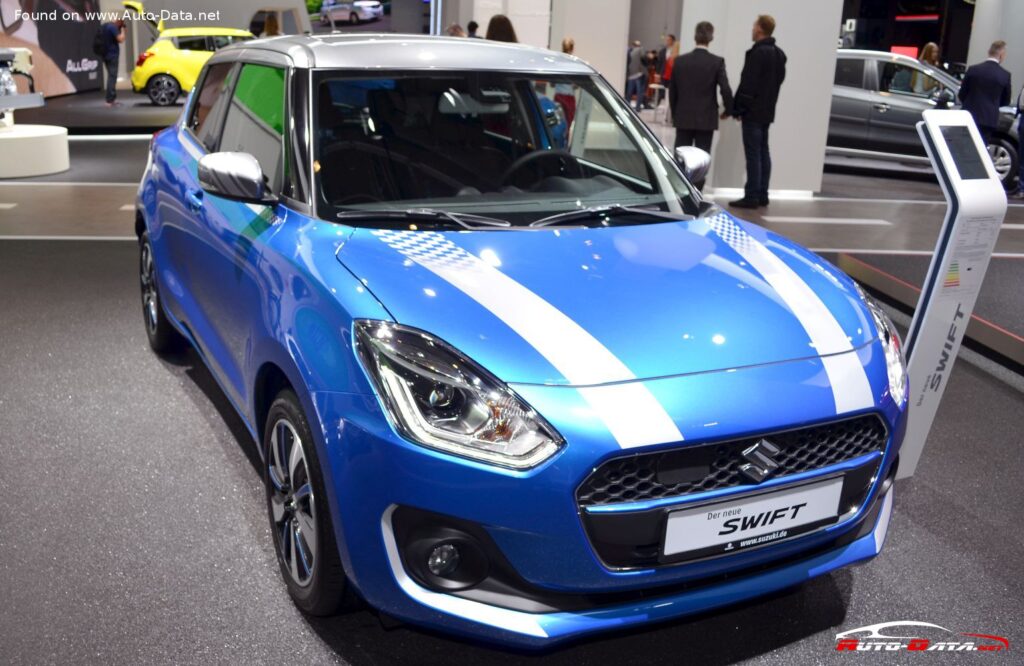
The Suzuki Swift VI 1.0 Boosterjet (111 Hp) Automatic, produced between 2017 and 2020, represents a significant iteration in Suzuki’s long-running Swift model line. This generation, while not widely sold in the United States, was a key player in the European and Asian subcompact hatchback market. The Swift VI aimed to balance fuel efficiency, nimble handling, and modern features, appealing to urban drivers and those seeking an economical and practical vehicle. It offered a step up in refinement and technology compared to its predecessors, competing with models like the Volkswagen Polo, Ford Fiesta, and Toyota Yaris.
Suzuki Swift VI 1.0 Boosterjet: An Overview
The Swift VI marked a departure from earlier generations with a more sophisticated design and a focus on lightweight construction. The 1.0 Boosterjet variant, equipped with a turbocharged three-cylinder engine and a six-speed automatic transmission, was a popular choice for its blend of performance and economy. While the Swift nameplate has a limited history in the US market, the VI generation demonstrates Suzuki’s engineering capabilities and its commitment to producing compact, efficient vehicles for global markets. This model specifically targeted buyers looking for a modern, well-equipped hatchback in a competitive segment.
Engine & Performance
The heart of the Swift VI 1.0 Boosterjet is the K10C 998 cc inline-three cylinder engine. This engine utilizes direct fuel injection and a turbocharger with an intercooler to produce 111 horsepower at 5500 rpm and 160 Nm (118.01 lb.-ft.) of torque between 1700 and 4000 rpm. This configuration provides a surprisingly responsive driving experience, particularly in urban environments. The six-speed automatic transmission delivers smooth gear changes and contributes to the car’s overall efficiency. Acceleration from 0 to 100 km/h (0-62 mph) takes approximately 10 seconds, with a 0-60 mph time calculated at 9.5 seconds. The vehicle achieves a maximum speed of 190 km/h (118.06 mph). The engine’s power-to-weight ratio is 8.5 kg/Hp, and its torque-to-weight ratio is 5.9 kg/Nm, contributing to its agile handling. The engine meets Euro 6 emission standards.
Design & Features
The Suzuki Swift VI is a five-door hatchback with a seating capacity of five. Its design emphasizes a sporty and modern aesthetic, with a distinctive front grille and sculpted body lines. The interior is designed to be practical and functional, with a focus on maximizing space within the compact dimensions. Key features include a well-integrated infotainment system, comfortable seating, and a range of safety technologies. Safety features, standard for the era, included ABS (Anti-lock Braking System) and a robust chassis designed for occupant protection. The rear seats fold down to increase cargo capacity from a minimum of 265 liters (9.36 cu. ft.) to a maximum of 947 liters (33.44 cu. ft.). The fuel tank capacity is 37 liters (9.77 US gal). The Swift VI prioritizes practicality and ease of use, making it well-suited for city driving and everyday commuting.
Technical Specifications
| Brand | Suzuki |
| Model | Swift |
| Generation | Swift VI |
| Type (Engine) | 1.0 BOOSTERJET (111 Hp) Automatic |
| Start of production | 2017 |
| End of production | 2020 |
| Powertrain Architecture | Internal Combustion engine |
| Body type | Hatchback |
| Seats | 5 |
| Doors | 5 |
| Fuel consumption (urban) | 6.4 l/100 km (36.8 US mpg, 44.1 UK mpg, 15.6 km/l) |
| Fuel consumption (extra urban) | 4.3 l/100 km (54.7 US mpg, 65.7 UK mpg, 23.3 km/l) |
| Fuel consumption (combined) | 5 l/100 km (47 US mpg, 56.5 UK mpg, 20 km/l) |
| CO2 emissions | 114 g/km |
| Fuel Type | Petrol (Gasoline) |
| Acceleration 0 – 100 km/h | 10 sec |
| Acceleration 0 – 62 mph | 10 sec |
| Acceleration 0 – 60 mph | 9.5 sec |
| Maximum speed | 190 km/h (118.06 mph) |
| Emission standard | Euro 6 |
| Weight-to-power ratio | 8.5 kg/Hp |
| Weight-to-torque ratio | 5.9 kg/Nm |
| Power | 111 Hp @ 5500 rpm |
| Torque | 160 Nm @ 1700-4000 rpm (118.01 lb.-ft. @ 1700-4000 rpm) |
| Engine layout | Front, Transverse |
| Engine Model/Code | K10C |
| Engine displacement | 998 cm3 (60.9 cu. in.) |
| Number of cylinders | 3 |
| Engine configuration | Inline |
| Cylinder Bore | 73 mm (2.87 in.) |
| Piston Stroke | 79.5 mm (3.13 in.) |
| Compression ratio | 10:1 |
| Number of valves per cylinder | 4 |
| Fuel injection system | Direct injection |
| Engine aspiration | Turbocharger, Intercooler |
| Valvetrain | DOHC-VVT |
| Engine oil capacity | 2.9 l (3.06 US qt | 2.55 UK qt) |
| Coolant | 4.7 l (4.97 US qt | 4.14 UK qt) |
| Kerb Weight | 940 kg (2072.35 lbs.) |
| Max. weight | 1380 kg (3042.38 lbs.) |
| Max load | 440 kg (970.03 lbs.) |
| Trunk (boot) space – minimum | 265 l (9.36 cu. ft.) |
| Trunk (boot) space – maximum | 947 l (33.44 cu. ft.) |
| Fuel tank capacity | 37 l (9.77 US gal | 8.14 UK gal) |
| Max. roof load | 50 kg (110.23 lbs.) |
| Permitted trailer load with brakes (12%) | 1000 kg (2204.62 lbs.) |
| Permitted trailer load without brakes | 400 kg (881.85 lbs.) |
| Permitted towbar download | 60 kg (132.28 lbs.) |
| Length | 3840 mm (151.18 in.) |
| Width | 1735 mm (68.31 in.) |
| Height | 1480 mm (58.27 in.) |
| Wheelbase | 2450 mm (96.46 in.) |
| Front track | 1520 mm (59.84 in.) |
| Rear (Back) track | 1525 mm (60.04 in.) |
| Ride height (ground clearance) | 115 mm (4.53 in.) |
| Minimum turning circle (turning diameter) | 9.6 m (31.5 ft.) |
| Drivetrain Architecture | Front wheel drive |
| Number of gears and type of gearbox | 6 gears, automatic transmission |
| Front suspension | Independent type McPherson |
| Rear suspension | independent torsion suspension |
| Front brakes | Ventilated discs |
| Rear brakes | Disc |
| Tires size | 185/55 R16 |
| Wheel rims size | 6J x 16 |
The Suzuki Swift VI 1.0 Boosterjet Automatic offered a compelling package for buyers in its segment, combining efficiency, practicality, and a surprisingly engaging driving experience. While not a common sight on American roads, it represents a well-engineered and thoughtfully designed vehicle that catered to the needs of European and Asian drivers.