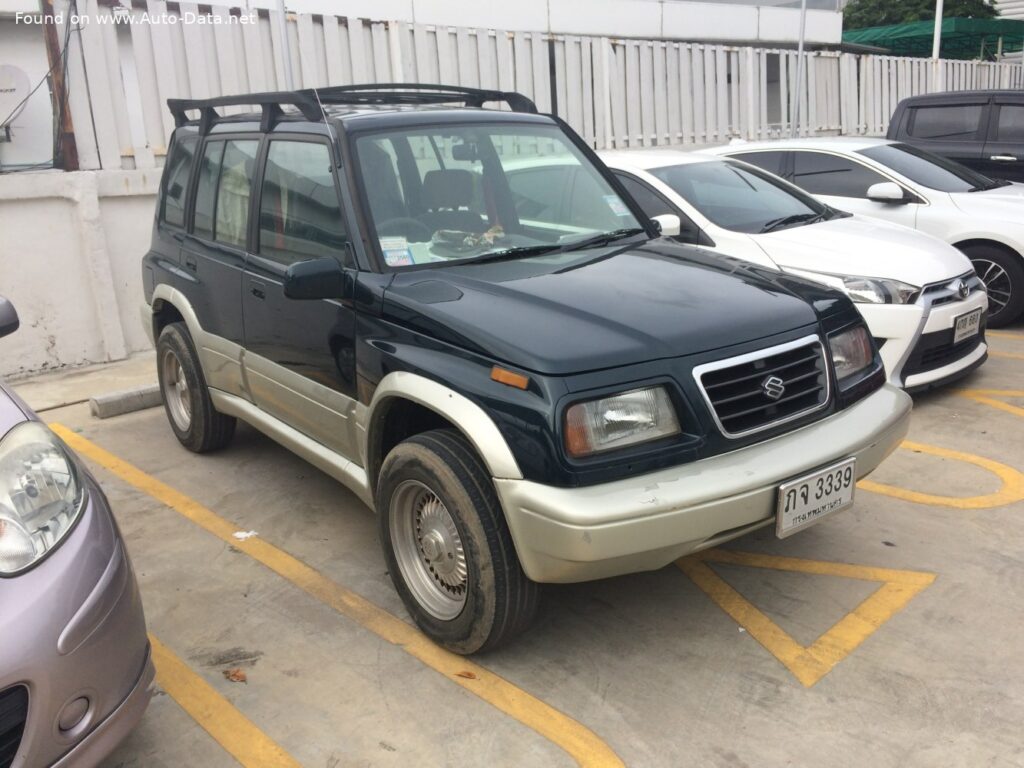
The Suzuki Vitara Cabrio (ET, TA) 1.9 D (ET) was a unique offering from the Japanese automaker, primarily marketed in Europe between 1996 and 1999. Representing a niche within the compact SUV segment, the Vitara Cabrio combined the ruggedness associated with the Vitara nameplate with the open-air enjoyment of a convertible. While not officially sold in the United States, the Vitara – known as the Geo Tracker and Chevrolet Tracker in the US market – enjoyed a considerable following for its affordability and off-road capability. The Cabriolet version, however, remained a largely European phenomenon, appealing to buyers seeking a distinctive and versatile vehicle.
Suzuki Vitara Cabrio: A European Niche
The Vitara Cabrio was built upon the success of the broader Vitara range, which had established itself as a popular choice for those needing a small, capable, and relatively inexpensive four-wheel-drive vehicle. The Cabriolet distinguished itself with a removable hardtop, offering drivers the option of a closed coupe or an open-air experience. This flexibility, combined with the Vitara’s inherent off-road prowess, made it a compelling option for outdoor enthusiasts and those desiring a vehicle that could handle both urban commutes and weekend adventures. The 1.9 D (ET) variant, powered by a turbocharged diesel engine, was designed to balance fuel efficiency with adequate performance for its intended purpose.
Engine & Performance
The 1.9 D (ET) variant of the Vitara Cabrio was equipped with the XUD9SD inline-four cylinder diesel engine. This 1905 cc (116.25 cubic inches) engine produced 75 horsepower at 4600 rpm and 135 Nm (99.57 lb.-ft.) of torque at 2250 rpm. While not a performance powerhouse, the engine’s torque output provided reasonable pulling power, particularly useful for off-road driving and navigating varied terrain. The engine featured a turbocharger and precombustion chamber fuel injection, technologies employed to improve efficiency and reduce emissions for the time. Acceleration from 0 to 100 km/h (0-62 mph) took approximately 17 seconds, and the vehicle reached a maximum speed of 137 km/h (85.13 mph). The weight-to-power ratio of 16.3 kg/Hp and weight-to-torque ratio of 9 kg/Nm reflected the vehicle’s modest power output relative to its 1220 kg (2689.64 lbs) kerb weight. Fuel economy was a strong point, achieving approximately 10.6 l/100 km (22.2 US mpg) in urban driving and 6.5 l/100 km (36.2 US mpg) on the open road.
Design & Features
The Suzuki Vitara Cabrio was a three-door, five-seat vehicle, categorized as a compact SUV/Cabriolet. Its body-on-frame construction, a hallmark of the Vitara series, contributed to its durability and off-road capability. The key distinguishing feature was, of course, the removable hardtop, which transformed the vehicle from a closed coupe to an open-air convertible. The interior, while functional, was not particularly luxurious, reflecting the vehicle’s price point. Safety features were relatively basic by modern standards, but included ventilated disc brakes on the front and drum brakes on the rear. Steering was rack and pinion with hydraulic assistance. The suspension utilized a wishbone setup at the front and coil springs at the rear, providing a reasonable balance between ride comfort and off-road performance. The vehicle’s all-wheel-drive system, selectable via a transfer case, enhanced its traction in challenging conditions. Practicality was enhanced by a trunk space ranging from 119 liters (4.2 cu. ft.) with the rear seats up to 596 liters (21.05 cu. ft.) with them folded down.
Technical Specifications
| Brand | Suzuki |
| Model | Vitara |
| Generation | Vitara Cabrio (ET,TA) |
| Type (Engine) | 1.9 D (ET) (75 Hp) |
| Start of production | 1996 year |
| End of production | 1999 year |
| Powertrain Architecture | Internal Combustion engine |
| Body type | Cabriolet, SUV |
| Seats | 5 |
| Doors | 3 |
| Fuel consumption (economy) – urban | 10.6 l/100 km (22.2 US mpg, 26.6 UK mpg, 9.4 km/l) |
| Fuel consumption (economy) – extra urban | 6.5 l/100 km (36.2 US mpg, 43.5 UK mpg, 15.4 km/l) |
| Fuel Type | Diesel |
| Acceleration 0 – 100 km/h | 17 sec |
| Acceleration 0 – 62 mph | 17 sec |
| Acceleration 0 – 60 mph | 16.2 sec |
| Maximum speed | 137 km/h (85.13 mph) |
| Weight-to-power ratio | 16.3 kg/Hp |
| Weight-to-torque ratio | 9 kg/Nm |
| Power | 75 Hp @ 4600 rpm |
| Power per litre | 39.4 Hp/l |
| Torque | 135 Nm @ 2250 rpm (99.57 lb.-ft. @ 2250 rpm) |
| Engine layout | Front, Transverse |
| Engine Model/Code | XUD9SD |
| Engine displacement | 1905 cm3 (116.25 cu. in.) |
| Number of cylinders | 4 |
| Engine configuration | Inline |
| Cylinder Bore | 83 mm (3.27 in.) |
| Piston Stroke | 88 mm (3.46 in.) |
| Compression ratio | 21.5:1 |
| Number of valves per cylinder | 2 |
| Fuel injection system | Precombustion chamber injection |
| Engine aspiration | Turbocharger |
| Valvetrain | DOHC |
| Engine oil capacity | 4.5 l (4.76 US qt | 3.96 UK qt) |
| Coolant | 6.6 l (6.97 US qt | 5.81 UK qt) |
| Kerb Weight | 1220 kg (2689.64 lbs.) |
| Max. weight | 1650 kg (3637.63 lbs.) |
| Max load | 430 kg (947.99 lbs.) |
| Trunk (boot) space – minimum | 119 l (4.2 cu. ft.) |
| Trunk (boot) space – maximum | 596 l (21.05 cu. ft.) |
| Fuel tank capacity | 55 l (14.53 US gal | 12.1 UK gal) |
| Length | 3630 mm (142.91 in.) |
| Width | 1670 mm (65.75 in.) |
| Height | 1630 mm (64.17 in.) |
| Wheelbase | 2200 mm (86.61 in.) |
| Front track | 1395 mm (54.92 in.) |
| Rear (Back) track | 1400 mm (55.12 in.) |
| Drive wheel | All wheel drive (4×4) |
| Number of gears and type of gearbox | 5 gears, manual transmission |
| Front suspension | Wishbone |
| Rear suspension | Coil spring |
| Front brakes | Ventilated discs |
| Rear brakes | Drum |
| Steering type | Steering rack and pinion |
| Power steering | Hydraulic Steering |
| Tires size | 195/80 R15 |
| Wheel rims size | 15 |
The Suzuki Vitara Cabrio 1.9 D (ET) remains a relatively rare and interesting vehicle, particularly for those interested in unique and versatile SUVs. Its combination of open-air enjoyment, four-wheel-drive capability, and diesel fuel efficiency made it a distinctive offering in the European market during its production run.