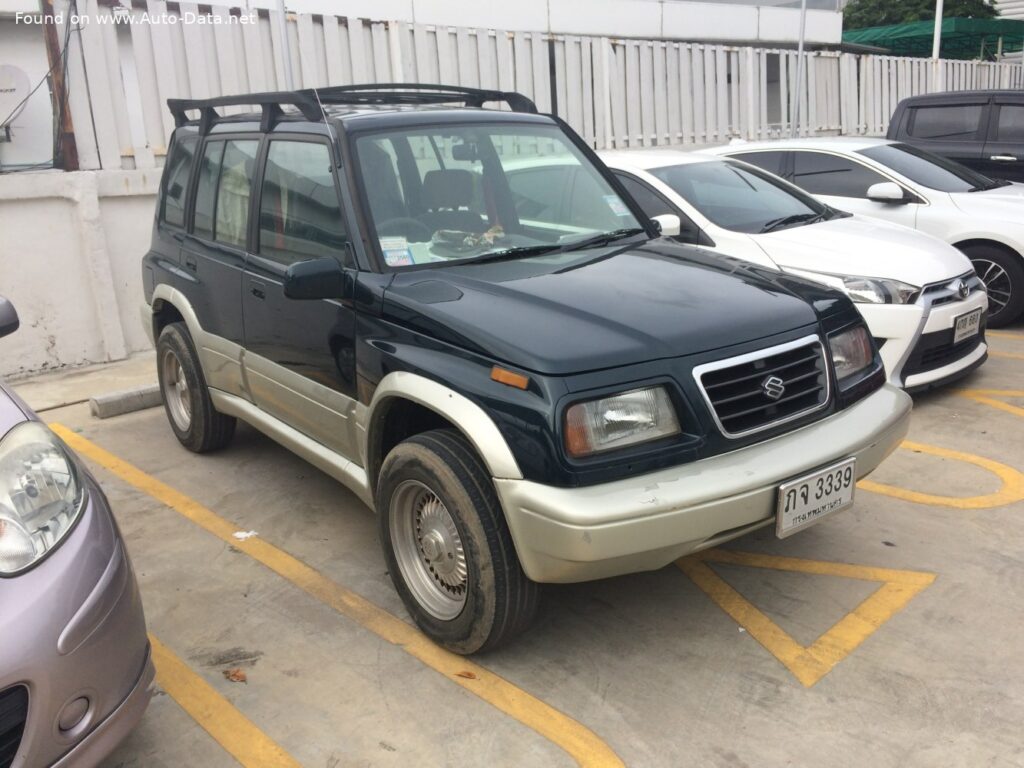
The Suzuki Vitara (ET, TA) is a compact SUV produced by the Japanese automaker Suzuki from 1990 to 1997. Representing the second generation of the Vitara line, it built upon the success of its predecessor, offering a blend of off-road capability and affordability. While not initially a major player in the North American market, the Vitara gained a following as a capable and reliable small SUV, particularly appealing to those seeking a vehicle for light off-roading and everyday use. The ET and TA designations refer to different body styles and minor variations within the second-generation range, with the model discussed here being the three-door version powered by a 1.6-liter engine and equipped with an automatic transmission.
Suzuki Vitara (ET, TA): A Detailed Overview
The Vitara (ET, TA) occupied a unique niche in the early 1990s. It was smaller and more affordable than many of the larger, more established SUVs of the time, yet offered genuine four-wheel-drive capability. This made it a popular choice in Europe and other international markets where compact SUVs were gaining traction. The three-door configuration, combined with the automatic transmission, aimed for a balance between practicality and ease of driving. The Vitara’s design reflected the boxy aesthetic common in SUVs of that era, prioritizing functionality over sleek styling.
Engine & Performance
The Suzuki Vitara (ET, TA) 1.6 i 16V was powered by the G16B engine, a 1.6-liter inline-four cylinder gasoline engine. This naturally aspirated engine produced 97 horsepower at 5600 rpm and 132 Nm (97.36 lb.-ft.) of torque at 4000 rpm. While not a powerhouse, the engine provided adequate performance for its intended purpose. The power-to-weight ratio of 10.7 kg/Hp and torque-to-weight ratio of 7.9 kg/Nm contributed to reasonable acceleration and off-road capability. Acceleration from 0 to 100 km/h (0-62 mph) took approximately 13 seconds, with a 0-60 mph time calculated at 12.4 seconds. The vehicle had a maximum speed of 152 km/h (94.45 mph). Fuel consumption was rated at 9.5 liters per 100 kilometers (24.8 US mpg), which was typical for a four-wheel-drive vehicle of its time. The engine utilized a multi-port fuel injection system and an overhead camshaft (OHC) valvetrain.
Design & Features
The Suzuki Vitara (ET, TA) was a three-door SUV with seating for five passengers. Its body-on-frame construction provided durability and off-road robustness. The exterior design was characterized by its boxy shape, large windows, and relatively high ground clearance. The three-door configuration meant limited rear passenger space and access, but it also contributed to the vehicle’s compact size and maneuverability. Key features included a four-wheel-drive system, ventilated disc brakes on the front wheels and drum brakes on the rear, and hydraulic power steering. Safety features were relatively basic by modern standards, reflecting the era in which the vehicle was produced. The trunk offered a minimum capacity of 202 liters (7.13 cubic feet). The vehicle’s dimensions were 3632 mm (142.99 in) in length, 1630 mm (64.17 in) in width, and 1662 mm (65.43 in) in height, with a wheelbase of 2200 mm (86.61 in).
Technical Specifications
| Brand | Suzuki |
| Model | Vitara |
| Generation | Vitara (ET, TA) |
| Type | 1.6 i 16V (3 dr) Automatic |
| Start of production | 1990 |
| End of production | 1997 |
| Powertrain Architecture | Internal Combustion engine |
| Body type | SUV |
| Seats | 5 |
| Doors | 3 |
| Fuel consumption (combined) | 9.5 l/100 km |
| Fuel consumption (US mpg) | 24.8 US mpg |
| Fuel consumption (UK mpg) | 29.7 UK mpg |
| Fuel consumption (km/l) | 10.5 km/l |
| Fuel Type | Petrol (Gasoline) |
| Acceleration 0 – 100 km/h | 13 sec |
| Acceleration 0 – 62 mph | 13 sec |
| Acceleration 0 – 60 mph | 12.4 sec |
| Maximum speed | 152 km/h |
| Maximum speed (mph) | 94.45 mph |
| Weight-to-power ratio | 10.7 kg/Hp |
| Weight-to-torque ratio | 7.9 kg/Nm |
| Power | 97 Hp @ 5600 rpm |
| Power per litre | 61 Hp/l |
| Torque | 132 Nm @ 4000 rpm |
| Torque (lb.-ft.) | 97.36 lb.-ft. @ 4000 rpm |
| Engine layout | Front, Longitudinal |
| Engine Model/Code | G16B |
| Engine displacement | 1589 cm3 |
| Engine displacement (cu. in.) | 96.97 cu. in. |
| Number of cylinders | 4 |
| Engine configuration | Inline |
| Cylinder Bore | 75 mm |
| Cylinder Bore (in.) | 2.95 in. |
| Piston Stroke | 90 mm |
| Piston Stroke (in.) | 3.54 in. |
| Compression ratio | 9.5:1 |
| Number of valves per cylinder | 4 |
| Fuel injection system | Multi-port manifold injection |
| Engine aspiration | Naturally aspirated engine |
| Valvetrain | OHC |
| Engine oil capacity | 4.2 l |
| Engine oil capacity (US qt) | 4.44 US qt |
| Engine oil capacity (UK qt) | 3.7 UK qt |
| Coolant | 5.3 l |
| Coolant (US qt) | 5.6 US qt |
| Coolant (UK qt) | 4.66 UK qt |
| Kerb Weight | 1040 kg |
| Kerb Weight (lbs.) | 2292.81 lbs. |
| Max. weight | 1500 kg |
| Max. weight (lbs.) | 3306.93 lbs. |
| Max load | 460 kg |
| Max load (lbs.) | 1014.13 lbs. |
| Trunk (boot) space – minimum | 202 l |
| Trunk (boot) space – minimum (cu. ft.) | 7.13 cu. ft. |
| Fuel tank capacity | 55 l |
| Fuel tank capacity (US gal) | 14.53 US gal |
| Fuel tank capacity (UK gal) | 12.1 UK gal |
| Length | 3632 mm |
| Length (in.) | 142.99 in. |
| Width | 1630 mm |
| Width (in.) | 64.17 in. |
| Height | 1662 mm |
| Height (in.) | 65.43 in. |
| Wheelbase | 2200 mm |
| Wheelbase (in.) | 86.61 in. |
| Front track | 1395 mm |
| Front track (in.) | 54.92 in. |
| Rear (Back) track | 1400 mm |
| Rear (Back) track (in.) | 55.12 in. |
| Drive wheel | All wheel drive (4×4) |
| Number of gears | 4 |
| Type of gearbox | automatic transmission |
| Front suspension | Wishbone |
| Rear suspension | Coil spring |
| Front brakes | Ventilated discs |
| Rear brakes | Drum |
| Steering type | Steering rack and pinion |
| Power steering | Hydraulic Steering |
| Tires size | 255/60 R15 S |
| Wheel rims size | 15 |