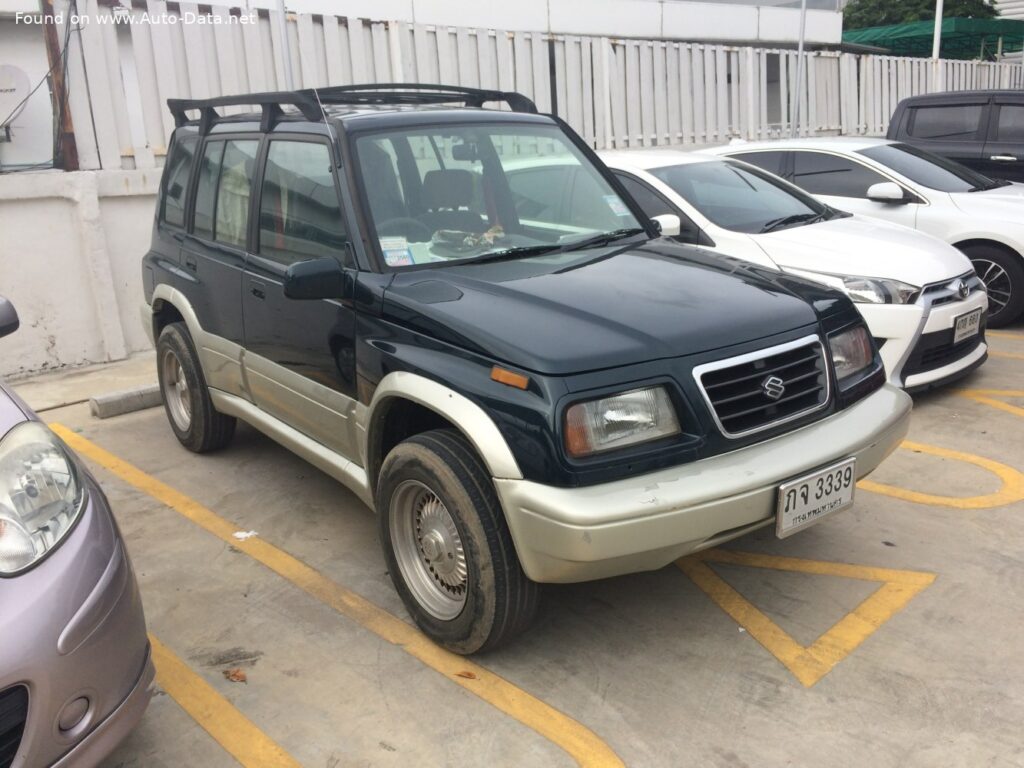
The Suzuki Vitara, known as the Suzuki Escudo in Japan, and often referred to as the Vitara ET and TA series, represents a significant entry by Suzuki into the increasingly popular compact sport utility vehicle (SUV) segment. Introduced in 1988 and continuing in production through 1995 for this generation, the Vitara aimed to provide a capable and affordable four-wheel-drive vehicle, particularly appealing to those seeking off-road capability combined with everyday usability. This first-generation Vitara was a key model for Suzuki, establishing the brand’s reputation for building robust and reliable SUVs, and it found considerable success in both European and Asian markets. While not initially a major player in the North American market, the Vitara laid the groundwork for Suzuki’s later SUV offerings in the region.
Suzuki Vitara (ET, TA): A Detailed Overview
The Vitara ET and TA series distinguished itself with its body-on-frame construction, a relatively uncommon feature for vehicles of its size at the time. This construction method contributed to its durability and off-road prowess. Available primarily as a three-door model, with a five-door version appearing later in some markets, the Vitara offered seating for five passengers. The 1.6-liter engine variant, producing 80 horsepower, was a common configuration, balancing fuel economy with adequate performance for its intended use.
Engine & Performance
The Suzuki Vitara ET/TA 1.6 i is powered by the G16A, a 1.6-liter inline-four cylinder gasoline engine. This naturally aspirated engine produces 80 horsepower at 5400 rpm and 127 Nm (93.67 lb.-ft.) of torque at 3000 rpm. While not a powerhouse, the engine’s torque delivery, combined with the vehicle’s relatively light weight, provides acceptable acceleration. The 0-60 mph time is approximately 14.3 seconds, and it reaches a top speed of 144 km/h (89.48 mph). The engine features a carburettor fuel injection system and an overhead camshaft (OHC) valvetrain with two valves per cylinder. The power-to-weight ratio of 12.8 kg/Hp and a power per litre of 50.3 Hp/l demonstrate a focus on efficiency rather than outright speed. Fuel consumption figures are 9.6 l/100 km (24.5 US mpg) in urban settings, 7.4 l/100 km (31.8 US mpg) on the open road, and 8.5 l/100 km (27.7 US mpg) combined.
Design & Features
The Vitara ET/TA is characterized by its boxy, utilitarian design, typical of SUVs from the late 1980s and early 1990s. Its three-door configuration emphasizes its off-road focus, while the compact dimensions make it relatively easy to maneuver in urban environments. The body-on-frame construction provides a robust platform for tackling rough terrain. Key features include a part-time four-wheel-drive system, allowing drivers to switch between two-wheel drive for fuel efficiency and four-wheel drive for enhanced traction. The interior is functional and spartan, prioritizing durability over luxury. Safety features for the era were limited, typically including seatbelts and basic structural protection. The vehicle’s 123-liter (4.34 cu. ft.) trunk space is modest but adequate for everyday needs. The hydraulic power steering aids maneuverability, and the suspension utilizes a wishbone setup at the front and coil springs at the rear, providing a reasonable balance between ride comfort and off-road capability. Disc brakes are fitted to the front wheels, while drum brakes are used at the rear.
Technical Specifications
| Brand | Suzuki |
| Model | Vitara |
| Generation | Vitara (ET,TA) |
| Type (Engine) | 1.6 i (80 Hp) |
| Start of production | 1988 |
| End of production | 1995 |
| Powertrain Architecture | Internal Combustion engine |
| Body type | SUV |
| Seats | 5 |
| Doors | 3 |
| Fuel consumption (urban) | 9.6 l/100 km (24.5 US mpg) |
| Fuel consumption (extra urban) | 7.4 l/100 km (31.8 US mpg) |
| Fuel consumption (combined) | 8.5 l/100 km (27.7 US mpg) |
| Fuel Type | Petrol (Gasoline) |
| Acceleration 0 – 100 km/h | 15 sec |
| Acceleration 0 – 62 mph | 15 sec |
| Acceleration 0 – 60 mph | 14.3 sec |
| Maximum speed | 144 km/h (89.48 mph) |
| Weight-to-power ratio | 12.8 kg/Hp |
| Weight-to-torque ratio | 8 kg/Nm |
| Power | 80 Hp @ 5400 rpm |
| Torque | 127 Nm @ 3000 rpm (93.67 lb.-ft. @ 3000 rpm) |
| Engine layout | Front, Longitudinal |
| Engine Model/Code | G16A |
| Engine displacement | 1589 cm3 (96.97 cu. in.) |
| Number of cylinders | 4 |
| Engine configuration | Inline |
| Cylinder Bore | 75 mm (2.95 in.) |
| Piston Stroke | 90 mm (3.54 in.) |
| Compression ratio | 8.9:1 |
| Number of valves per cylinder | 2 |
| Fuel injection system | Carburettor |
| Engine aspiration | Naturally aspirated |
| Valvetrain | OHC |
| Engine oil capacity | 4.2 l (4.44 US qt | 3.7 UK qt) |
| Coolant | 5.3 l (5.6 US qt | 4.66 UK qt) |
| Kerb Weight | 1020 kg (2248.72 lbs.) |
| Max. weight | 1450 kg (3196.7 lbs.) |
| Max load | 430 kg (947.99 lbs.) |
| Trunk (boot) space – minimum | 123 l (4.34 cu. ft.) |
| Fuel tank capacity | 42 l (11.1 US gal | 9.24 UK gal) |
| Length | 3620 mm (142.52 in.) |
| Width | 1630 mm (64.17 in.) |
| Height | 1665 mm (65.55 in.) |
| Wheelbase | 2200 mm (86.61 in.) |
| Front track | 1395 mm (54.92 in.) |
| Rear (Back) track | 1400 mm (55.12 in.) |
| Drive wheel | All wheel drive (4×4) |
| Number of gears and type of gearbox | 5 gears, manual transmission |
| Front suspension | Wishbone |
| Rear suspension | Coil spring |
| Front brakes | Disc |
| Rear brakes | Drum |
| Steering type | Steering rack and pinion |
| Power steering | Hydraulic Steering |
| Tires size | 195 R15 |
| Wheel rims size | 15 |
The Suzuki Vitara ET/TA 1.6 i, while not a performance leader, offered a compelling package of affordability, capability, and reliability. Its body-on-frame construction and four-wheel-drive system made it a popular choice for those seeking a versatile vehicle capable of handling both on-road and off-road adventures. It remains a fondly remembered vehicle for enthusiasts and a testament to Suzuki’s early success in the compact SUV market.