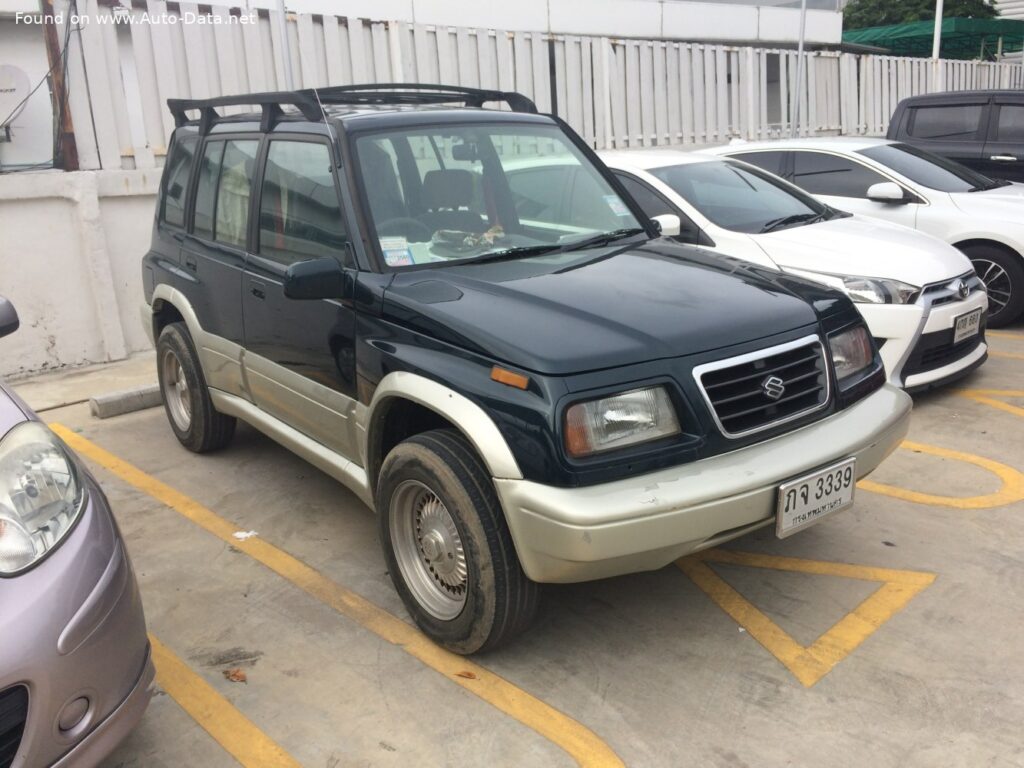
The Suzuki Vitara (ET, TA) represents a significant entry in Suzuki’s lineage of compact sport utility vehicles, produced between 1994 and 1998. While not initially a major player in the North American market, the Vitara was a popular choice in Europe, Australia, and parts of Asia, offering a blend of affordability, practicality, and off-road capability. This generation, designated ET and TA, built upon the success of earlier Vitara models, offering a more refined experience and a diesel engine option to cater to diverse consumer needs. The 2.0 TDI variant, equipped with an automatic transmission, provided a unique combination of fuel efficiency and convenience for its time.
Suzuki Vitara (ET, TA): A Detailed Overview
The Vitara (ET, TA) occupied the burgeoning compact SUV segment, competing with vehicles like the Honda CR-V and Toyota RAV4, though often at a more accessible price point. It distinguished itself with its robust four-wheel-drive system and relatively compact dimensions, making it suitable for both urban driving and light off-road adventures. The introduction of the 2.0 TDI engine, a turbocharged diesel, broadened its appeal to buyers seeking improved fuel economy and torque for towing or navigating challenging terrain.
Engine & Performance
The heart of the Suzuki Vitara (ET, TA) 2.0 TDI is a 1.998-liter inline-four cylinder diesel engine, designated the RF. This engine produces 83 horsepower at 4000 rpm and 168 Nm (123.91 lb.-ft.) of torque at 2000 rpm. While the horsepower figure may seem modest by modern standards, the diesel engine’s torque characteristics provide ample pulling power. The engine utilizes a precombustion chamber injection system and is turbocharged, enhancing its efficiency and performance. Power is delivered to all four wheels via a four-speed automatic transmission, offering a level of convenience not commonly found in diesel-powered SUVs of that era. The weight-to-power ratio stands at 16.9 kg/Hp, and the weight-to-torque ratio is 8.4 kg/Nm. Maximum speed is rated at 130 km/h (80.78 mph). Fuel economy figures are 11.5 l/100 km (20.5 US mpg, 24.6 UK mpg, 8.7 km/l) in urban settings, 7.3 l/100 km (32.2 US mpg, 38.7 UK mpg, 13.7 km/l) on the extra-urban cycle, and 9.3 l/100 km (25.3 US mpg, 30.4 UK mpg, 10.8 km/l) combined.
Design & Features
The Suzuki Vitara (ET, TA) is a five-door, five-seat SUV characterized by its boxy, utilitarian design. This design prioritized practicality and interior space over sleek aesthetics. The body-on-frame construction, a hallmark of many early SUVs, contributed to its durability and off-road capability. Key features included a spacious trunk offering between 580 and 1300 liters (20.48 to 45.91 cubic feet) of cargo volume depending on the rear seats’ configuration. The vehicle’s dimensions are 4125 mm (162.4 in) in length, 1695 mm (66.73 in) in width, and 1695 mm (66.73 in) in height, with a wheelbase of 2480 mm (97.64 in). Safety features for the time were relatively basic, typically including seatbelts and a robust chassis. The focus was on providing a durable and reliable vehicle capable of handling various road conditions. The suspension system consists of wishbone front suspension and coil spring rear suspension, providing a comfortable ride. Hydraulic power steering and ventilated front disc brakes with drum brakes in the rear contribute to the driving experience.
Technical Specifications
| Brand | Suzuki |
| Model | Vitara |
| Generation | Vitara (ET, TA) |
| Type (Engine) | 2.0 TDI (83 Hp) Automatic |
| Start of production | 1994 |
| End of production | 1998 |
| Powertrain Architecture | Internal Combustion engine |
| Body type | SUV |
| Seats | 5 |
| Doors | 5 |
| Fuel consumption (urban) | 11.5 l/100 km (20.5 US mpg, 24.6 UK mpg) |
| Fuel consumption (extra urban) | 7.3 l/100 km (32.2 US mpg, 38.7 UK mpg) |
| Fuel consumption (combined) | 9.3 l/100 km (25.3 US mpg, 30.4 UK mpg) |
| Fuel Type | Diesel |
| Maximum speed | 130 km/h (80.78 mph) |
| Weight-to-power ratio | 16.9 kg/Hp |
| Weight-to-torque ratio | 8.4 kg/Nm |
| Power | 83 Hp @ 4000 rpm |
| Torque | 168 Nm @ 2000 rpm (123.91 lb.-ft. @ 2000 rpm) |
| Engine layout | Front, Longitudinal |
| Engine Model/Code | RF |
| Engine displacement | 1998 cm3 (121.93 cu. in.) |
| Number of cylinders | 4 |
| Engine configuration | Inline |
| Cylinder Bore | 86 mm (3.39 in.) |
| Piston Stroke | 86 mm (3.39 in.) |
| Compression ratio | 20.9:1 |
| Number of valves per cylinder | 2 |
| Fuel injection system | Precombustion chamber injection |
| Engine aspiration | Turbocharger |
| Valvetrain | OHC |
| Engine oil capacity | 5.5 l (5.81 US qt | 4.84 UK qt) |
| Coolant capacity | 6.6 l (6.97 US qt | 5.81 UK qt) |
| Kerb Weight | 1405 kg (3097.49 lbs.) |
| Max. weight | 1945 kg (4287.99 lbs.) |
| Max load | 540 kg (1190.5 lbs.) |
| Trunk (boot) space – minimum | 580 l (20.48 cu. ft.) |
| Trunk (boot) space – maximum | 1300 l (45.91 cu. ft.) |
| Fuel tank capacity | 70 l (18.49 US gal | 15.4 UK gal) |
| Length | 4125 mm (162.4 in.) |
| Width | 1695 mm (66.73 in.) |
| Height | 1695 mm (66.73 in.) |
| Wheelbase | 2480 mm (97.64 in.) |
| Front track | 1455 mm (57.28 in.) |
| Rear track | 1450 mm (57.09 in.) |
| Drive wheel | All wheel drive (4×4) |
| Number of gears | 4 |
| Gearbox type | Automatic transmission |
| Front suspension | Wishbone |
| Rear suspension | Coil spring |
| Front brakes | Ventilated discs |
| Rear brakes | Drum |
| Steering type | Steering rack and pinion |
| Power steering | Hydraulic |
| Tires size | 215/65 R16 S |
The Suzuki Vitara (ET, TA) 2.0 TDI Automatic, while not a performance vehicle, offered a compelling package of practicality, affordability, and off-road capability. Its robust construction and fuel-efficient diesel engine made it a popular choice for those seeking a versatile and reliable SUV in the mid-1990s.