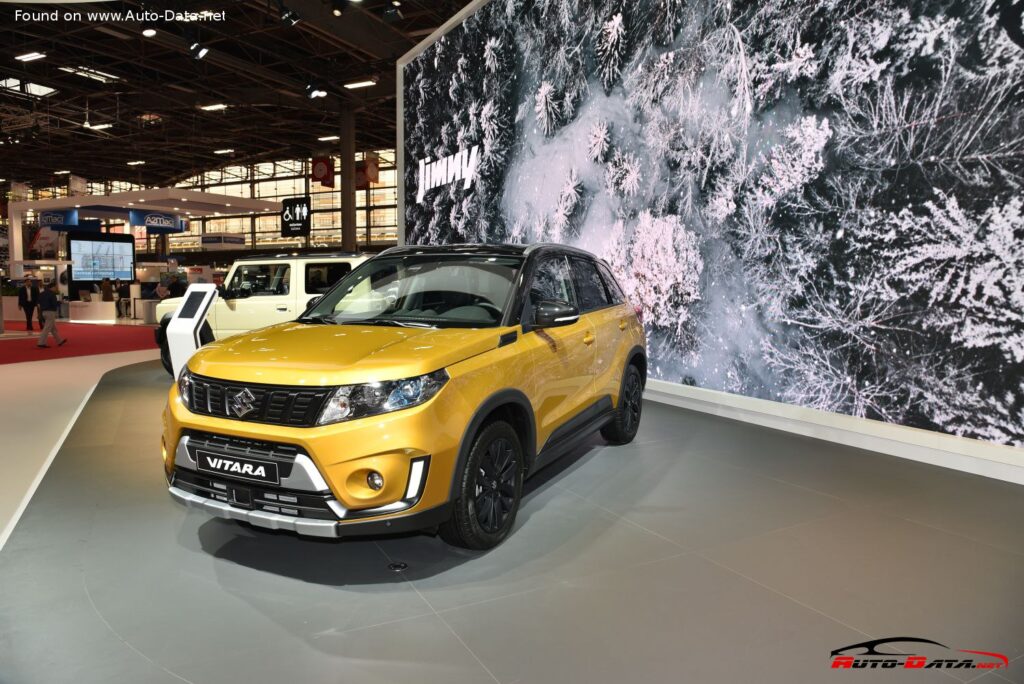
The Suzuki Vitara IV, particularly the facelifted version introduced in October 2018, represents a significant evolution in Suzuki’s compact SUV offerings. Positioned as a global model, the Vitara IV aimed to blend practicality, affordability, and a degree of off-road capability. While not initially a major seller in the United States (Suzuki withdrew from the US market in 2012), the Vitara found considerable success in Europe, Asia, and Australia, competing with vehicles like the Nissan Juke, Renault Captur, and Peugeot 2008. The 1.0 Boosterjet engine variant, producing 112 horsepower, was a key component of the lineup, focusing on fuel efficiency and responsive performance.
Suzuki Vitara IV (2018-2020) 1.0 Boosterjet: An Overview
The 2018 facelift brought styling updates, enhanced safety features, and refinements to the interior. The 1.0 Boosterjet engine, a three-cylinder turbocharged unit, was central to the model’s appeal, offering a balance between power and economy. This generation of Vitara aimed to appeal to buyers seeking a versatile vehicle suitable for both urban driving and occasional adventures. The Vitara IV’s design language moved away from the more utilitarian aesthetic of its predecessors, adopting a more modern and approachable appearance.
Engine & Performance
The heart of the 2018-2020 Suzuki Vitara 1.0 Boosterjet is the K10C-DITC engine, a 998cc inline-three cylinder gasoline engine. This engine utilizes direct fuel injection and a turbocharger with an intercooler to deliver 112 horsepower at 5500 rpm and 170 Nm (125.39 lb.-ft.) of torque between 2000 and 3500 rpm. The Boosterjet technology provides a relatively quick response and a usable powerband for everyday driving. The engine’s small displacement contributes to its fuel efficiency. Power is delivered to the front wheels via a five-speed manual transmission in this configuration. Acceleration from 0 to 100 km/h (0-62 mph) takes 11.5 seconds, while 0-60 mph is achieved in approximately 10.9 seconds. The vehicle has a maximum speed of 180 km/h (111.85 mph). The weight-to-power ratio is 9.7 kg/Hp, and the weight-to-torque ratio is 6.4 kg/Nm, indicating a reasonable balance between weight and performance.
Design & Features
The Suzuki Vitara IV is a five-door, five-seat SUV characterized by its rounded lines and relatively compact dimensions. The 2018 facelift included revisions to the front grille, headlights, and bumpers, giving the vehicle a more contemporary look. Inside, the Vitara offers a functional and reasonably well-equipped cabin. Standard features typically included air conditioning, power windows, and a basic audio system. Higher trim levels added features like alloy wheels, a touchscreen infotainment system, and advanced safety technologies. The trunk space is a practical 375 liters (13.24 cu. ft.) with the rear seats up, expanding to 1120 liters (39.55 cu. ft.) when folded down. Safety features, particularly in the facelifted model, were enhanced to meet evolving European safety standards, including ABS, and multiple airbags. The ride height of 185 mm (7.28 in) provides adequate ground clearance for light off-road use, aligning with the Vitara’s heritage as a capable all-rounder.
Technical Specifications
| Brand | Suzuki |
| Model | Vitara |
| Generation | Vitara IV (facelift 2018) |
| Type (Engine) | 1.0 BOOSTERJET (112 Hp) |
| Start of production | October, 2018 |
| End of production | April, 2020 |
| Powertrain Architecture | Internal Combustion engine |
| Body type | SUV |
| Seats | 5 |
| Doors | 5 |
| Fuel consumption (urban) | 6.2 l/100 km (37.9 US mpg, 45.6 UK mpg, 16.1 km/l) |
| Fuel consumption (extra urban) | 4.8 l/100 km (49 US mpg, 58.9 UK mpg, 20.8 km/l) |
| Fuel consumption (combined) | 5.3 l/100 km (44.4 US mpg, 53.3 UK mpg, 18.9 km/l) |
| CO2 emissions | 121 g/km |
| Fuel Type | Petrol (Gasoline) |
| Acceleration 0 – 100 km/h | 11.5 sec |
| Acceleration 0 – 62 mph | 11.5 sec |
| Acceleration 0 – 60 mph | 10.9 sec |
| Maximum speed | 180 km/h (111.85 mph) |
| Emission standard | Euro 6 |
| Weight-to-power ratio | 9.7 kg/Hp |
| Weight-to-torque ratio | 6.4 kg/Nm |
| Power | 112 Hp @ 5500 rpm |
| Torque | 170 Nm @ 2000-3500 rpm (125.39 lb.-ft. @ 2000-3500 rpm) |
| Engine layout | Front, Transverse |
| Engine Model/Code | K10C-DITC |
| Engine displacement | 998 cm3 (60.9 cu. in.) |
| Number of cylinders | 3 |
| Engine configuration | Inline |
| Cylinder Bore | 73 mm (2.87 in.) |
| Piston Stroke | 79.5 mm (3.13 in.) |
| Compression ratio | 10:1 |
| Number of valves per cylinder | 4 |
| Fuel injection system | Direct injection |
| Engine aspiration | Turbocharger, Intercooler |
| Engine oil capacity | 2.7 l (2.85 US qt | 2.38 UK qt) |
| Coolant | 5.5 l (5.81 US qt | 4.84 UK qt) |
| Kerb Weight | 1085-1160 kg (2392.02 – 2557.36 lbs.) |
| Max. weight | 1730 kg (3814 lbs.) |
| Max load | 570-645 kg (1256.63 – 1421.98 lbs.) |
| Trunk (boot) space – minimum | 375 l (13.24 cu. ft.) |
| Trunk (boot) space – maximum | 1120 l (39.55 cu. ft.) |
| Fuel tank capacity | 47 l (12.42 US gal | 10.34 UK gal) |
| Length | 4175 mm (164.37 in.) |
| Width | 1775 mm (69.88 in.) |
| Height | 1610 mm (63.39 in.) |
| Wheelbase | 2500 mm (98.43 in.) |
| Front track | 1535 mm (60.43 in.) |
| Rear (Back) track | 1505 mm (59.25 in.) |
| Ride height (ground clearance) | 185 mm (7.28 in.) |
| Minimum turning circle (turning diameter) | 10.4 m (34.12 ft.) |
| Drivetrain Architecture | Front wheel drive |
| Number of gears and type of gearbox | 5 gears, manual transmission |
| Front suspension | Independent type McPherson |
| Rear suspension | Torsion |
| Front brakes | Ventilated discs |
| Rear brakes | Disc |
| Assisting systems | ABS (Anti-lock braking system) |
| Steering type | Steering rack and pinion |
| Power steering | Electric Steering |
| Tires size | 215/60 R16; 215/55 R17 |
| Wheel rims size | 16; 17 |