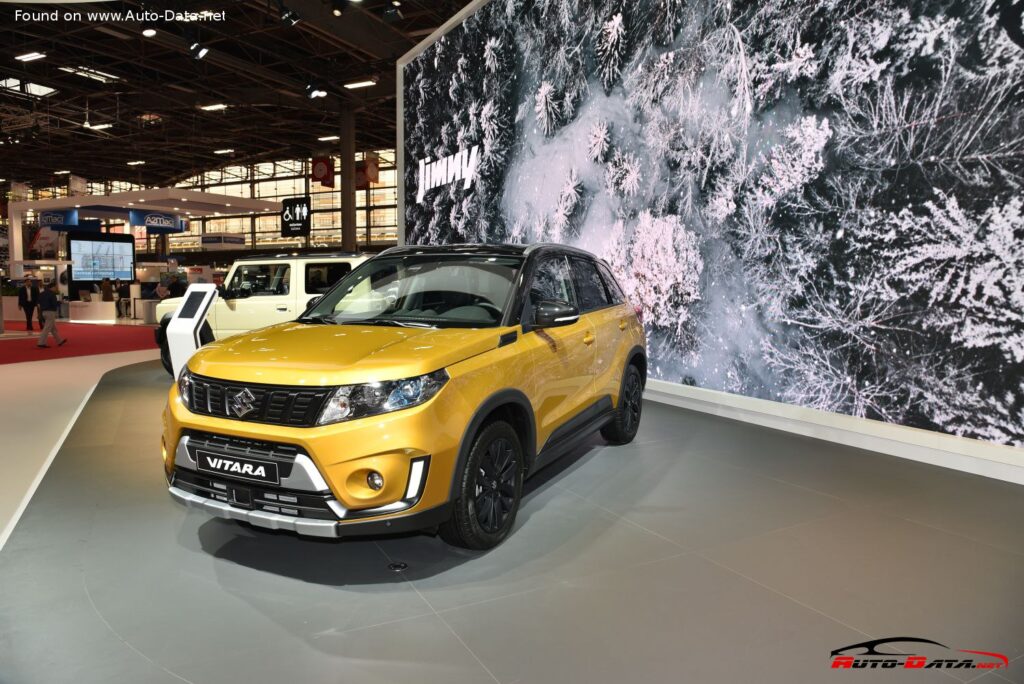
The Suzuki Vitara IV, particularly the facelifted version introduced in October 2018, represents a significant evolution in Suzuki’s compact SUV offerings. While the Vitara name has a long history dating back to the 1980s, the IV generation, launched in 2015, marked a return to a more road-focused, crossover-style vehicle. The 2018 facelift brought styling updates, enhanced safety features, and powertrain refinements, including the introduction of the 1.0 Boosterjet engine. This model was primarily aimed at the European market, where compact SUVs were experiencing a surge in popularity, offering a blend of affordability, practicality, and modern technology. Though not widely sold in the United States, the Vitara IV provides an interesting case study in how global automakers cater to specific regional demands.
Suzuki Vitara IV (Facelift 2018): A Detailed Overview
The Vitara IV facelift, specifically the 1.0 Boosterjet Automatic variant, aimed to provide an efficient and versatile option within the competitive subcompact SUV segment. It offered a balance between fuel economy, performance, and practicality, appealing to buyers seeking a comfortable and capable vehicle for both urban and occasional off-road use. The facelifted model featured revised front and rear styling, an updated interior with improved materials, and the integration of advanced safety technologies. The 1.0 Boosterjet engine, a key component of this iteration, was designed to deliver a responsive driving experience while minimizing fuel consumption and emissions.
Engine & Performance
The heart of the 2018 Suzuki Vitara IV 1.0 Boosterjet Automatic is the K10C-DITC 998cc inline-3 cylinder engine. This turbocharged powerplant produces 112 horsepower at 5500 rpm and 160 Nm (118.01 lb.-ft.) of torque between 1800 and 4000 rpm. The direct injection and turbocharging contribute to a surprisingly punchy performance for its small displacement. Power is delivered to the front wheels via a six-speed automatic transmission. While not a performance-oriented vehicle, the Vitara 1.0 Boosterjet achieves a 0-100 km/h (0-62 mph) time of 12.5 seconds, and a 0-60 mph time of 11.9 seconds. Its maximum speed is electronically limited to 180 km/h (111.85 mph). The engine’s power-to-weight ratio is 10.1 kg/Hp, and its torque-to-weight ratio is 7.1 kg/Nm, indicating a reasonable level of responsiveness. Fuel economy is a strong point, with combined cycle consumption rated at 5.7 l/100 km (41.3 US mpg, 49.6 UK mpg), and CO2 emissions of 129 g/km, meeting Euro 6 emission standards.
Design & Features
The Suzuki Vitara IV is a five-door, five-seat SUV characterized by its robust and modern styling. The 2018 facelift brought a redesigned front grille, new headlights with LED daytime running lights, and a refreshed rear bumper. The vehicle’s dimensions are 4175 mm (164.37 in) in length, 1775 mm (69.88 in) in width, and 1610 mm (63.39 in) in height, with a wheelbase of 2500 mm (98.43 in). The interior offers a practical and comfortable cabin with a focus on functionality. Key features include a touchscreen infotainment system, Bluetooth connectivity, and available safety technologies such as ABS, and various driver-assistance systems. Trunk space is a useful 375 liters (13.24 cu. ft.) with the rear seats up, expanding to 1120 liters (39.55 cu. ft.) when folded down. The ride height of 185 mm (7.28 in) provides adequate ground clearance for light off-road excursions. The vehicle’s kerb weight ranges from 1130 to 1180 kg (2491.22 – 2601.45 lbs.), depending on the specific trim level and options.
Technical Specifications
| Brand | Suzuki |
| Model | Vitara |
| Generation | Vitara IV (facelift 2018) |
| Type (Engine) | 1.0 BOOSTERJET (112 Hp) Automatic |
| Start of production | October, 2018 |
| End of production | April, 2020 |
| Powertrain Architecture | Internal Combustion engine |
| Body type | SUV |
| Seats | 5 |
| Doors | 5 |
| Fuel consumption (urban) | 6.6 l/100 km (35.6 US mpg, 42.8 UK mpg, 15.2 km/l) |
| Fuel consumption (extra urban) | 5.1 l/100 km (46.1 US mpg, 55.4 UK mpg, 19.6 km/l) |
| Fuel consumption (combined) | 5.7 l/100 km (41.3 US mpg, 49.6 UK mpg, 17.5 km/l) |
| CO2 emissions | 129 g/km |
| Fuel Type | Petrol (Gasoline) |
| Acceleration 0 – 100 km/h | 12.5 sec |
| Acceleration 0 – 62 mph | 12.5 sec |
| Acceleration 0 – 60 mph | 11.9 sec |
| Maximum speed | 180 km/h (111.85 mph) |
| Emission standard | Euro 6 |
| Weight-to-power ratio | 10.1 kg/Hp |
| Weight-to-torque ratio | 7.1 kg/Nm |
| Power | 112 Hp @ 5500 rpm |
| Torque | 160 Nm @ 1800-4000 rpm (118.01 lb.-ft.) |
| Engine layout | Front, Transverse |
| Engine Model/Code | K10C-DITC |
| Engine displacement | 998 cm3 (60.9 cu. in.) |
| Number of cylinders | 3 |
| Engine configuration | Inline |
| Cylinder Bore | 73 mm (2.87 in.) |
| Piston Stroke | 79.5 mm (3.13 in.) |
| Compression ratio | 10:1 |
| Number of valves per cylinder | 4 |
| Fuel injection system | Direct injection |
| Engine aspiration | Turbocharger, Intercooler |
| Engine oil capacity | 2.7 l (2.85 US qt | 2.38 UK qt) |
| Coolant | 5.7 l (6.02 US qt | 5.02 UK qt) |
| Kerb Weight | 1130-1180 kg (2491.22 – 2601.45 lbs.) |
| Max. weight | 1730 kg (3814 lbs.) |
| Max load | 550-600 kg (1212.54 – 1322.77 lbs.) |
| Trunk (boot) space – minimum | 375 l (13.24 cu. ft.) |
| Trunk (boot) space – maximum | 1120 l (39.55 cu. ft.) |
| Fuel tank capacity | 47 l (12.42 US gal | 10.34 UK gal) |
| Length | 4175 mm (164.37 in.) |
| Width | 1775 mm (69.88 in.) |
| Height | 1610 mm (63.39 in.) |
| Wheelbase | 2500 mm (98.43 in.) |
| Front track | 1535 mm (60.43 in.) |
| Rear track | 1505 mm (59.25 in.) |
| Ride height (ground clearance) | 185 mm (7.28 in.) |
| Minimum turning circle | 10.4 m (34.12 ft.) |
| Drivetrain | Front wheel drive |
| Number of gears | 6 |
| Gearbox type | Automatic transmission |
| Front suspension | Independent type McPherson |
| Rear suspension | Torsion |
| Front brakes | Ventilated discs |
| Rear brakes | Disc |
| Steering type | Steering rack and pinion |
| Power steering | Electric Steering |
| Tires size | 215/60 R16; 215/55 R17 |
| Wheel rims size | 16; 17 |