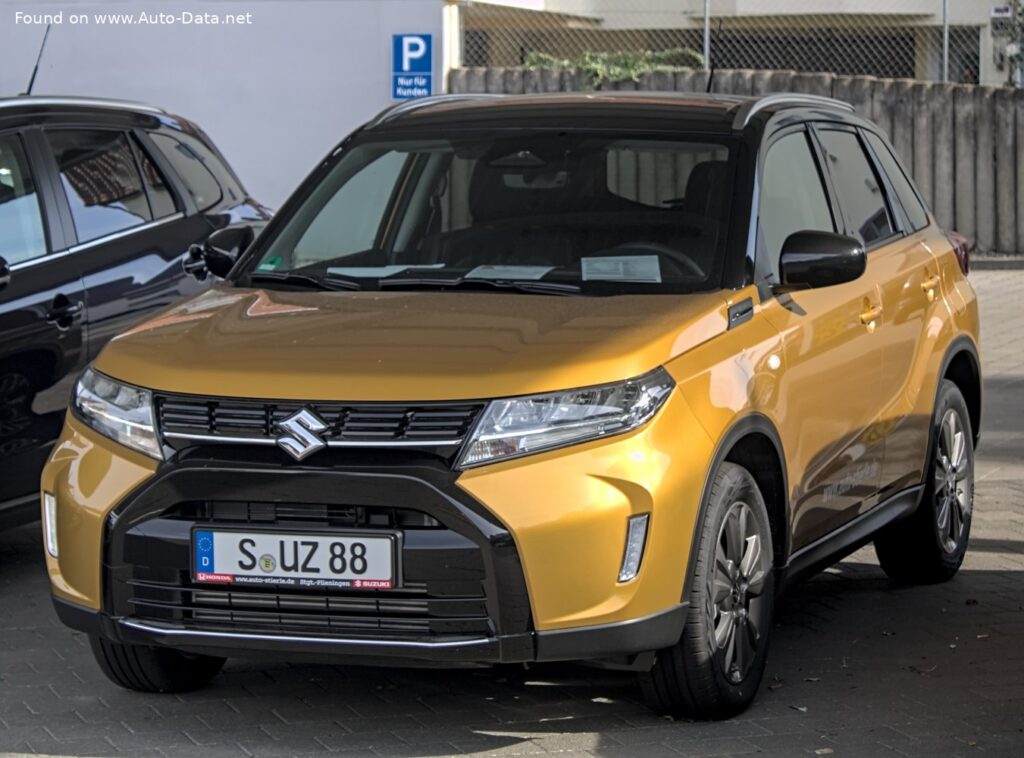
The Suzuki Vitara IV, particularly the 2024 facelifted model, represents Suzuki’s offering in the increasingly competitive compact SUV segment. While the Vitara name has a long history dating back to the early 1980s, the fourth generation, launched in 2015, marked a shift towards a more road-focused, crossover-style vehicle. The 2024 facelift brings updated styling, enhanced technology, and a continued focus on fuel efficiency through mild-hybrid technology. This model is primarily marketed in Europe and other international markets, where compact SUVs are highly popular. The Vitara distinguishes itself with its available ALLGRIP all-wheel-drive system, providing enhanced traction and capability for varied driving conditions.
Suzuki Vitara IV (Facelift 2024): Overview
The Vitara IV (facelift 2024) is a five-door, five-seat SUV powered by a 1.4-liter Boosterjet turbocharged engine coupled with a 48V mild-hybrid system. This combination aims to balance performance with reduced emissions and improved fuel economy. The vehicle is positioned as a practical and affordable option for buyers seeking a versatile and capable compact SUV. The facelifted model features cosmetic updates to the exterior and interior, along with enhancements to the safety and infotainment systems. Production of the 2024 model is slated to begin in July 2025.
Engine & Performance
The heart of the 2024 Suzuki Vitara is the K14D 1.4-liter Boosterjet inline-four cylinder engine. This engine produces 110 horsepower at 4,500 rpm and 235 Nm (173.33 lb.-ft.) of torque between 2,000 and 2,500 rpm. The engine utilizes direct fuel injection and a turbocharger with an intercooler to optimize performance and efficiency. Crucially, the Vitara employs a 48V mild-hybrid electric vehicle (MHEV) system. This system incorporates a 48V lithium-ion battery and a 17 horsepower electric motor integrated into the transmission. The electric motor provides torque assist during acceleration, contributing to improved responsiveness and reduced fuel consumption. The combined effect of the turbocharging and mild-hybrid system results in a power-to-weight ratio of 86.3 horsepower per tonne and a torque-to-weight ratio of 184.3 Nm per tonne. The vehicle is equipped with a six-speed automatic transmission and Suzuki’s ALLGRIP Select all-wheel-drive system, allowing drivers to choose between various driving modes to suit different conditions. Maximum speed is electronically limited to 180 km/h (111.85 mph).
Design & Features
The Suzuki Vitara IV (facelift 2024) maintains the overall silhouette of the fourth-generation model but receives styling updates to the front and rear fascias. These updates typically include a redesigned grille, new headlight and taillight designs, and revised bumpers. The body is a classic five-door SUV configuration, offering practical access and ample interior space. Inside, the facelifted Vitara features an updated dashboard layout with a modern infotainment system, likely incorporating smartphone integration via Apple CarPlay and Android Auto. Safety features are a key focus, with the inclusion of standard equipment such as ABS (Anti-lock Braking System), and potentially advanced driver-assistance systems (ADAS) like lane departure warning, adaptive cruise control, and automatic emergency braking, depending on the trim level. The interior offers seating for five passengers and a trunk space ranging from 362 liters (12.78 cu. ft.) with the rear seats up to 1119 liters (39.52 cu. ft.) with the rear seats folded down. The vehicle’s dimensions are 4185 mm (164.76 in.) in length, 1775 mm (69.88 in.) in width, and 1600 mm (62.99 in.) in height, with a wheelbase of 2500 mm (98.43 in.).
Technical Specifications
| Brand | Suzuki |
| Model | Vitara |
| Generation | Vitara IV (facelift 2024) |
| Type | 1.4 BOOSTERJET (110 Hp) Mild Hybrid ALLGRIP Automatic |
| Start of production | July, 2025 |
| Powertrain Architecture | MHEV (Mild Hybrid Electric Vehicle) |
| Body type | SUV |
| Seats | 5 |
| Doors | 5 |
| Fuel consumption at Low speed (WLTP) | 7.1 l/100 km (33.1 US mpg) |
| Fuel consumption at Medium speed (WLTP) | 5.6 l/100 km (42 US mpg) |
| Fuel consumption at high speed (WLTP) | 4.9 l/100 km (48 US mpg) |
| Fuel consumption at very high speed (WLTP) | 6.2 l/100 km (37.9 US mpg) |
| Combined fuel consumption (WLTP) | 5.8 l/100 km (40.6 US mpg) |
| CO2 emissions (WLTP) | 137-138 g/km |
| Fuel Type | Petrol (Gasoline) |
| Maximum speed | 180 km/h (111.85 mph) |
| Emission standard | Euro 6e-bis |
| Weight-to-power ratio | 11.6 kg/Hp |
| Weight-to-torque ratio | 5.4 kg/Nm |
| Battery voltage | 48 V |
| Battery technology | Lithium-ion (Li-Ion) |
| Electric motor power | 17 Hp |
| Electric motor Torque | 50 Nm (36.88 lb.-ft.) |
| Power | 110 Hp @ 4500 rpm |
| Torque | 235 Nm @ 2000-2500 rpm (173.33 lb.-ft. @ 2000-2500 rpm) |
| Engine displacement | 1373 cm3 (83.79 cu. in.) |
| Number of cylinders | 4 |
| Cylinder Bore | 73 mm (2.87 in.) |
| Piston Stroke | 82 mm (3.23 in.) |
| Kerb Weight | 1275-1315 kg (2810.89 – 2899.08 lbs.) |
| Max. weight | 1750 kg (3858.09 lbs.) |
| Trunk (boot) space – minimum | 362 l (12.78 cu. ft.) |
| Trunk (boot) space – maximum | 1119 l (39.52 cu. ft.) |
| Fuel tank capacity | 47 l (12.42 US gal) |
| Length | 4185 mm (164.76 in.) |
| Width | 1775 mm (69.88 in.) |
| Height | 1600 mm (62.99 in.) |
| Wheelbase | 2500 mm (98.43 in.) |
| Number of gears | 6 |
| Type of gearbox | automatic transmission |