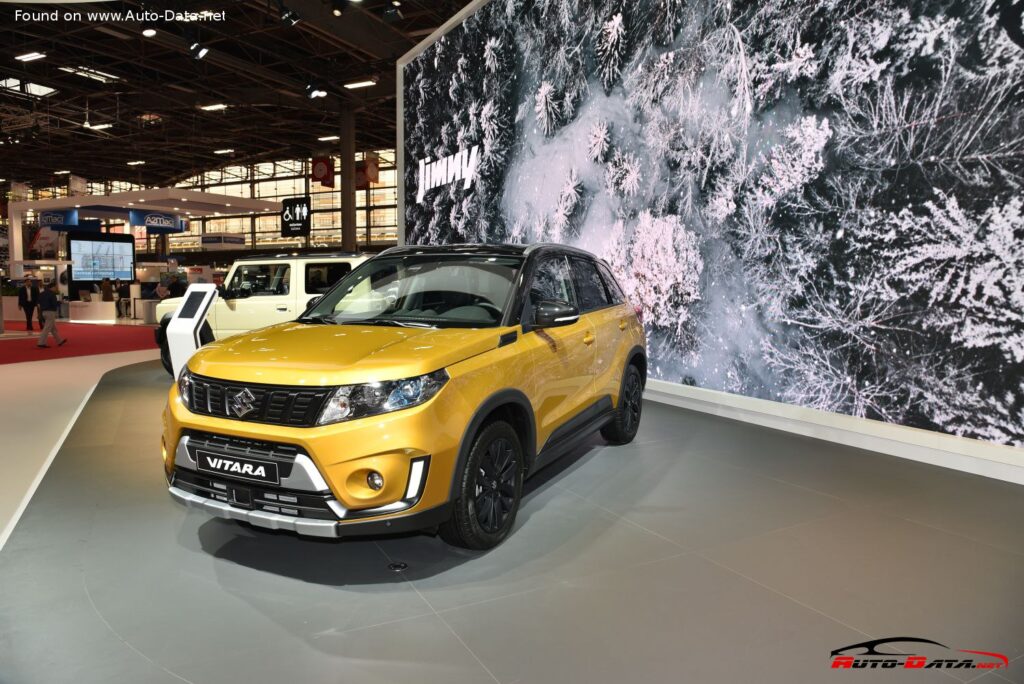
The Suzuki Vitara IV, particularly the facelifted version introduced in 2018, represents Suzuki’s entry into the competitive subcompact SUV segment. While not officially sold in the United States, the Vitara is a popular model in Europe, Asia, and other international markets. Positioned as an affordable and practical crossover, the Vitara IV offers a blend of fuel efficiency, modern features, and a surprisingly capable all-wheel-drive system in some configurations. The 1.4 BoosterJet Mild Hybrid variant, produced from 2020 to 2024, aimed to enhance fuel economy and reduce emissions through the integration of a mild hybrid system. This model caters to buyers seeking a versatile vehicle for both urban commuting and occasional off-road adventures.
Suzuki Vitara IV (Facelift 2018) 1.4 BoosterJet Mild Hybrid: An Overview
The Vitara IV, launched in 2015, was a significant departure from its predecessors, offering a more modern design and a wider range of features. The 2018 facelift brought styling updates, improved safety equipment, and the introduction of the BoosterJet engine family. The 1.4 BoosterJet Mild Hybrid version, introduced in 2020, further refined the lineup, focusing on efficiency and compliance with increasingly stringent emissions regulations. This iteration of the Vitara aimed to balance performance with environmental responsibility, making it an attractive option for environmentally conscious consumers in its target markets.
Engine & Performance
The heart of the Suzuki Vitara IV 1.4 BoosterJet Mild Hybrid is a 1.4-liter, turbocharged inline-four cylinder gasoline engine (K14D engine code). This engine produces 129 horsepower at 5,500 rpm and 235 Nm (173.33 lb-ft) of torque between 2,000 and 3,000 rpm. The “BoosterJet” designation signifies Suzuki’s direct-injection turbocharged technology, designed to deliver a responsive driving experience and improved fuel efficiency. The mild hybrid system incorporates a 48V electric motor, adding 14 horsepower at 3000 rpm and 53 Nm (39.09 lb-ft) of torque at 500 rpm. This electric assist provides a boost during acceleration and enables a start/stop system to conserve fuel when idling. Power is delivered to the front wheels via a six-speed manual transmission. Acceleration from 0 to 100 km/h (0-62 mph) takes 9.5 seconds, with a top speed of 190 km/h (118.06 mph). The engine’s power-to-weight ratio is 9.3 kg/Hp, and the torque-to-weight ratio is 5.1 kg/Nm.
Design & Features
The Suzuki Vitara IV is a five-door, five-seat SUV characterized by its robust and contemporary styling. The facelifted model features a redesigned front grille, updated headlights, and a more sculpted bumper. The interior offers a functional and comfortable cabin with a focus on practicality. Standard features typically include air conditioning, a touchscreen infotainment system, Bluetooth connectivity, and various safety systems. The 2020-2024 models benefit from enhanced safety features, including advanced driver-assistance systems (ADAS) such as lane departure warning, and autonomous emergency braking. The trunk offers 375 liters (13.24 cu ft) of space with the rear seats up, expanding to 710 liters (25.07 cu ft) when folded down. The vehicle’s dimensions are 4175 mm (164.37 in) in length, 1775 mm (69.88 in) in width, and 1610 mm (63.39 in) in height, with a wheelbase of 2500 mm (98.43 in). Ground clearance is a respectable 185 mm (7.28 in).
Technical Specifications
| Brand | Suzuki |
| Model | Vitara |
| Generation | Vitara IV (facelift 2018) |
| Type (Engine) | 1.4 BOOSTERJET (129 Hp) Mild Hybrid |
| Start of production | April, 2020 |
| End of production | April, 2024 |
| Powertrain Architecture | MHEV (Mild Hybrid Electric Vehicle) |
| Body type | SUV |
| Seats | 5 |
| Doors | 5 |
| Fuel consumption at Low speed (WLTP) | 6.5 l/100 km (36.2 US mpg) |
| Fuel consumption at Medium speed (WLTP) | 5.1 l/100 km (46.1 US mpg) |
| Fuel consumption at high speed (WLTP) | 5.0 l/100 km (47 US mpg) |
| Fuel consumption at very high speed (WLTP) | 6.4 l/100 km (36.8 US mpg) |
| Combined fuel consumption (WLTP) | 5.7 l/100 km (41.3 US mpg) |
| CO2 emissions (WLTP) | 128 g/km |
| CO2 emissions (NEDC, WLTP equivalent) | 104 g/km |
| Fuel Type | Petrol (Gasoline) |
| Acceleration 0 – 100 km/h | 9.5 sec |
| Acceleration 0 – 62 mph | 9.5 sec |
| Acceleration 0 – 60 mph | 9 sec |
| Maximum speed | 190 km/h (118.06 mph) |
| Emission standard | Euro 6d |
| Weight-to-power ratio | 9.3 kg/Hp |
| Weight-to-torque ratio | 5.1 kg/Nm |
| Electric motor power | 14 Hp @ 3000 rpm |
| Electric motor Torque | 53 Nm @ 500 rpm (39.09 lb.-ft. @ 500 rpm) |
| Power | 129 Hp @ 5500 rpm |
| Torque | 235 Nm @ 2000-3000 rpm (173.33 lb.-ft. @ 2000-3000 rpm) |
| Engine layout | Front, Transverse |
| Engine Model/Code | K14D |
| Engine displacement | 1373 cm3 (83.79 cu. in.) |
| Number of cylinders | 4 |
| Engine configuration | Inline |
| Number of valves per cylinder | 4 |
| Fuel injection system | Direct injection |
| Engine aspiration | Turbocharger, Intercooler |
| Valvetrain | Dual VVT |
| Engine oil capacity | 3.6 l (3.8 US qt | 3.17 UK qt) |
| Kerb Weight | 1205 kg (2656.57 lbs.) |
| Max. weight | 1770 kg (3902.18 lbs.) |
| Max load | 565 kg (1245.61 lbs.) |
| Trunk (boot) space – minimum | 375 l (13.24 cu. ft.) |
| Trunk (boot) space – maximum | 710 l (25.07 cu. ft.) |
| Fuel tank capacity | 47 l (12.42 US gal | 10.34 UK gal) |
| Permitted trailer load with brakes (12%) | 1200 kg (2645.55 lbs.) |
| Permitted trailer load without brakes | 400 kg (881.85 lbs.) |
| Length | 4175 mm (164.37 in.) |
| Width | 1775 mm (69.88 in.) |
| Height | 1610 mm (63.39 in.) |
| Wheelbase | 2500 mm (98.43 in.) |
| Front track | 1535 mm (60.43 in.) |
| Rear (Back) track | 1505 mm (59.25 in.) |
| Ride height (ground clearance) | 185 mm (7.28 in.) |
| Minimum turning circle (turning diameter) | 10.4 m (34.12 ft.) |
| Drivetrain Architecture | Front wheel drive. MHEV. |
| Drive wheel | Front wheel drive |
| Number of gears and type of gearbox | 6 gears, manual transmission |
| Front suspension | Independent type McPherson |
| Rear suspension | Torsion |
| Front brakes | Ventilated discs |
| Rear brakes | Disc |