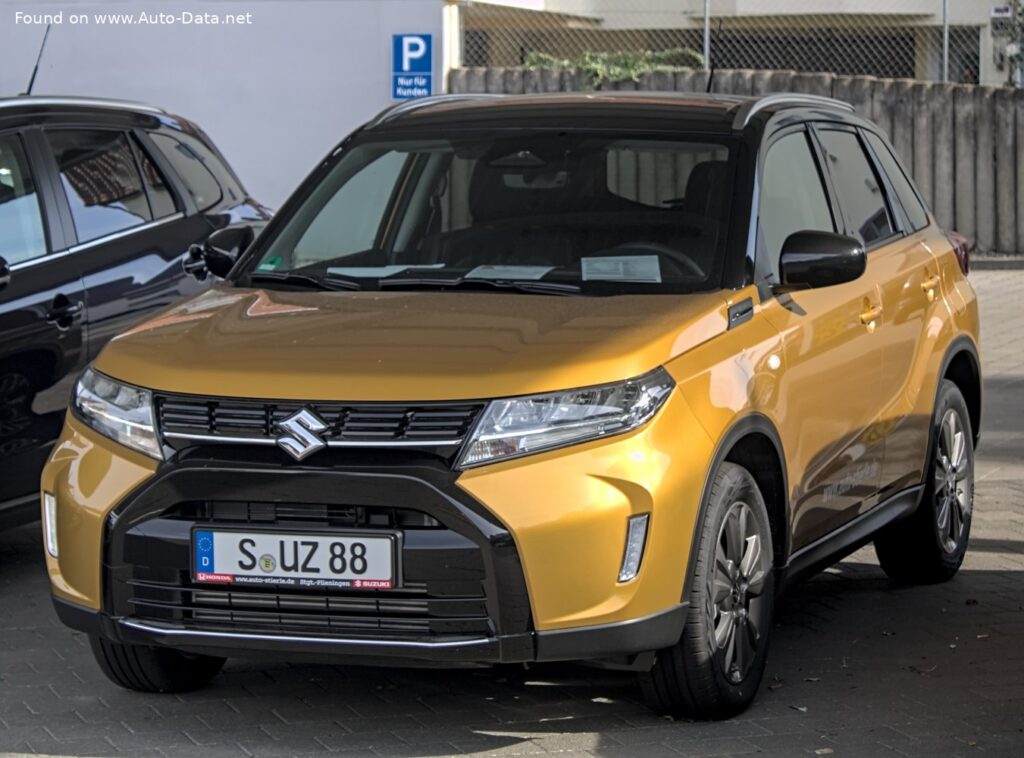
The Suzuki Vitara IV, particularly the 2024 facelifted model featuring the 1.5 DUALJET Full Hybrid powertrain with ALLGRIP AGS, represents Suzuki’s continued commitment to compact, versatile SUVs. Introduced in April 2024, this iteration builds upon the foundation laid by the Vitara IV generation, which debuted in 2015. While the Vitara name has a long history dating back to the 1980s, the IV generation is a distinctly modern vehicle, designed to appeal to buyers seeking a blend of practicality, fuel efficiency, and available all-wheel drive. The 2024 facelift brings updated styling and, crucially, a full hybrid powertrain option, enhancing its appeal in a market increasingly focused on lower emissions and improved fuel economy. This model is primarily sold in European and Asian markets, where compact SUVs are highly popular, offering a compelling alternative to larger, more expensive options.
Suzuki Vitara IV (Facelift 2024): Overview
The Vitara IV (facelift 2024) 1.5 DUALJET Full Hybrid ALLGRIP AGS is positioned as a subcompact SUV, competing with vehicles like the Nissan Juke, Renault Captur, and Peugeot 2008 in its target markets. It distinguishes itself through its standard ALLGRIP Auto four-wheel-drive system (on certain trims) and the availability of a full hybrid powertrain, offering a balance between gasoline engine performance and electric motor assistance. The “AGS” designation refers to Suzuki’s Auto Gear Shift, a type of automated manual transmission designed to improve fuel efficiency and provide a smoother driving experience.
Engine & Performance
The heart of the 2024 Vitara 1.5 DUALJET Full Hybrid is a 1.5-liter naturally aspirated inline-four cylinder gasoline engine (K15C engine code) paired with an electric motor. This combination delivers a total system output of 116 horsepower. The gasoline engine itself produces 102 horsepower at 6000 rpm and 138 Nm (101.78 lb-ft) of torque at 4400 rpm. The electric motor contributes an additional 33 horsepower and 60 Nm (44.25 lb-ft) of torque. The powertrain utilizes a lithium-ion battery, located under the trunk floor, with a voltage of 140V. This Full Hybrid Electric Vehicle (FHEV) architecture allows for short periods of electric-only driving, primarily at low speeds, and provides assistance to the gasoline engine during acceleration, improving fuel economy. The vehicle is equipped with a 6-speed AGS (Auto Gear Shift) automatic transmission. Performance figures include a maximum speed of 175 km/h (108.74 mph) and a weight-to-power ratio of 11.4 kg/Hp.
Design & Features
The 2024 Suzuki Vitara maintains the familiar SUV body style of the IV generation, with the facelift bringing subtle updates to the front fascia, including a revised grille and headlight design. It’s a five-door, five-seater vehicle, offering a practical and spacious interior for its class. Key features include the ALLGRIP Auto all-wheel-drive system, which automatically switches between two-wheel drive and four-wheel drive based on road conditions, enhancing stability and traction. Inside, the Vitara offers a modern infotainment system, though specifics vary by trim level. Safety features are a priority, with standard equipment including ABS (Anti-lock Braking System) and a suite of driver-assistance technologies depending on the trim. Trunk space is a respectable 289 liters (10.21 cu. ft.) with the rear seats up, expanding to 1046 liters (36.94 cu. ft.) when folded down. The vehicle’s dimensions are 4185 mm (164.76 in) in length, 1775 mm (69.88 in) in width, and 1600 mm (62.99 in) in height.
Technical Specifications
| Brand | Suzuki |
| Model | Vitara |
| Generation | Vitara IV (facelift 2024) |
| Type (Engine) | 1.5 DUALJET (116 Hp) Full Hybrid ALLGRIP AGS |
| Start of production | April, 2024 |
| Powertrain Architecture | FHEV (Full Hybrid Electric Vehicle) |
| Body type | SUV |
| Seats | 5 |
| Doors | 5 |
| Fuel consumption at Low speed (WLTP) | 5.6 l/100 km (42 US mpg, 50.4 UK mpg, 17.9 km/l) |
| Fuel consumption at Medium speed (WLTP) | 5.1-5.2 l/100 km (46.1 – 45.2 US mpg, 55.4 – 54.3 UK mpg, 19.6 – 19.2 km/l) |
| Fuel consumption at high speed (WLTP) | 4.9 l/100 km (48 US mpg, 57.6 UK mpg, 20.4 km/l) |
| Fuel consumption at very high speed (WLTP) | 6.5-6.7 l/100 km (36.2 – 35.1 US mpg, 43.5 – 42.2 UK mpg, 15.4 – 14.9 km/l) |
| Combined fuel consumption (WLTP) | 5.6-5.7 l/100 km (42 – 41.3 US mpg, 50.4 – 49.6 UK mpg, 17.9 – 17.5 km/l) |
| CO2 emissions (WLTP) | 126-129 g/km |
| Fuel Type | Petrol (Gasoline) |
| Maximum speed | 175 km/h (108.74 mph) |
| Emission standard | Euro 6d |
| Weight-to-power ratio | 11.4 kg/Hp, 87.9 Hp/tonne |
| Weight-to-torque ratio | 9.6 kg/Nm, 104.5 Nm/tonne |
| Battery voltage | 140 V |
| Battery technology | Lithium-ion (Li-Ion) |
| Battery location | Under the trunk |
| Electric motor power | 33 Hp |
| Electric motor Torque | 60 Nm (44.25 lb.-ft.) |
| Electric motor location | Between the combustion engine and the transmission |
| Electric motor type | Synchronous |
| System power | 116 Hp |
| Power | 102 Hp @ 6000 rpm |
| Torque | 138 Nm @ 4400 rpm (101.78 lb.-ft. @ 4400 rpm) |
| Engine layout | Front, Transverse |
| Engine Model/Code | K15C |
| Engine displacement | 1462 cm3 (89.22 cu. in.) |
| Number of cylinders | 4 |
| Engine configuration | Inline |
| Cylinder Bore | 74 mm (2.91 in.) |
| Piston Stroke | 85 mm (3.35 in.) |
| Compression ratio | 13:1 |
| Number of valves per cylinder | 4 |
| Fuel injection system | Multi-port manifold injection |
| Engine aspiration | Naturally aspirated engine |
| Valvetrain | DOHC, VVT |
| Engine oil capacity | 3.3 l (3.49 US qt | 2.9 UK qt) |
| Coolant | 4.8 l (5.07 US qt | 4.22 UK qt) |
| Kerb Weight | 1320-1347 kg (2910.1 – 2969.63 lbs.) |
| Max. weight | 1770 kg (3902.18 lbs.) |
| Max load | 423-450 kg (932.56 – 992.08 lbs.) |
| Trunk (boot) space – minimum | 289 l (10.21 cu. ft.) |
| Trunk (boot) space – maximum | 1046 l (36.94 cu. ft.) |
| Fuel tank capacity | 47 l (12.42 US gal | 10.34 UK gal) |
| Length | 4185 mm (164.76 in.) |
| Width | 1775 mm (69.88 in.) |
| Height | 1600 mm (62.99 in.) |
| Wheelbase | 2500 mm (98.43 in.) |
| Front track | 1535 mm (60.43 in.) |
| Rear (Back) track | 1505 mm (59.25 in.) |
| Ride height (ground clearance) | 175 mm (6.89 in.) |
| Minimum turning circle (turning diameter) | 10.4 m (34.12 ft.) |
| Drivetrain Architecture | The Internal combustion engine (ICE) and the electric motor permanently drive the front wheels of the vehicle, capable of running in full electric or mixed mode, and if necessary through the electrically or mechanically controlled clutch, the rear wheels are driven. |
| Drive wheel | All wheel drive (4×4) |
| Number of gears and type of gearbox | 6 gears, automatic transmission AGS |
| Front suspension | Coil spring, Independent type McPherson |
| Rear suspension | Coil spring, Torsion |
| Front brakes | Ventilated discs |
| Rear brakes | Disc |