
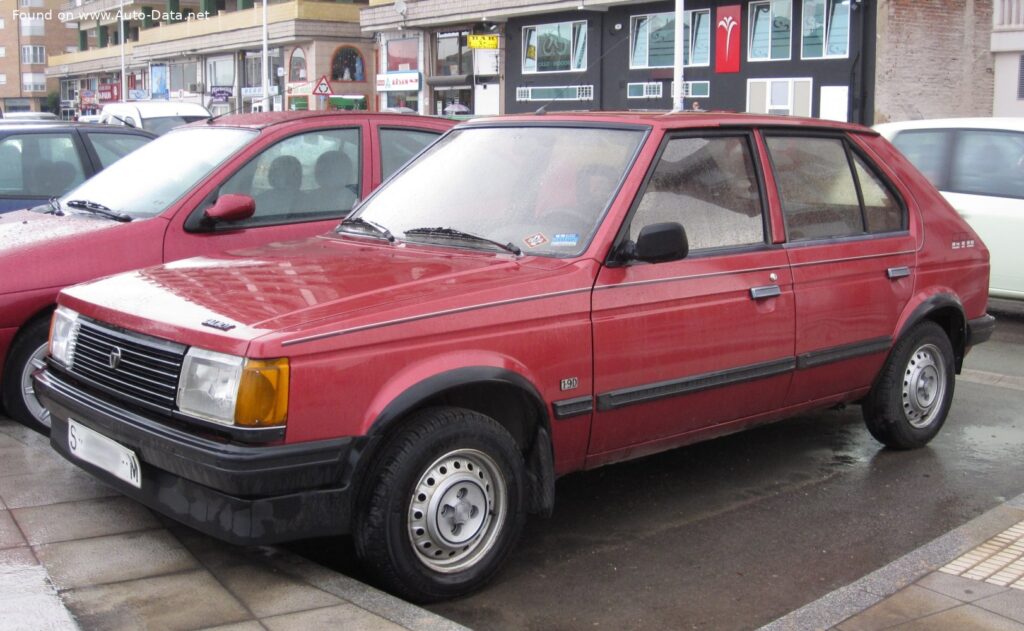
The Talbot Horizon represents a significant, albeit complex, chapter in European automotive history, emerging from a lineage of corporate mergers and rebranding that characterized the late 20th century. This particular variant, the Talbot Horizon 1.9 Diesel (64 Hp), produced between 1984 and 1986, epitomizes the practical, economical motoring prevalent in Europe during its era. Originally conceived under Chrysler Europe as a replacement for the successful Simca 1100, the Horizon project eventually saw the light of day under the revived Talbot marque, following Peugeot S.A.’s acquisition of Chrysler Europe in 1978. Positioned as a compact family hatchback, the Horizon was designed to compete in the highly competitive C-segment, offering a blend of space, affordability, and, with its diesel variants, remarkable fuel efficiency. While never officially sold in the United States, its design and engineering principles were influenced by its transatlantic origins, yet tailored specifically for the demands of the European market, where diesel powerplants were gaining considerable traction due to their economic advantages.
The Evolution and Market Impact of the Talbot Horizon
The original Talbot Horizon was a car with a multifaceted identity, reflecting the turbulent corporate landscape from which it sprang. Its journey began as the “C2” project within Simca, a French subsidiary of Chrysler Europe, aimed at developing a modern compact car. When Peugeot S.A. (PSA) acquired Chrysler Europe, including the Simca and Rootes Group assets, in 1978, they decided to rebrand the entire operation under the historic Talbot nameplate. This move saw the Horizon, which had already launched as the Chrysler-Simca Horizon in 1978, continue its production under the Talbot banner. The car was well-received upon its debut, even winning the prestigious European Car of the Year award in 1979, a testament to its contemporary design and practical attributes. Its success was crucial for the newly resurrected Talbot brand, providing a much-needed volume seller in a market dominated by established players like Volkswagen, Ford, and Renault. The Horizon’s appeal lay in its spacious interior for its class, comfortable ride, and a range of economical engines, including the robust diesel option that became increasingly popular.
The 1.9 Diesel variant, specifically the 64 Hp model produced from 1984 to 1986, arrived late in the Horizon’s production cycle, offering an even more compelling proposition for European buyers prioritizing running costs. During the 1980s, diesel engines were synonymous with durability and low fuel consumption, making them an ideal choice for high-mileage drivers, taxi operators, and families looking to stretch their budgets. The Horizon’s role in its primary market was that of a reliable, no-frills workhorse that delivered on its promise of economical transport. It represented a pragmatic choice for consumers, embodying the spirit of accessible motoring that was a hallmark of the compact car segment in that era. Despite its eventual discontinuation with the demise of the Talbot brand in the late 1980s, the Horizon left an indelible mark as a resilient and well-engineered vehicle that navigated a complex corporate history with surprising success.
Engine and Performance: The Talbot Horizon 1.9 Diesel (64 Hp)
At the heart of the 1984-1986 Talbot Horizon 1.9 Diesel lies a powertrain architecture built around a naturally aspirated internal combustion engine designed for efficiency and longevity. The 1.9-liter diesel engine, producing a modest 64 horsepower, was a workhorse unit, characteristic of European diesel technology of the period. Unlike modern turbocharged diesels that prioritize brisk acceleration, this engine was engineered for smooth, consistent power delivery and exceptional fuel economy, qualities highly valued by its target demographic. The “naturally aspirated” designation means the engine relies solely on atmospheric pressure to draw air into its cylinders, a simpler design that contributes to its renowned reliability and lower manufacturing costs compared to forced induction systems. This simplicity also translated into fewer potential points of failure, making it a favorite among owners who valued dependability over outright performance.
The 64 Hp output, while seemingly low by today’s standards, was entirely adequate for the Horizon’s intended purpose. In a compact hatchback weighing around 2,200 to 2,400 pounds (depending on specification), this engine provided sufficient power for urban commuting and comfortable cruising on European highways, albeit with a more relaxed pace. Acceleration was unhurried, but the engine’s strong torque characteristics at lower RPMs made it tractable in city traffic and capable of handling modest loads without excessive strain. The diesel engine’s inherent efficiency meant that drivers could achieve impressive mileage figures, a critical factor for many European families and businesses in an era of fluctuating fuel prices. Furthermore, the robust construction of these early diesel engines meant they were capable of accumulating hundreds of thousands of miles with proper maintenance, cementing the Horizon’s reputation as a durable and cost-effective vehicle. Its fuel type, diesel, was a clear indicator of its European market focus, where diesel fuel was often more affordable and readily available than gasoline, and diesel vehicles benefited from favorable taxation in many countries.
Design and Features: Practicality in the 1980s
The Talbot Horizon’s design was a quintessential representation of the compact hatchback aesthetic of the late 1970s and early 1980s. Its body type, a five-door hatchback, was a highly practical and popular choice in Europe, offering a versatile blend of passenger space and cargo capacity. The design, penned by Simca’s styling department, prioritized functionality and interior volume over radical aesthetics. It featured clean, straightforward lines, a relatively upright stance, and large glass areas that contributed to good outward visibility, a practical consideration for urban driving. While not overtly sporty, its proportions were well-balanced, and the design aged gracefully, continuing to look relevant through its production run.
Inside, the Horizon continued its theme of practicality. The cabin was designed to be spacious for its class, comfortably accommodating four adults, and the rear seats often featured a split-folding function, further enhancing its versatility for carrying larger items. Materials were durable and hard-wearing, chosen for their ability to withstand the rigors of family use, rather than luxurious appeal. Features, by modern standards, were basic but comprehensive for a compact car of its time. Standard equipment typically included cloth upholstery, a simple heating and ventilation system, and perhaps a basic radio. Power steering, power windows, or air conditioning were often optional extras or reserved for higher trim levels, reflecting the focus on affordability and essential utility. Safety features were also rudimentary compared to contemporary vehicles; standard equipment would have included three-point seatbelts for front occupants and possibly for outboard rear passengers, along with a robust body structure designed to meet the prevailing safety standards of the era. The Horizon’s overall design philosophy was one of honest, unpretentious motoring, providing reliable transport with a focus on interior space and economical operation, making it a staple on European roads for many years.
Technical Specifications: Talbot Horizon 1.9 Diesel (64 Hp)
| Brand | Talbot |
| Model | Horizon |
| Generation | Horizon |
| Type (Engine) | 1.9 Diesel (64 Hp) |
| Start of production | 1984 year |
| End of production | 1986 year |
| Powertrain Architecture | Internal Combustion engine |
| Body type | Hatchback |
| Fuel Type | Diesel |
| Power | 64 Hp |
| Engine aspiration | Naturally aspirated engine |
