
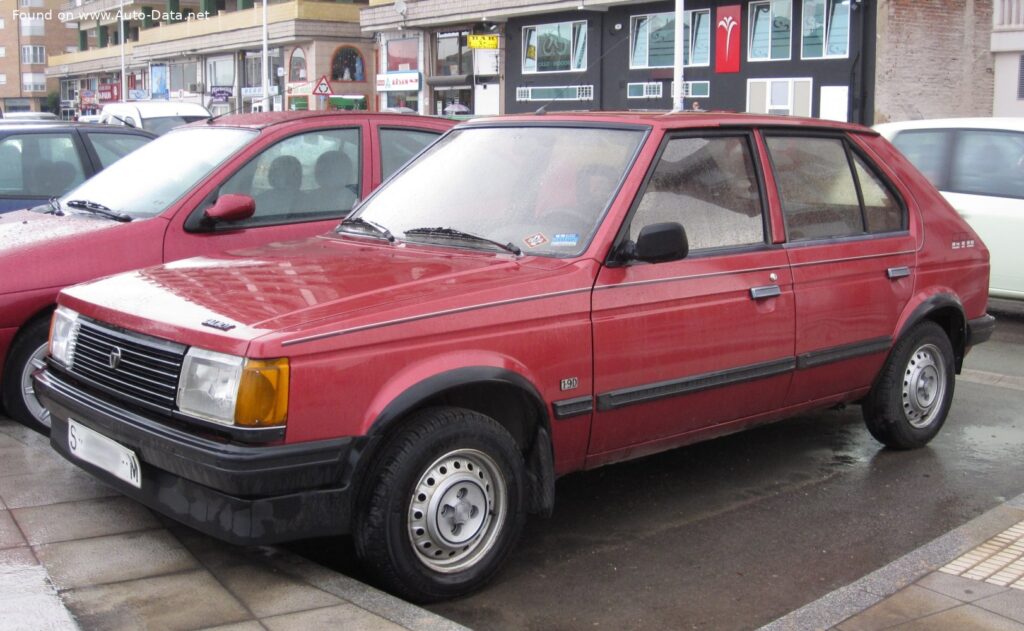
The Talbot Horizon, a compact family car originally conceived as the Chrysler Horizon, represents a significant chapter in the European automotive landscape of the late 1970s and 1980s. Born from Chrysler Europe’s “C2” project, it was designed as a modern, front-wheel-drive hatchback aimed squarely at the burgeoning European compact segment, competing with popular models like the Volkswagen Golf and Ford Escort. Following Chrysler Europe’s acquisition by PSA Peugeot Citroën in 1978, the car was rebranded under the resurrected Talbot marque, launching in 1979. The specific variant, the Talbot Horizon 1.9 Diesel (65 Hp), introduced in 1982, was a testament to the growing demand for fuel-efficient, economical vehicles in Europe, where diesel engines held a much stronger market share than in the United States at the time. This model offered a practical, no-nonsense approach to daily motoring, prioritizing reliability and running costs above outright performance or luxury, a characteristic that defined many European family cars of its era.
The Evolution and Market Impact of the Talbot Horizon
The Horizon’s journey from a Chrysler design to a Talbot product under Peugeot ownership highlights the turbulent and dynamic nature of the European automotive industry in the late 20th century. While never officially sold in the United States under the Talbot badge (an unrelated, larger Dodge Omni/Plymouth Horizon was sold there), the European Talbot Horizon played a crucial role in its primary markets. It was lauded for its spacious interior, comfortable ride, and practical hatchback configuration, making it a popular choice for families and fleet operators alike. Its “Car of the Year” award in Europe for 1979 underscored its initial promise and contemporary design. The introduction of diesel variants, particularly the 1.9-liter engine, significantly broadened its appeal, offering a compelling alternative to gasoline-powered cars amidst rising fuel prices and increased environmental consciousness in Europe. This focus on economy was a strategic move by Peugeot-Talbot to capture a segment of the market that valued long-term running costs.
Powertrain and Performance: The Talbot Horizon 1.9 Diesel (65 Hp)
At the heart of the 1982-1986 Talbot Horizon 1.9 Diesel model was its robust 1.9-liter (1897 cubic centimeters) naturally aspirated inline-four diesel engine. This powerplant, delivering a modest but adequate 65 horsepower (Hp), was a testament to the engineering philosophy of the time: reliability and fuel economy over spirited performance. Unlike modern turbocharged diesel engines, this unit relied solely on atmospheric pressure for air intake, resulting in a linear, predictable power delivery characteristic of many diesels from the era. The engine’s strength lay in its torque production at lower RPMs, providing sufficient pulling power for city driving and comfortable cruising on European highways, albeit without rapid acceleration. Mated primarily to a manual transmission (though automatic options were available for other Horizon variants), the 1.9 Diesel offered a driving experience focused on practicality.
While 65 Hp might seem low by today’s standards, it was competitive for a compact diesel family car in the early 1980s. For context, many gasoline engines of similar displacement from that period produced only marginally more power, often at higher RPMs. The diesel’s advantage was its superior fuel efficiency, making it an attractive option in countries like France, where diesel fuel was often cheaper and consumption was a primary concern for buyers. The engine was known for its durability and straightforward mechanical design, contributing to lower maintenance costs and a long service life, characteristics highly valued by consumers looking for an economical daily driver. Its performance, while not exciting, was entirely competent for the car’s intended purpose, providing reliable and economical transport for the average European family.
Design and Features: Practicality Personified
The Talbot Horizon’s design epitomized the functional aesthetic prevalent in European compact hatchbacks of its time. Its two-box, five-door hatchback body offered excellent practicality, a hallmark of the segment. The design was clean, uncluttered, and emphasized interior space and accessibility. With its relatively short wheelbase and efficient packaging, the Horizon provided surprising passenger room for its exterior dimensions, particularly in the rear seats, which could comfortably accommodate adults. The large tailgate and folding rear seats further enhanced its versatility, allowing for easy loading of luggage or larger items, making it ideal for family trips or hauling groceries.
Inside, the Horizon’s cabin was utilitarian but well-thought-out. Dashboards were typically functional, with clear instrumentation and logically placed controls, reflecting the era’s focus on ergonomics over elaborate styling. Materials, while not luxurious, were chosen for durability and ease of cleaning, standing up to the rigors of family life. Safety features, by early 1980s standards, included robust body construction and front and rear seatbelts. While lacking the advanced active and passive safety systems of modern vehicles, the Horizon was designed to meet the prevailing safety regulations of its time, offering a reasonable level of protection for its occupants. Its straightforward mechanicals and robust construction contributed to its reputation for reliability and ease of repair, making it an accessible and dependable choice for a wide range of buyers.
Beyond its core functionality, the Talbot Horizon also offered various trim levels across its production run, though the 1.9 Diesel often leaned towards more basic or mid-range specifications, aligning with its economical positioning. Features might have included items like a radio-cassette player, cloth upholstery, and perhaps a sunroof on higher trims, but the emphasis remained on core functionality and value. The car’s enduring appeal in its home markets was largely due to this blend of practicality, economy, and robust engineering, making it a workhorse for many European households.
Technical Specifications: Talbot Horizon 1.9 Diesel (65 Hp)
Below is a detailed breakdown of the key technical specifications for the Talbot Horizon 1.9 Diesel (65 Hp) model, produced between 1982 and 1986. This data highlights the core engineering principles that underpinned this economical European hatchback.
| Brand | Talbot |
| Model | Horizon |
| Generation | Horizon |
| Type (Engine) | 1.9 Diesel (65 Hp) |
| Start of production | 1982 year |
| End of production | 1986 year |
| Powertrain Architecture | Internal Combustion engine |
| Body type | Hatchback |
| Fuel Type | Diesel |
| Power | 65 Hp |
| Engine aspiration | Naturally aspirated engine |
