
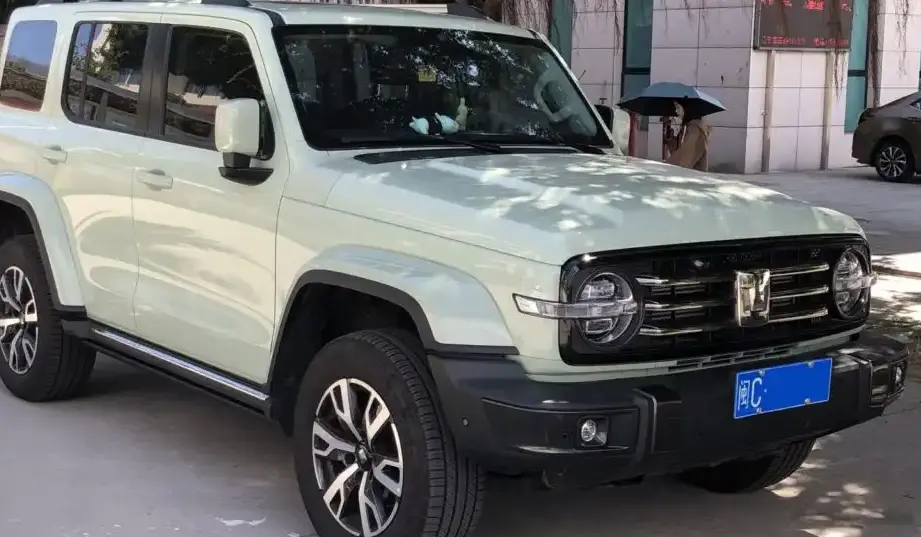
The Tank 300 2.0T Hybrid 4WD Automatic, launched in 2022, represents a significant entry into the growing market of rugged, off-road capable SUVs. Produced by Tank, a sub-brand of Great Wall Motors, the 300 is specifically designed for the Chinese domestic market, but has begun to see limited export availability. This particular variant, featuring a 2.0-liter turbocharged engine paired with a 48-volt mild-hybrid system and a 9-speed automatic transmission, occupies a mid-to-upper position within the 300 lineup, offering a balance of performance, fuel efficiency, and off-road capability. It’s positioned above the base gasoline models and below potential future high-performance trims.
Technical Specifications
| Brand | Tank |
| Model | 300 |
| Generation | 300 |
| Type (Engine) | 2.0T (351 Hp) Hybrid 4WD Automatic |
| Start of production | 2022 |
| Powertrain Architecture | FHEV (Full Hybrid Electric Vehicle) |
| Body type | SUV |
| Seats | 5 |
| Doors | 5 |
| Fuel consumption (combined) | 8.4 l/100 km (28 US mpg, 33.6 UK mpg, 11.9 km/l) |
| Fuel Type | Petrol (Gasoline) |
| Emission standard | Euro 5 |
| Weight-to-power ratio | 6.6 kg/Hp, 151.8 Hp/tonne |
| Weight-to-torque ratio | 3.8 kg/Nm, 265.9 Nm/tonne |
| Battery technology | Lithium-ion (Li-Ion) |
| Electric motor power | 106 Hp |
| Electric motor Torque | 268 Nm (197.67 lb.-ft.) |
| Electric motor location | Between the combustion engine and the transmission |
| Electric motor type | Synchronous |
| System power | 351 Hp |
| System torque | 615 Nm (453.6 lb.-ft.) |
| Power | 245 Hp @ 5500-6000 rpm |
| Torque | 380 Nm @ 1700-4000 rpm (280.27 lb.-ft. @ 1700-4000 rpm) |
| Engine layout | Front, Longitudinal |
| Engine Model/Code | E20NA |
| Engine displacement | 1998 cm3 (121.93 cu. in.) |
| Number of cylinders | 4 |
| Engine configuration | Inline |
| Cylinder Bore | 82 mm (3.23 in.) |
| Piston Stroke | 94.6 mm (3.72 in.) |
| Compression ratio | 11:1 |
| Number of valves per cylinder | 4 |
| Fuel injection system | Direct injection |
| Engine aspiration | Turbocharger, Intercooler |
| Valvetrain | DOHC |
| Engine oil capacity | 5.9 l (6.23 US qt | 5.19 UK qt) |
| Kerb Weight | 2313 kg (5099.29 lbs.) |
| Max. weight | 2753 kg (6069.33 lbs.) |
| Max load | 440 kg (970.03 lbs.) |
| Fuel tank capacity | 75 l (19.81 US gal | 16.5 UK gal) |
| Permitted trailer load with brakes (12%) | 2500 kg (5511.56 lbs.) |
| Permitted trailer load without brakes | 750 kg (1653.47 lbs.) |
| Length | 4760 mm (187.4 in.) |
| Width | 1930 mm (75.98 in.) |
| Height | 1903 mm (74.92 in.) |
| Wheelbase | 2750 mm (108.27 in.) |
| Front track | 1608 mm (63.31 in.) |
| Rear track | 1608 mm (63.31 in.) |
| Ride height (ground clearance) | 224 mm (8.82 in.) |
| Minimum turning circle | 12 m (39.37 ft.) |
| Approach angle | 33° |
| Departure angle | 34° |
| Wading depth | 700 mm (27.56 in.) |
| Drivetrain Architecture | ICE and electric motor drive rear wheels, front wheels engaged via clutch |
| Drive wheel | All wheel drive (4×4) |
| Number of gears | 9 |
| Gearbox type | Automatic transmission |
| Front suspension | Double wishbone, Independent coil spring, Transverse stabilizer |
| Rear suspension | Dependent spring suspension, Transverse stabilizer |
| Front brakes | Ventilated discs |
| Rear brakes | Ventilated discs |
| Assisting systems | ABS (Anti-lock braking system) |
| Steering type | Steering rack and pinion |
| Power steering | Electric Steering |
| Tires size | 265/65 R17 |
| Wheel rims size | 17 |
Powertrain & Engine Architecture
The heart of the Tank 300 2.0T Hybrid is the E20NA 2.0-liter inline-four cylinder turbocharged gasoline engine. This engine utilizes direct fuel injection and a double overhead camshaft (DOHC) valvetrain to optimize combustion efficiency and power output. The turbocharger, coupled with an intercooler, helps to mitigate turbo lag and maintain consistent power delivery. The engine produces 245 horsepower and 280 lb-ft of torque on its own. Crucially, this engine is paired with a 48-volt mild-hybrid system. This system incorporates an electric motor integrated between the engine and the 9-speed automatic transmission. The electric motor contributes an additional 106 horsepower and 198 lb-ft of torque, bringing the total system output to 351 horsepower and 454 lb-ft of torque. The 9-speed automatic transmission is sourced from ZF, known for its smooth shifting and wide gear ratio spread, contributing to both on-road refinement and off-road crawling capability.
Driving Characteristics
The 2.0T Hybrid powertrain delivers a surprisingly refined driving experience for a vehicle of this type. The electric motor provides instant torque, filling in gaps in the turbocharger’s powerband and resulting in brisk acceleration. The 9-speed automatic transmission is well-tuned, offering smooth and timely gear changes. While not a sports car, the Tank 300 2.0T Hybrid feels adequately powered for highway cruising and passing maneuvers. Off-road, the combination of the 4WD system, ample ground clearance (8.82 inches), and the low-end torque provided by the electric motor makes it a capable performer on challenging terrain. Compared to lower-trim gasoline-only versions, the hybrid offers a noticeable improvement in responsiveness and overall power. The hybrid system also contributes to improved fuel economy, although the Tank 300 remains a relatively heavy vehicle.
Equipment & Trim Levels
The Tank 300 2.0T Hybrid typically comes well-equipped, reflecting its position as a mid-to-upper trim level. Standard features generally include leather upholstery, a large touchscreen infotainment system with Apple CarPlay and Android Auto compatibility, a panoramic sunroof, automatic climate control, and a suite of advanced driver-assistance systems (ADAS) such as adaptive cruise control, lane departure warning, and automatic emergency braking. Optional extras may include upgraded audio systems, premium interior trim materials, and specialized off-road equipment like a winch and upgraded tires. The interior design emphasizes a rugged, utilitarian aesthetic with durable materials and intuitive controls.
Chassis & Braking
The Tank 300 utilizes a body-on-frame construction, providing a robust and durable platform for off-road use. The front suspension consists of a double wishbone independent setup with coil springs and a transverse stabilizer bar, while the rear suspension employs a dependent spring suspension, also with a transverse stabilizer bar. This configuration balances ride comfort with off-road articulation. The braking system features ventilated discs on all four wheels, providing ample stopping power. An Anti-lock Braking System (ABS) is standard, enhancing safety and control during emergency braking situations.
Market Reception & Comparison
The Tank 300 has been well-received in the Chinese market, where it has quickly gained popularity among buyers seeking a capable and stylish off-road SUV. Critics have praised its robust construction, comfortable interior, and impressive off-road performance. The 2.0T Hybrid variant is particularly appreciated for its improved fuel efficiency and enhanced power delivery compared to the base gasoline models. Compared to competitors like the Jeep Wrangler and Toyota 4Runner (which are not widely available in China), the Tank 300 offers a more modern and refined driving experience, albeit with a slightly less established off-road pedigree.
Legacy
As a relatively new vehicle, the long-term reliability of the Tank 300 2.0T Hybrid powertrain remains to be fully assessed. However, the components used – the ZF transmission and the Great Wall Motors engine – have a generally good reputation for durability. The hybrid system, while relatively simple, could present potential long-term maintenance challenges. On the used car market, the Tank 300 is expected to hold its value reasonably well, particularly among enthusiasts seeking a capable and unique off-road vehicle. Its combination of modern technology, rugged styling, and impressive performance positions it as a compelling option in the growing segment of adventure-focused SUVs.
