
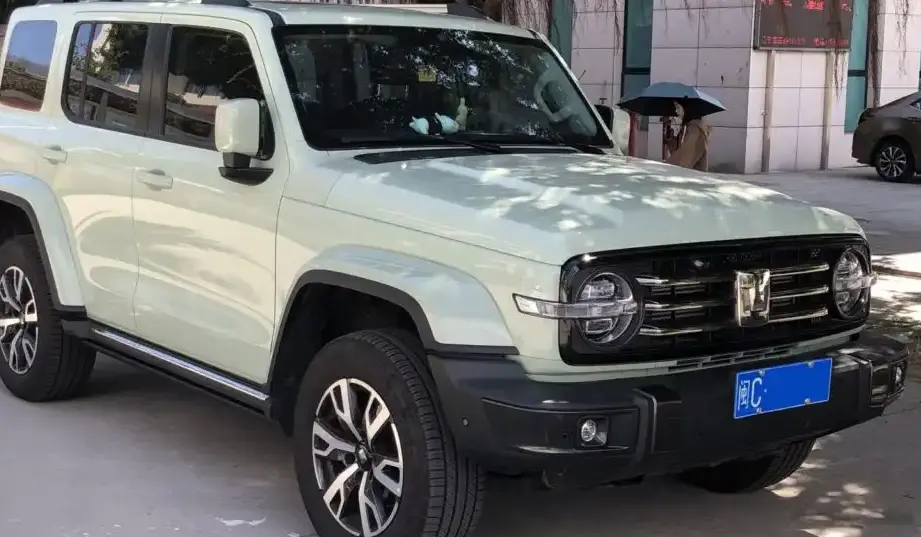
The Tank 300 Hi4-T 2.0T, introduced in April 2024, represents a significant step in the Tank brand’s expansion into the plug-in hybrid electric vehicle (PHEV) market. As a derivative of the larger Tank 300 SUV family, this variant combines a 2.0-liter turbocharged gasoline engine with a 37.1 kWh battery pack and an electric motor, delivering a combined system output of 408 horsepower. Positioned as a premium offering within the 300 lineup, the Hi4-T aims to provide both off-road capability and enhanced fuel efficiency, appealing to buyers seeking a versatile and technologically advanced SUV. It is primarily targeted towards the Chinese domestic market, where demand for both SUVs and new energy vehicles is rapidly growing.
Technical Specifications
| Brand | Tank |
| Model | 300 |
| Generation | 300 |
| Type (Engine) | Hi4-T 2.0T 37.1 kWh (408 Hp) Plug-in Hybrid 4WD Automatic |
| Start of production | April, 2024 |
| Powertrain Architecture | PHEV (Plug-in Hybrid Electric Vehicle) |
| Body type | SUV |
| Seats | 5 |
| Doors | 5 |
| Fuel consumption (economy) – combined (WLTC) | 2.06-8.8 l/100 km (114.2 – 26.7 US mpg, 137.1 – 32.1 UK mpg, 48.5 – 11.4 km/l) |
| Fuel Type | Petrol / electricity |
| Acceleration 0 – 100 km/h | 6.7 sec |
| Acceleration 0 – 62 mph | 6.7 sec |
| Acceleration 0 – 60 mph | 6.4 sec |
| Maximum speed | 180 km/h (111.85 mph) |
| Emission standard | China VI b |
| Weight-to-power ratio | 6.5 kg/Hp, 154.3 Hp/tonne |
| Weight-to-torque ratio | 3.5 kg/Nm, 283.6 Nm/tonne |
| Gross battery capacity | 37.1 kWh |
| Battery voltage | 325.6 V |
| Battery technology | Lithium nickel manganese cobalt oxides (Li-NMC) |
| All-electric range (WLTC) | 105 km (65.24 mi) |
| Average Energy consumption (WLTC) | 27.6 kWh/100 km (44.42 kWh/100 mi, 76 MPGe, 3.6 km/kWh, 2.3 mi/kWh) |
| Electric motor power | 163 Hp |
| Electric motor Torque | 400 Nm (295.02 lb.-ft.) |
| Electric motor model/code | TZ290XH001 |
| Maximum revolutions of the electric motor | 7000 rpm |
| Electric motor location | Between the combustion engine and the transmission |
| Electric motor type | Synchronous |
| System power | 408 Hp |
| System torque | 750 Nm (553.17 lb.-ft.) |
| Power | 252 Hp @ 6000 rpm |
| Torque | 385 Nm @ 1700-4000 rpm (283.96 lb.-ft. @ 1700-4000 rpm) |
| Engine layout | Front, Longitudinal |
| Engine Model/Code | E20NB |
| Engine displacement | 1998 cm3 (121.93 cu. in.) |
| Number of cylinders | 4 |
| Engine configuration | Inline |
| Cylinder Bore | 82 mm (3.23 in.) |
| Piston Stroke | 94.6 mm (3.72 in.) |
| Number of valves per cylinder | 4 |
| Fuel injection system | Direct injection |
| Engine aspiration | Turbocharger, Intercooler |
| Valvetrain | DOHC |
| Engine oil capacity | 5.9 l (6.23 US qt | 5.19 UK qt) |
| Coolant | 9.4 l (9.93 US qt | 8.27 UK qt) |
| Kerb Weight | 2645 kg (5831.23 lbs.) |
| Max. weight | 3085 kg (6801.26 lbs.) |
| Max load | 440 kg (970.03 lbs.) |
| Fuel tank capacity | 70 l (18.49 US gal | 15.4 UK gal) |
| Permitted trailer load with brakes (12%) | 2500 kg (5511.56 lbs.) |
| Length | 4750 mm (187.01 in.) |
| Width | 1930 mm (75.98 in.) |
| Height | 1903 mm (74.92 in.) |
| Wheelbase | 2750 mm (108.27 in.) |
| Front track | 1608 mm (63.31 in.) |
| Rear (Back) track | 1608 mm (63.31 in.) |
| Ride height (ground clearance) | 222 mm (8.74 in.) |
| Approach angle | 32° |
| Departure angle | 33° |
| Ramp-over (brakeover) angle | 22° |
| Climb angle | 36.9° |
| Wading depth | 700 mm (27.56 in.) |
| Drivetrain Architecture | The Internal combustion engine (ICE) and the electric motor permanently drive the rear wheels of the vehicle, capable of running in full electric or mixed mode, and if necessary through the electrically or mechanically controlled clutch, the front wheels are driven. |
| Drive wheel | All wheel drive (4×4) |
| Number of gears and type of gearbox | 9 gears, automatic transmission |
| Front suspension | Double wishbone, Independent coil spring, Transverse stabilizer |
| Rear suspension | dependent spring suspension, Transverse stabilizer |
| Front brakes | Ventilated discs |
| Rear brakes | Ventilated discs |
| Assisting systems | ABS (Anti-lock braking system) |
| Steering type | Steering rack and pinion |
| Power steering | Electric Steering |
| Tires size | 265/60 R18 |
| Wheel rims size | 18 |
Powertrain & Engine Architecture
The Tank 300 Hi4-T’s powertrain centers around the E20NB 2.0-liter inline-four cylinder turbocharged engine. This engine utilizes direct fuel injection and a double overhead camshaft (DOHC) valvetrain to optimize combustion efficiency and power output. The turbocharger, coupled with an intercooler, helps to mitigate turbo lag and maintain consistent power delivery. The engine produces 252 horsepower at 6000 rpm and 385 Nm (283.96 lb-ft) of torque between 1700 and 4000 rpm. Complementing the gasoline engine is a 37.1 kWh lithium nickel manganese cobalt oxide (Li-NMC) battery pack and a 163 hp electric motor. The electric motor is positioned between the engine and the transmission, allowing for seamless integration of electric and gasoline power. The combined system output reaches 408 horsepower and 750 Nm (553.17 lb-ft) of torque. Power is delivered to all four wheels via a sophisticated 9-speed automatic transmission, optimized for both on-road comfort and off-road performance.
Driving Characteristics
The Hi4-T offers a unique driving experience, blending the responsiveness of an electric motor with the range and refueling convenience of a gasoline engine. In pure electric mode, the vehicle provides near-silent operation and instant torque, making it ideal for urban driving. The 105 km (65.24 mi) all-electric range allows for daily commutes without relying on gasoline. When the gasoline engine engages, the transition is smooth and largely imperceptible. The combined power output of 408 hp results in brisk acceleration, with a 0-100 km/h time of 6.7 seconds. The 9-speed automatic transmission provides smooth gear changes, and the all-wheel-drive system ensures confident traction in various conditions. Compared to lower-powered Tank 300 variants, the Hi4-T offers significantly enhanced performance, while maintaining a respectable level of fuel efficiency.
Equipment & Trim Levels
The Tank 300 Hi4-T is typically equipped with a comprehensive suite of standard features, reflecting its premium positioning. These include leather upholstery, a large touchscreen infotainment system with smartphone integration, advanced driver-assistance systems (ADAS) such as adaptive cruise control and lane-keeping assist, and a panoramic sunroof. Optional extras may include upgraded audio systems, premium interior trim materials, and specialized off-road equipment. The interior design emphasizes both comfort and functionality, with a focus on durable materials and intuitive controls.
Chassis & Braking
The Tank 300 Hi4-T utilizes a robust chassis designed to handle both on-road and off-road driving. The front suspension features a double wishbone setup with independent coil springs and a transverse stabilizer bar, while the rear suspension employs a dependent spring suspension with a transverse stabilizer bar. This configuration provides a balance of ride comfort and off-road articulation. The braking system consists of ventilated discs on all four wheels, coupled with an anti-lock braking system (ABS) for enhanced safety. The vehicle’s high ground clearance (222 mm / 8.74 in) and impressive approach, departure, and ramp-over angles contribute to its off-road prowess.
Market Reception & Comparison
The Tank 300 Hi4-T has been well-received in the Chinese market, where it competes with other plug-in hybrid SUVs. Critics have praised its combination of performance, fuel efficiency, and off-road capability. Compared to non-hybrid Tank 300 variants, the Hi4-T offers superior fuel economy and a more refined driving experience. However, it also carries a higher price tag. The Hi4-T’s fuel consumption ranges from 2.06 to 8.8 l/100 km, depending on driving conditions and battery charge level. Its all-electric range of 105 km is competitive within its segment.
Legacy
As a relatively new model, the long-term reliability of the Tank 300 Hi4-T powertrain remains to be fully assessed. However, the combination of a proven 2.0-liter turbocharged engine and a modern electric powertrain suggests a high level of durability. The vehicle’s popularity in the Chinese market indicates a strong demand for plug-in hybrid SUVs with off-road capability. The Hi4-T is expected to play a significant role in Tank’s brand expansion and its transition towards a more sustainable future.
