
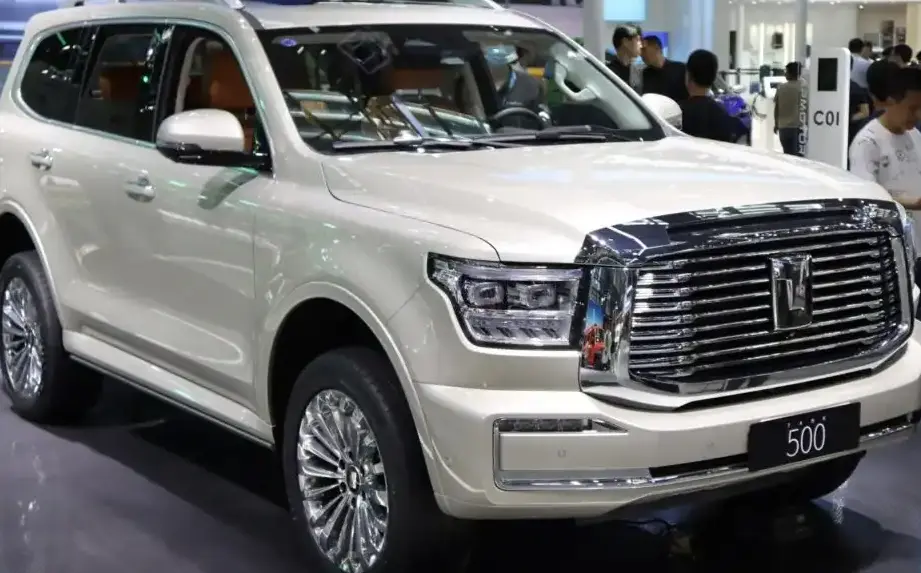
The Tank 500 2.0T Hybrid 4WD Automatic, launched in September 2023, represents a significant entry into the growing market of rugged, luxury SUVs. Produced by Tank, a sub-brand of Great Wall Motors, the 500 is designed to appeal to consumers seeking off-road capability combined with modern technology and comfort. This particular variant, featuring a 2.0-liter turbocharged engine paired with a hybrid system and a 9-speed automatic transmission, positions itself as a compelling alternative to established players in the full-size SUV segment. The Tank 500 is primarily targeted towards the Chinese domestic market, but export plans are underway, aiming to establish a global presence. It’s built on a dedicated body-on-frame platform, emphasizing durability and off-road prowess.
Technical Specifications
| Brand | Tank |
| Model | 500 |
| Generation | 500 |
| Type (Engine) | 2.0T (346 Hp) Hybrid 4WD Automatic |
| Start of production | September, 2023 |
| Powertrain Architecture | FHEV (Full Hybrid Electric Vehicle) |
| Body type | SUV |
| Seats | 7 |
| Doors | 5 |
| Fuel consumption (economy) – combined | 8.5 l/100 km |
| Fuel consumption (economy) – combined | 27.7 US mpg |
| Fuel consumption (economy) – combined | 33.2 UK mpg |
| Fuel consumption (economy) – combined | 11.8 km/l |
| CO2 emissions | 199 g/km |
| Fuel Type | Petrol (Gasoline) |
| Acceleration 0 – 100 km/h | 8.3 sec |
| Acceleration 0 – 62 mph | 8.3 sec |
| Acceleration 0 – 60 mph | 7.9 sec |
| Emission standard | Euro 5 |
| Weight-to-power ratio | 7.5 kg/Hp |
| Weight-to-power ratio | 132.8 Hp/tonne |
| Weight-to-torque ratio | 4 kg/Nm |
| Weight-to-torque ratio | 248.8 Nm/tonne |
| Battery technology | Lithium-ion (Li-Ion) |
| Electric motor power | 106 Hp |
| Electric motor Torque | 268 Nm / 197.67 lb.-ft. |
| Electric motor location | Between the combustion engine and the transmission |
| Electric motor type | Synchronous |
| System power | 346 Hp |
| System torque | 648 Nm / 477.94 lb.-ft. |
| Power | 244 Hp @ 5500-6000 rpm |
| Power per litre | 122.1 Hp/l |
| Torque | 380 Nm @ 1700-4000 rpm / 280.27 lb.-ft. @ 1700-4000 rpm |
| Engine layout | Front, Longitudinal |
| Engine displacement | 1998 cm3 / 121.93 cu. in. |
| Number of cylinders | 4 |
| Engine configuration | Inline |
| Cylinder Bore | 82 mm / 3.23 in. |
| Piston Stroke | 94.6 mm / 3.72 in. |
| Compression ratio | 11:1 |
| Number of valves per cylinder | 4 |
| Fuel injection system | Direct injection |
| Engine aspiration | Turbocharger, Intercooler |
| Valvetrain | DOHC |
| Engine oil capacity | 5.9 l / 6.23 US qt | 5.19 UK qt |
| Kerb Weight | 2605 kg / 5743.04 lbs. |
| Max. weight | 3395 kg / 7484.69 lbs. |
| Max load | 790 kg / 1741.65 lbs. |
| Trunk (boot) space – minimum | 98 l / 3.46 cu. ft. |
| Trunk (boot) space – maximum | 1489 l / 52.58 cu. ft. |
| Fuel tank capacity | 75 l / 19.81 US gal | 16.5 UK gal |
| Permitted trailer load with brakes (12%) | 3000 kg / 6613.87 lbs. |
| Permitted trailer load without brakes | 750 kg / 1653.47 lbs. |
| Length | 5078 mm / 199.92 in. |
| Width | 1934 mm / 76.14 in. |
| Height | 1905 mm / 75 in. |
| Wheelbase | 2850 mm / 112.2 in. |
| Front track | 1635 mm / 64.37 in. |
| Rear (Back) track | 1635 mm / 64.37 in. |
| Ride height (ground clearance) | 224 mm / 8.82 in. |
| Minimum turning circle (turning diameter) | 11.2 m / 36.75 ft. |
| Approach angle | 30° |
| Departure angle | 24° |
| Ramp-over (brakeover) angle | 22.5° |
| Climb angle | 36.9° |
| Wading depth | 800 mm / 31.5 in. |
| Drivetrain Architecture | The Internal combustion engine (ICE) and the electric motor permanently drive the rear wheels of the vehicle, capable of running in full electric or mixed mode, and if necessary through the electrically or mechanically controlled clutch, the front wheels are driven. |
| Drive wheel | All wheel drive (4×4) |
| Number of gears and type of gearbox | 9 gears, automatic transmission |
| Front suspension | Double wishbone, Independent coil spring, Transverse stabilizer |
| Rear suspension | Rigid axle suspension, Transverse stabilizer, Coil spring |
| Front brakes | Ventilated discs |
| Rear brakes | Ventilated discs |
| Assisting systems | ABS (Anti-lock braking system) |
| Steering type | Steering rack and pinion |
| Power steering | Electric Steering |
| Tires size | 265/60 R18; 265/50 R20 |
| Wheel rims size | 8J x 18; 8.5J x 20 |
Powertrain & Engine Architecture
The heart of the Tank 500 2.0T is a 2.0-liter inline-four cylinder turbocharged gasoline engine. This engine, internally designated with specific codes dependent on the market, utilizes direct fuel injection and a double overhead camshaft (DOHC) valvetrain to optimize combustion efficiency and power output. The turbocharger, coupled with an intercooler, helps to mitigate turbo lag and maintain consistent boost pressure across the rev range. The engine produces 244 horsepower at 5500-6000 rpm and 280.27 lb-ft of torque between 1700-4000 rpm. This is then supplemented by an electric motor producing 106 hp and 197.67 lb-ft of torque. The combined system output reaches 346 hp and 477.94 lb-ft of torque. The electric motor is strategically positioned between the engine and the transmission. The 9-speed automatic transmission is a crucial component, providing smooth and efficient gear changes. It’s designed to handle the combined output of the engine and electric motor, delivering power to all four wheels via a sophisticated all-wheel-drive system.
Driving Characteristics
The Tank 500 2.0T Hybrid offers a surprisingly refined driving experience for a vehicle of its size and capability. The hybrid system provides instant torque, resulting in brisk acceleration – 0-60 mph in approximately 7.9 seconds. The 9-speed automatic transmission contributes to smooth power delivery, although some drivers may notice occasional hunting for the optimal gear in certain driving situations. Compared to potential higher-output variants (if offered), the 2.0T provides a balance between performance and fuel efficiency. While not as overtly powerful, it offers sufficient power for everyday driving and confident highway cruising. The all-wheel-drive system, combined with the vehicle’s robust suspension, provides excellent traction and stability, both on and off-road.
Equipment & Trim Levels
The Tank 500 2.0T Hybrid typically comes well-equipped, reflecting its positioning as a premium SUV. Standard features generally include leather upholstery, a large touchscreen infotainment system with navigation, a panoramic sunroof, and a comprehensive suite of advanced driver-assistance systems (ADAS). Optional extras may include upgraded audio systems, ventilated and massaging front seats, and more sophisticated off-road features like locking differentials and terrain management systems. Interior trim levels vary, offering different color schemes and material choices.
Chassis & Braking
The Tank 500 utilizes a body-on-frame construction, providing a robust and durable chassis. The front suspension employs a double wishbone setup with independent coil springs and a transverse stabilizer bar, while the rear features a rigid axle suspension with coil springs and a transverse stabilizer bar. This configuration is designed to provide a comfortable ride while maintaining excellent off-road capability. The braking system consists of ventilated discs on all four wheels, coupled with an anti-lock braking system (ABS) and electronic brake-force distribution (EBD) for enhanced safety.
Market Reception & Comparison
The Tank 500 has been well-received in the Chinese market, where it has quickly gained popularity among consumers seeking a capable and luxurious SUV. Critics have praised its off-road performance, comfortable ride, and well-appointed interior. Compared to other trims within the Tank 500 lineup (should they become available), the 2.0T Hybrid offers a compelling balance between performance, fuel efficiency, and price. It provides a more economical option than potential higher-output engines, while still delivering ample power and capability for most drivers.
Legacy
As a relatively new vehicle, the long-term reliability of the Tank 500 2.0T Hybrid remains to be fully established. However, Great Wall Motors has a growing reputation for building durable and reliable vehicles. The combination of a modern turbocharged engine, a hybrid system, and a robust chassis suggests that the Tank 500 has the potential to become a long-lasting and dependable SUV. In the used car market, the 2.0T Hybrid is expected to hold its value well, particularly among buyers seeking a capable and well-equipped off-road vehicle.

