
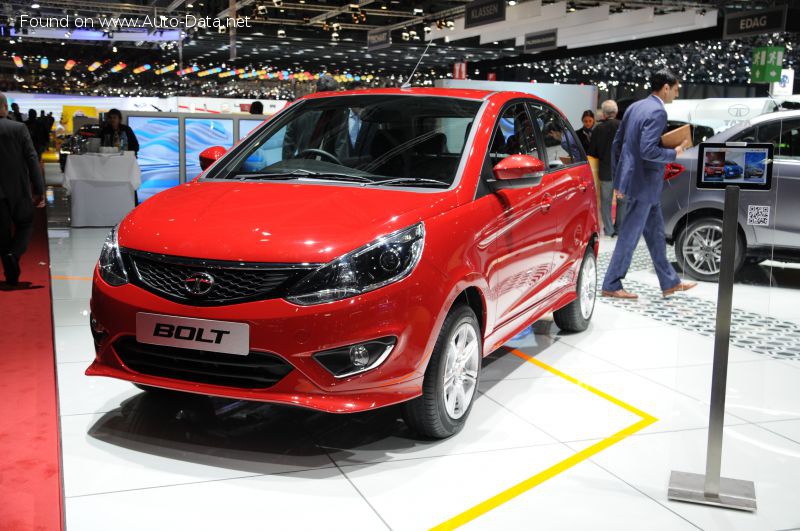
The Tata Bolt 1.2 T (90 Hp) is a subcompact hatchback produced by the Indian manufacturer Tata Motors from 2014 to 2019. Designed as a successor to the Tata Vista, the Bolt represented a significant step forward for Tata in terms of design, features, and overall refinement. While not officially sold in the United States, the Bolt was a key model for Tata in the Indian market, competing with established players like the Maruti Suzuki Swift and Hyundai Grand i10. It aimed to offer a more modern and feature-rich alternative within the affordable hatchback segment.
The Tata Bolt 1.2 T: A Detailed Overview
The Bolt was part of Tata Motors’ ‘Horizon Next’ strategy, which focused on developing vehicles with improved design and technology. The 1.2 T variant, powered by a turbocharged petrol engine, was positioned as the performance-oriented option within the Bolt lineup. It offered a balance between fuel efficiency and adequate power for urban and highway driving. The vehicle was primarily targeted at young, urban consumers seeking a stylish and practical hatchback.
Engine & Performance
The heart of the Tata Bolt 1.2 T is a 1.2-liter, inline-four cylinder petrol engine equipped with a turbocharger and intercooler. This engine produces 90 horsepower at 5000 rpm and 140 Nm (103.26 lb.-ft.) of torque between 1500 and 4000 rpm. The turbocharging provides a noticeable boost in performance, improving acceleration and making overtaking easier. The engine features multi-port fuel injection and a single overhead camshaft (SOHC) valvetrain. Power per liter is rated at 75.4 hp/l, indicating a relatively efficient engine design for its time. The engine is transversely mounted at the front of the vehicle.
Power is delivered to the front wheels through a five-speed manual transmission. Acceleration from 0 to 100 km/h (0-62 mph) takes approximately 17 seconds, while 0 to 60 mph is achieved in around 16.2 seconds. The Bolt 1.2 T has a maximum speed of 154 km/h (95.69 mph). The weight-to-power ratio is 12.2 kg/Hp, and the weight-to-torque ratio is 7.8 kg/Nm, providing a reasonable, though not exceptional, driving experience.
Design & Features
The Tata Bolt features a contemporary hatchback design for its era. It’s a five-door vehicle with seating for five passengers. The exterior styling incorporates elements aimed at appealing to a younger demographic, with a relatively sporty front grille and sculpted body lines. The vehicle measures 3825 mm (150.59 in) in length, 1695 mm (66.73 in) in width, and 1562 mm (61.5 in) in height. The wheelbase is 2470 mm (97.24 in), and the ride height (ground clearance) is 165 mm (6.5 in).
Inside, the Bolt offered a relatively well-equipped interior for its price point. Features included power steering (electric), air conditioning, and a basic audio system. Safety features, while not as comprehensive as modern vehicles, included standard safety equipment for the Indian market at the time. The trunk (boot) space is 210 liters (7.42 cu. ft.), which is adequate for everyday use but limited for larger items. The fuel tank capacity is 44 liters (11.62 US gal).
Technical Specifications
| Specification | Value |
| Brand | Tata |
| Model | Bolt |
| Generation | Bolt |
| Type (Engine) | 1.2 T (90 Hp) |
| Start of production | 2014 |
| End of production | April, 2019 |
| Powertrain Architecture | Internal Combustion engine |
| Body type | Hatchback |
| Seats | 5 |
| Doors | 5 |
| Fuel consumption (combined) | 5.7 l/100 km (41.3 US mpg, 49.6 UK mpg, 17.5 km/l) |
| Fuel Type | Petrol (Gasoline) |
| Acceleration 0 – 100 km/h | 17 sec |
| Acceleration 0 – 62 mph | 17 sec |
| Acceleration 0 – 60 mph | 16.2 sec |
| Maximum speed | 154 km/h (95.69 mph) |
| Weight-to-power ratio | 12.2 kg/Hp |
| Weight-to-torque ratio | 7.8 kg/Nm |
| Power | 90 Hp @ 5000 rpm |
| Power per litre | 75.4 Hp/l |
| Torque | 140 Nm @ 1500-4000 rpm (103.26 lb.-ft. @ 1500-4000 rpm) |
| Engine layout | Front, Transverse |
| Engine displacement | 1193 cm3 (72.8 cu. in.) |
| Number of cylinders | 4 |
| Engine configuration | Inline |
| Number of valves per cylinder | 2 |
| Fuel injection system | Multi-port manifold injection |
| Engine aspiration | Turbocharger, Intercooler |
| Valvetrain | SOHC |
| Engine oil capacity | 4 l (4.23 US qt | 3.52 UK qt) |
| Coolant capacity | 6 l (6.34 US qt | 5.28 UK qt) |
| Kerb Weight | 1095 kg (2414.06 lbs.) |
| Trunk (boot) space – minimum | 210 l (7.42 cu. ft.) |
| Fuel tank capacity | 44 l (11.62 US gal | 9.68 UK gal) |
| Length | 3825 mm (150.59 in.) |
| Width | 1695 mm (66.73 in.) |
| Height | 1562 mm (61.5 in.) |
| Wheelbase | 2470 mm (97.24 in.) |
| Ride height (ground clearance) | 165 mm (6.5 in.) |
| Minimum turning circle | 10.2 m (33.46 ft.) |
| Drivetrain Architecture | ICE, Front Wheel Drive |
| Drive wheel | Front wheel drive |
| Number of gears and type of gearbox | 5 gears, manual transmission |
| Front suspension | Independent, McPherson with coil spring and anti-roll bar |
| Rear suspension | Semi-independent, coil spring |
| Front brakes | Disc |
| Rear brakes | Drum |
| Steering type | Steering rack and pinion |
| Power steering | Electric |
| Tires size | 175/65 R14 |
| Wheel rims size | 14 |
The Tata Bolt 1.2 T, while not a groundbreaking vehicle, represented a positive step for Tata Motors in terms of product development and design. It offered a competitive package within the Indian subcompact hatchback segment, providing a blend of style, features, and performance at an affordable price point. Although it wasn’t sold in the US market, it demonstrates Tata’s ambition to create globally relevant vehicles.
