
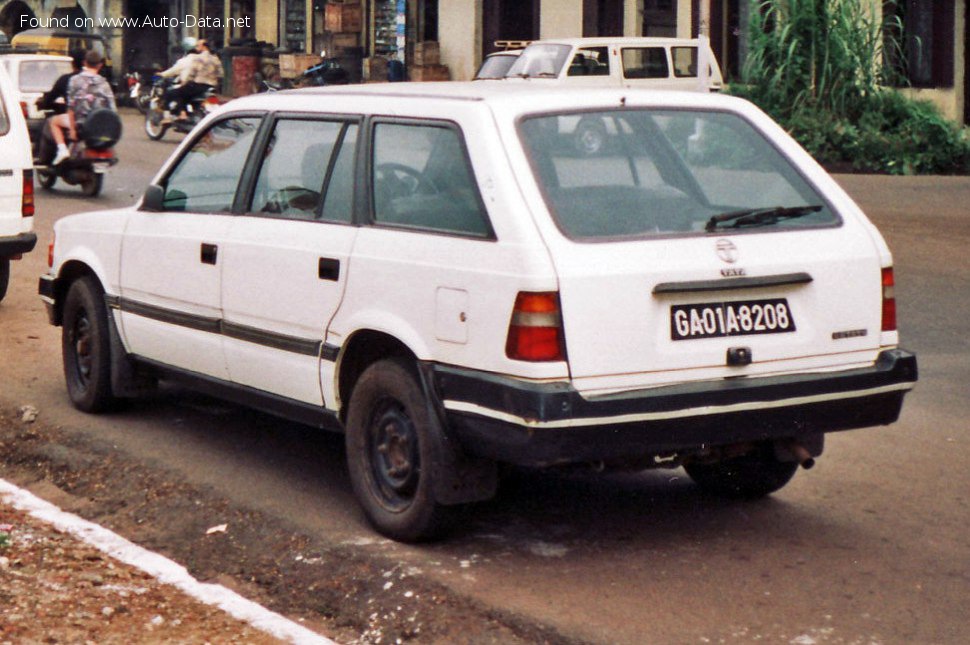
The Tata Estate 1.9 D is a station wagon produced by the Indian manufacturer Tata Motors from 1992 to 2000. While largely unknown in North America, the Estate held a significant position in the Indian automotive market as a spacious, rugged, and relatively affordable vehicle, particularly popular for family transport and commercial use. It represented a key step in Tata’s development as an independent automobile manufacturer, building upon earlier designs and offering a practical alternative to imported vehicles. The 1.9 D variant, powered by a diesel engine producing 68 horsepower, was a common choice due to its fuel efficiency and durability.
The Tata Estate 1.9 D: A Detailed Overview
The Tata Estate was conceived as a versatile vehicle capable of handling both passenger and cargo duties. It was based on the Tata Sierra, an earlier SUV model, but adapted into a more practical station wagon configuration. The Estate aimed to provide a domestically produced alternative to imported estates and utility vehicles, catering to the needs of a growing middle class and businesses in India. The 1.9 D model specifically targeted buyers seeking a balance between affordability, fuel economy, and load-carrying capacity.
Engine & Performance
The heart of the Tata Estate 1.9 D is a 1.9-liter inline-four cylinder diesel engine. This engine, producing 68 horsepower at 4500 rpm and 118 Nm (87.03 lb.-ft.) of torque at 2500 rpm, was not designed for outright speed but for reliability and fuel efficiency. The engine utilizes a precombustion chamber injection system, a common diesel technology of the era, and features an overhead camshaft (OHC) valvetrain with two valves per cylinder. The naturally aspirated engine delivers a power-to-liter ratio of 34.9 hp/l. Performance figures reflect this focus; acceleration from 0 to 100 km/h (0-62 mph) takes approximately 44.1 seconds, while 0 to 60 mph is achieved in around 41.9 seconds. The top speed is rated at 113 km/h (70.21 mph). The engine’s longitudinal front-engine layout and rear-wheel drive configuration were typical for vehicles of this type and era.
Design & Features
The Tata Estate 1.9 D is a five-door station wagon with seating for five passengers. Its body-on-frame construction contributed to its robust nature and ability to withstand rough road conditions. The design, while utilitarian, was relatively modern for its time in the Indian market. Key features included a spacious interior, a large cargo area accessible through a rear tailgate, and a relatively comfortable ride. The Estate offered a practical solution for families and businesses needing to transport both passengers and goods. Safety features were limited by the standards of the early 1990s, but the inclusion of an Anti-lock Braking System (ABS) was a notable addition for the time, enhancing braking performance and stability. The vehicle’s hydraulic steering provided reasonable maneuverability, although it lacked the precision of more modern power steering systems. The Estate’s tires were sized 195/70 R15 S, providing a balance between ride comfort and durability.
Technical Specifications
| Brand | Tata |
| Model | Estate |
| Generation | Estate |
| Type (Engine) | 1.9 D (68 Hp) |
| Start of production | 1992 |
| End of production | 2000 |
| Powertrain Architecture | Internal Combustion engine |
| Body type | Station wagon (estate) |
| Seats | 5 |
| Doors | 5 |
| Fuel consumption (urban) | 12 l/100 km (19.6 US mpg / 23.5 UK mpg / 8.3 km/l) |
| Fuel consumption (extra urban) | 7 l/100 km (33.6 US mpg / 40.4 UK mpg / 14.3 km/l) |
| Fuel Type | Diesel |
| Acceleration 0 – 100 km/h | 44.1 sec |
| Acceleration 0 – 62 mph | 44.1 sec |
| Acceleration 0 – 60 mph | 41.9 sec |
| Maximum speed | 113 km/h (70.21 mph) |
| Weight-to-power ratio | 24.1 kg/Hp |
| Weight-to-torque ratio | 13.9 kg/Nm |
| Power | 68 Hp @ 4500 rpm |
| Power per litre | 34.9 Hp/l |
| Torque | 118 Nm @ 2500 rpm (87.03 lb.-ft. @ 2500 rpm) |
| Engine layout | Front, Longitudinal |
| Engine displacement | 1948 cm3 (118.87 cu. in.) |
| Number of cylinders | 4 |
| Engine configuration | Inline |
| Cylinder Bore | 83 mm (3.27 in.) |
| Piston Stroke | 90 mm (3.54 in.) |
| Compression ratio | 22.5:1 |
| Number of valves per cylinder | 2 |
| Fuel injection system | Precombustion chamber injection |
| Engine aspiration | Naturally aspirated engine |
| Valvetrain | OHC |
| Kerb Weight | 1640 kg (3615.58 lbs.) |
| Max. weight | 2100 kg (4629.71 lbs.) |
| Max load | 460 kg (1014.13 lbs.) |
| Fuel tank capacity | 50 l (13.21 US gal | 11 UK gal) |
| Length | 4625 mm (182.09 in.) |
| Width | 1700 mm (66.93 in.) |
| Height | 1610 mm (63.39 in.) |
| Wheelbase | 2825 mm (111.22 in.) |
| Front track | 1460 mm (57.48 in.) |
| Rear track | 1450 mm (57.09 in.) |
| Drivetrain Architecture | Rear wheel drive |
| Drive wheel | Rear wheel drive |
| Number of gears and type of gearbox | 5 gears, manual transmission |
| Front suspension | Double wishbone |
| Rear suspension | Coil spring |
| Front brakes | Disc |
| Rear brakes | Drum |
| Assisting systems | ABS (Anti-lock braking system) |
| Steering type | Worm-reduction unit |
| Power steering | Hydraulic Steering |
| Tires size | 195/70 R15 S |
The Tata Estate 1.9 D, while not a performance vehicle, served a crucial role in the Indian automotive landscape. Its combination of practicality, affordability, and durability made it a popular choice for families and businesses alike. It represents a significant milestone in Tata Motors’ journey towards becoming a major automotive manufacturer, demonstrating the company’s ability to develop and produce vehicles tailored to the specific needs of the Indian market.
