
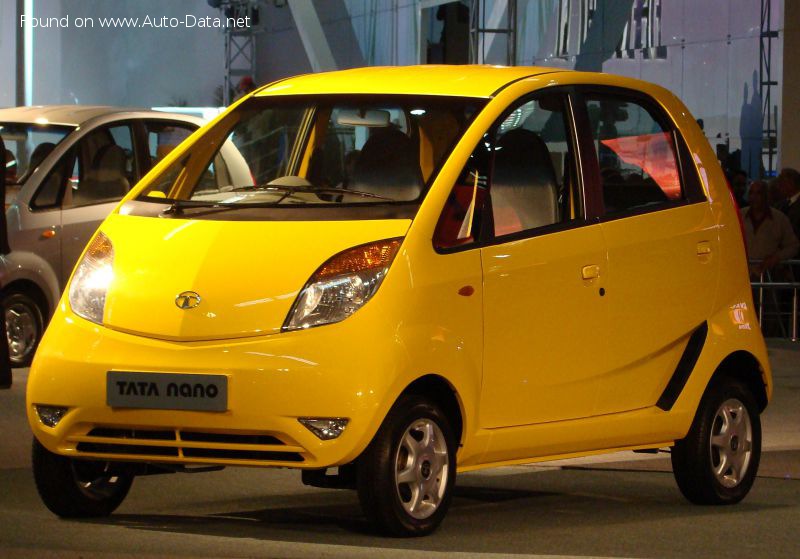
The Tata Nano is a rear-engined, four-door hatchback that was produced by the Indian automobile manufacturer Tata Motors from 2008 to 2015. Conceived with the intention of offering affordable transportation to the masses, the Nano was initially marketed as “the world’s cheapest car.” While the project faced numerous challenges and ultimately didn’t achieve the widespread success initially envisioned, the Tata Nano remains a significant vehicle in automotive history due to its innovative engineering and ambitious goals. The 0.6-liter version, producing 38 horsepower, was the base model and the most widely produced variant.
The Tata Nano 0.6: A Revolutionary Concept
The Tata Nano emerged from a vision by Ratan Tata to create a safe, affordable car for Indian families who were transitioning from two-wheelers to four-wheelers. The primary goal was to provide a viable alternative to motorcycles for families of four, offering protection from the elements and a higher level of safety. The Nano’s design and engineering were heavily focused on cost reduction without compromising basic functionality. This led to several innovative solutions, including a rear-mounted engine and a minimalist approach to features.
Engine & Performance
The heart of the Tata Nano 0.6 is a 624cc (38.08 cubic inches) inline two-cylinder petrol engine. This naturally aspirated engine produces 38 horsepower at 5500 rpm and 51 Nm (37.62 lb-ft) of torque at 4000 rpm. While the power output is modest, it was sufficient for navigating urban traffic conditions in India. The engine features a multi-port manifold fuel injection system and a single overhead camshaft (SOHC) valvetrain with two valves per cylinder. The engine’s rear-mounted, transverse layout was a key element in reducing production costs and maximizing interior space. Acceleration from 0 to 100 km/h (0-62 mph) takes 12.6 seconds, and the vehicle has a top speed of 105 km/h (65.24 mph). The Nano achieves a combined fuel consumption of 4.2 liters per 100 kilometers (56 US mpg or 67.3 UK mpg), making it remarkably fuel-efficient.
Design & Features
The Tata Nano is a five-door hatchback with a relatively simple and functional design. Its compact dimensions – measuring 3164 mm (124.57 inches) in length, 1750 mm (68.9 inches) in width, and 1652 mm (65.04 inches) in height – make it easy to maneuver in congested city streets. The vehicle’s interior is spartan but provides seating for four passengers. The Nano’s trunk space ranges from a minimum of 110 liters (3.88 cubic feet) to a maximum of 500 liters (17.66 cubic feet) with the rear seats folded down. Safety features in the base model were limited, reflecting the vehicle’s low price point. However, later models incorporated improvements such as reinforced body structures. The Nano’s suspension consists of an independent McPherson strut setup at the front and a semi-independent coil spring arrangement at the rear. Braking is handled by drum brakes on all four wheels. The Nano’s tires are typically sized 135/70 R12 or 155/65 R12, mounted on 12-inch wheel rims.
Technical Specifications
| Brand | Tata |
| Model | Nano |
| Generation | Nano |
| Type (Engine) | 0.6 (38 Hp) |
| Start of production | 2008 |
| End of production | 2015 |
| Powertrain Architecture | Internal Combustion engine |
| Body type | Hatchback |
| Seats | 4 |
| Doors | 5 |
| Fuel consumption (combined) | 4.2 l/100 km (56 US mpg, 67.3 UK mpg, 23.8 km/l) |
| Fuel Type | Petrol (Gasoline) |
| Acceleration 0 – 100 km/h | 12.6 sec |
| Acceleration 0 – 62 mph | 12.6 sec |
| Acceleration 0 – 60 mph | 12 sec |
| Maximum speed | 105 km/h (65.24 mph) |
| Weight-to-power ratio | 18.3 kg/Hp, 54.7 Hp/tonne |
| Weight-to-torque ratio | 13.6 kg/Nm, 73.4 Nm/tonne |
| Power | 38 Hp @ 5500 rpm |
| Power per litre | 60.9 Hp/l |
| Torque | 51 Nm @ 4000 rpm (37.62 lb.-ft. @ 4000 rpm) |
| Engine layout | Rear, Transverse |
| Engine displacement | 624 cm3 (38.08 cu. in.) |
| Number of cylinders | 2 |
| Engine configuration | Inline |
| Cylinder Bore | 73.5 mm (2.89 in.) |
| Piston Stroke | 73.5 mm (2.89 in.) |
| Compression ratio | 10.3:1 |
| Number of valves per cylinder | 2 |
| Fuel injection system | Multi-port manifold injection |
| Engine aspiration | Naturally aspirated engine |
| Valvetrain | SOHC |
| Engine oil capacity | 2.2 l (2.32 US qt | 1.94 UK qt) |
| Coolant | 2.4 l (2.54 US qt | 2.11 UK qt) |
| Kerb Weight | 695 kg (1532.21 lbs.) |
| Trunk (boot) space – minimum | 110 l (3.88 cu. ft.) |
| Trunk (boot) space – maximum | 500 l (17.66 cu. ft.) |
| Fuel tank capacity | 24 l (6.34 US gal | 5.28 UK gal) |
| Length | 3164 mm (124.57 in.) |
| Width | 1750 mm (68.9 in.) |
| Height | 1652 mm (65.04 in.) |
| Wheelbase | 2230 mm (87.8 in.) |
| Ride height (ground clearance) | 180 mm (7.09 in.) |
| Minimum turning circle | 8.0 m (26.25 ft.) |
| Drivetrain Architecture | Rear wheel drive |
| Number of gears and type of gearbox | 4 gears, manual transmission |
| Front suspension | Independent, type McPherson with coil spring and anti-roll bar |
| Rear suspension | Semi-independent, coil spring |
| Front brakes | Drum |
| Rear brakes | Drum |
| Tires size | 135/70 R12; 155/65 R12 |
| Wheel rims size | 12 |
Despite its eventual discontinuation, the Tata Nano remains a fascinating case study in automotive engineering and business strategy. It demonstrated the potential for affordable mobility in emerging markets and spurred innovation in cost-reduction techniques. While the Nano didn’t revolutionize the automotive industry as initially hoped, its legacy as a bold and ambitious project continues to resonate.
