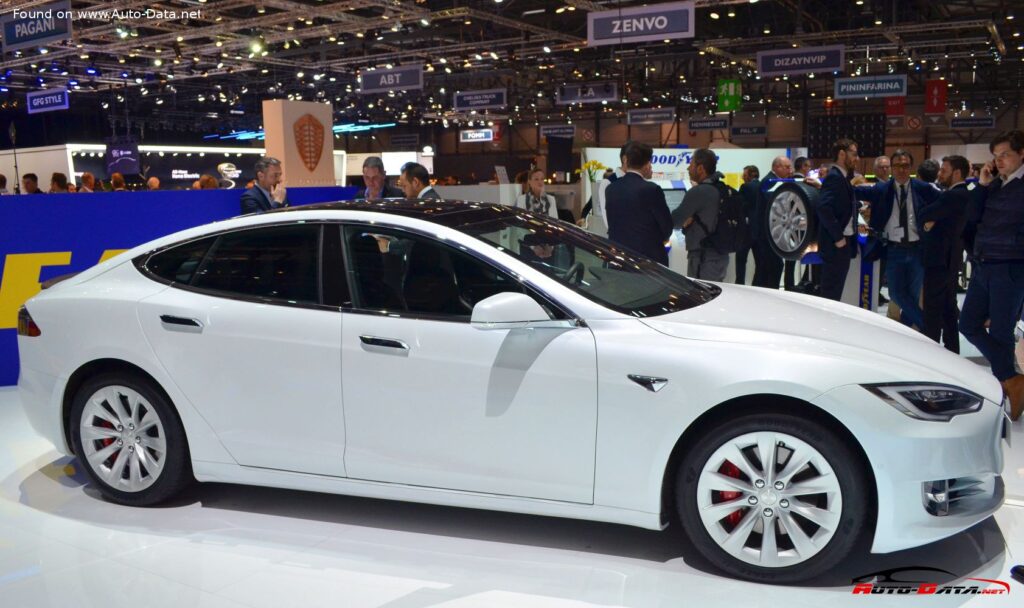
The Tesla Model S, launched in 2012, represented a pivotal moment in the automotive industry, demonstrating the viability of high-performance, long-range electric vehicles. The 2016 facelift, specifically the 60 kWh variant, continued this trajectory, offering a compelling blend of efficiency, performance, and technology. Positioned in the premium large car segment, the Model S aimed to disrupt the established luxury market dominated by internal combustion engine vehicles. This iteration, produced from April 2016 to April 2017, served as a crucial stepping stone in Tesla’s evolution, refining the original design and enhancing its capabilities.
Tesla Model S (Facelift 2016) 60: An Overview
The Model S 60, as the name suggests, featured a 60 kWh battery pack, delivering a balance between range and cost. While not the longest-range option in the Model S lineup, it provided sufficient capacity for daily commuting and longer journeys, appealing to a broader customer base. The facelift brought subtle but significant aesthetic updates, along with improvements to the vehicle’s technology and overall refinement. It’s important to note that Tesla’s business model and production strategies differed significantly from traditional automakers, with continuous over-the-air software updates adding features and improving performance throughout the vehicle’s lifespan.
Engine & Performance
The Tesla Model S 60 is powered by a single electric motor located on the rear axle. This motor produces 315 horsepower (Hp) at 6850 rpm and 440 Newton-meters (324.53 lb.-ft.) of torque. The powertrain architecture is a Battery Electric Vehicle (BEV), meaning it relies entirely on electricity for propulsion. Acceleration from 0 to 60 mph is achieved in 5.5 seconds, while 0-62 mph and 0-100 km/h take 5.8 seconds each. The vehicle boasts a maximum speed of 130.49 mph (210 km/h). The weight-to-power ratio is 6.4 kg/Hp, and the weight-to-torque ratio is 4.6 kg/Nm. The electric motor is capable of reaching a maximum of 16,000 rpm. The single-speed automatic transmission ensures seamless power delivery.
Design & Features
The 2016 Model S retains the sleek, liftback body style that became synonymous with the model. This design offers a practical combination of coupe-like aesthetics and the cargo capacity of a hatchback. The vehicle seats up to seven passengers, offering a spacious and comfortable interior. Key features include a large touchscreen display that controls most vehicle functions, advanced driver-assistance systems (ADAS) such as Autopilot (available as an option), and over-the-air software updates. Safety was a paramount concern, with the Model S incorporating a robust safety cell and numerous passive and active safety features. The low center of gravity, due to the battery pack being located beneath the floor, contributes to excellent handling and stability. The drag coefficient of 0.24 further enhances efficiency and performance.
Technology and Innovation
The 2016 Model S 60 was at the forefront of automotive technology. The lithium-ion battery pack, with a gross capacity of 60 kWh and operating at 300V, provided a NEDC-rated all-electric range of 400 km (248.55 miles). Energy consumption averaged 15.5 kWh per 100 km (24.94 kWh per 100 miles), equating to 135 MPGe and 6.5 km/kWh (4 mi/kWh). The vehicle’s regenerative braking system captures energy during deceleration, further extending its range. The air suspension system provides a comfortable ride and allows for adjustable ride height. The Model S also featured a sophisticated thermal management system to optimize battery performance and longevity.
Technical Specifications
| Brand | Tesla |
| Model | Model S |
| Generation | Model S (facelift 2016) |
| Type (Engine) | 60 60 kWh (315 Hp) |
| Start of production | April, 2016 |
| End of production | April, 2017 |
| Powertrain Architecture | BEV (Electric Vehicle) |
| Body type | Liftback |
| Seats | 7 |
| Doors | 5 |
| Fuel Type | Electricity |
| Acceleration 0 – 100 km/h | 5.8 sec |
| Acceleration 0 – 62 mph | 5.8 sec |
| Acceleration 0 – 60 mph | 5.5 sec |
| Maximum speed | 210 km/h (130.49 mph) |
| Weight-to-power ratio | 6.4 kg/Hp |
| Weight-to-torque ratio | 4.6 kg/Nm |
| Gross battery capacity | 60 kWh |
| Battery voltage | 300 V |
| Battery technology | Lithium-ion (Li-Ion) |
| Battery location | Below the floor |
| All-electric range (NEDC) | 400 km (248.55 mi) |
| Average Energy consumption (NEDC) | 15.5 kWh/100 km (24.94 kWh/100 mi) |
| Electric motor power | 315 Hp @ 6850 rpm |
| Electric motor Torque | 440 Nm (324.53 lb.-ft.) |
| Maximum revolutions of the electric motor | 16000 rpm |
| Electric motor location | Rear axle, Transverse |
| System power | 315 Hp |
| System torque | 440 Nm (324.53 lb.-ft.) |
| Kerb Weight | 2027 kg (4468.77 lbs.) |
| Max. weight | 2590 kg (5709.97 lbs.) |
| Max load | 563 kg (1241.2 lbs.) |
| Trunk (boot) space – minimum | 745 l (26.31 cu. ft.) |
| Trunk (boot) space – maximum | 1645 l (58.09 cu. ft.) |
| Max. roof load | 75 kg (165.35 lbs.) |
| Length | 4979 mm (196.02 in.) |
| Width | 1964 mm (77.32 in.) |
| Width including mirrors | 2189 mm (86.18 in.) |
| Height | 1445 mm (56.89 in.) |
| Wheelbase | 2960 mm (116.54 in.) |
| Front track | 1662 mm (65.43 in.) |
| Rear (Back) track | 1700 mm (66.93 in.) |
| Front overhang | 937 mm (36.89 in.) |
| Rear overhang | 1081 mm (42.56 in.) |
| Ride height (ground clearance) | 117-160 mm (4.61 – 6.3 in.) |
| Drag coefficient (Cd) | 0.24 |
| Minimum turning circle (turning diameter) | 12.4 m (40.68 ft.) |
| Drivetrain Architecture | One electric motor drives the rear wheels. |
| Drive wheel | Rear wheel drive |
| Number of gears and type of gearbox | 1 gears, automatic transmission |
| Front suspension | Double wishbone, Transverse stabilizer, Air suspension |
| Rear suspension | Independent multi-link suspension, Air suspension, Transverse stabilizer |
| Front brakes | Ventilated discs, 355×32 mm |
| Rear brakes | Ventilated discs, 365×28 mm |
| Assisting systems | ABS (Anti-lock braking system) |
| Steering type | Steering rack and pinion |
| Power steering | Electric Steering |
| Tires size | Front wheel tires: 245/45 R19; 245/35 R21Rear wheel tires: 245/45 R19; 265/35 R21 |
| Wheel rims size | Front wheel rims: 8J x 19; 8.5J x 21Rear wheel rims: 8J x 19; 9J x 21 |