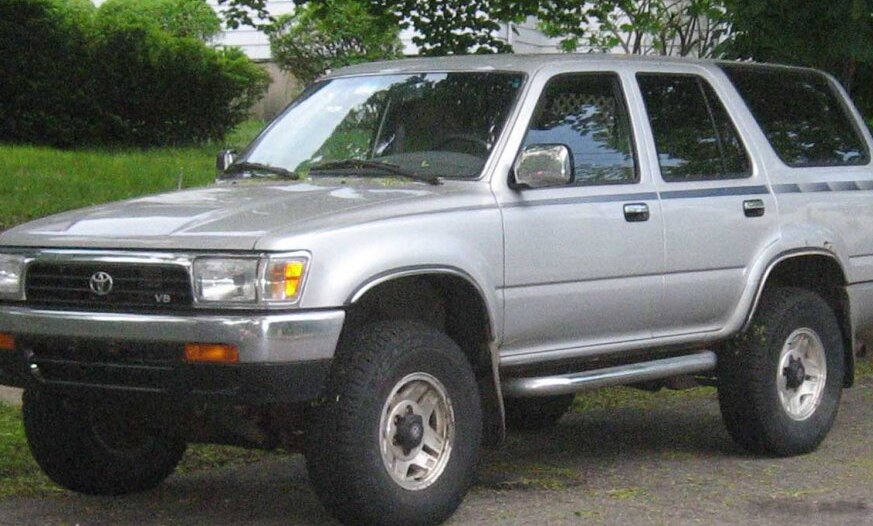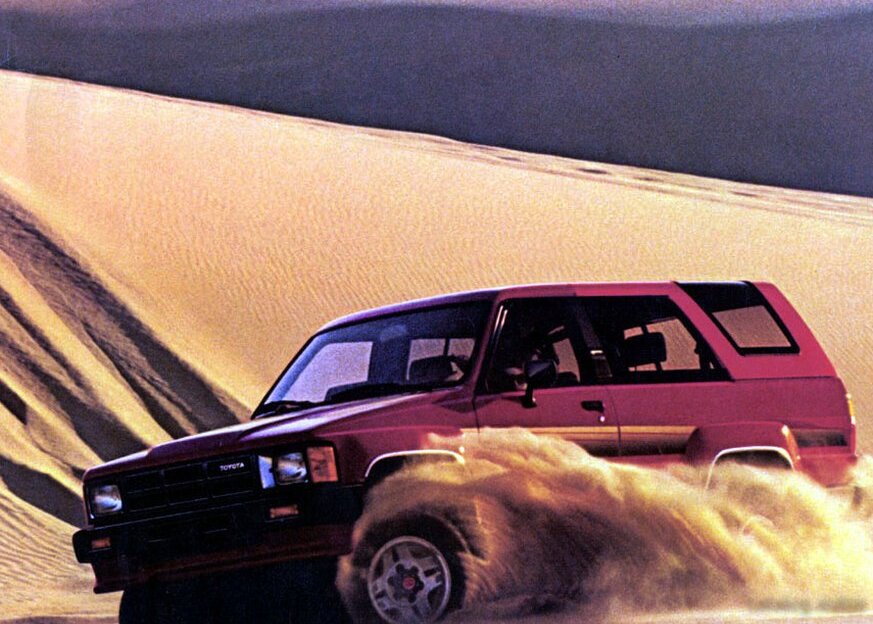
The Toyota 4Runner I 2.4i 4×4, produced between 1985 and 1989, represents the first generation of Toyota’s popular SUV. Positioned as a rugged, body-on-frame vehicle, it was designed to compete with offerings like the Chevrolet Blazer and Ford Bronco II, offering a blend of off-road capability and on-road practicality. This particular variant, equipped with the 2.4-liter 22R-E engine and a five-speed manual transmission, served as an entry-level option within the 4Runner lineup, appealing to buyers seeking affordability and basic four-wheel drive functionality. It was built on the 130 series platform, sharing components with the Toyota Hilux pickup truck.
Technical Specifications
| Brand | Toyota |
| Model | 4Runner |
| Generation | 4Runner I |
| Type (Engine) | 2.4i (114 Hp) 4×4 |
| Start of production | 1985 |
| End of production | 1989 |
| Powertrain Architecture | Internal Combustion engine |
| Body type | SUV |
| Seats | 5 |
| Doors | 3 |
| Fuel consumption (urban) | 18 l/100 km (13.1 US mpg, 15.7 UK mpg, 5.6 km/l) |
| Fuel consumption (extra urban) | 10 l/100 km (23.5 US mpg, 28.2 UK mpg, 10 km/l) |
| Fuel consumption (combined) | 13.8 l/100 km (17 US mpg, 20.5 UK mpg, 7.2 km/l) |
| Fuel Type | Petrol (Gasoline) |
| Acceleration 0 – 100 km/h | 18.4 sec |
| Acceleration 0 – 62 mph | 18.4 sec |
| Acceleration 0 – 60 mph | 17.5 sec |
| Maximum speed | 155 km/h (96.31 mph) |
| Weight-to-power ratio | 14.8 kg/Hp, 67.6 Hp/tonne |
| Weight-to-torque ratio | 8.8 kg/Nm, 113.8 Nm/tonne |
| Power | 114 Hp @ 4800 rpm |
| Power per litre | 48.2 Hp/l |
| Torque | 192 Nm @ 3600 rpm (141.61 lb.-ft. @ 3600 rpm) |
| Engine layout | Front, Longitudinal |
| Engine Model/Code | 22R-E |
| Engine displacement | 2366 cm3 (144.38 cu. in.) |
| Number of cylinders | 4 |
| Engine configuration | Inline |
| Cylinder Bore | 92 mm (3.62 in.) |
| Piston Stroke | 89 mm (3.5 in.) |
| Compression ratio | 9.3:1 |
| Number of valves per cylinder | 2 |
| Fuel injection system | Multi-port manifold injection |
| Engine aspiration | Naturally aspirated engine |
| Valvetrain | OHC |
| Engine oil capacity | 4.3 l (4.54 US qt | 3.78 UK qt) |
| Coolant | 8.5 l (8.98 US qt | 7.48 UK qt) |
| Kerb Weight | 1687 kg (3719.2 lbs.) |
| Trunk (boot) space – minimum | 1200 l (42.38 cu. ft.) |
| Trunk (boot) space – maximum | 2100 l (74.16 cu. ft.) |
| Fuel tank capacity | 65 l (17.17 US gal | 14.3 UK gal) |
| Length | 4435 mm (174.61 in.) |
| Width | 1689 mm (66.5 in.) |
| Height | 1679 mm (66.1 in.) |
| Wheelbase | 2625 mm (103.35 in.) |
| Front track | 1430 mm (56.3 in.) |
| Rear (Back) track | 1425 mm (56.1 in.) |
| Ride height (ground clearance) | 210 mm (8.27 in.) |
| Drive wheel | All wheel drive (4×4) |
| Number of gears and type of gearbox | 5 gears, manual transmission |
| Front suspension | Double wishbone |
| Rear suspension | Rigid axle suspension |
| Front brakes | Ventilated discs |
| Rear brakes | Drum |
| Steering type | Worm-reduction unit |
| Power steering | Hydraulic Steering |
| Tires size | 225/75 R15 |
| Wheel rims size | 15 |
Powertrain & Engine Architecture
The heart of the 4Runner I 2.4i is the 22R-E engine, a 2.4-liter inline-four cylinder gasoline engine. This engine is a member of Toyota’s renowned ‘R’ series, known for its durability and relative simplicity. The 22R-E features a cast iron block and an aluminum cylinder head, utilizing a single overhead camshaft (OHC) design with two valves per cylinder. Fuel delivery is managed by a multi-port fuel injection system, improving efficiency and responsiveness compared to earlier carbureted versions. The engine produces 114 horsepower at 4,800 rpm and 192 Nm (141.61 lb-ft) of torque at 3,600 rpm. The five-speed manual transmission offered with this variant provided a relatively direct driving experience, although gear ratios were optimized for low-end torque rather than outright acceleration.
Driving Characteristics
The 4Runner I 2.4i 4×4, with its 114 horsepower and manual transmission, offered a utilitarian driving experience. Acceleration was modest, taking approximately 18.4 seconds to reach 60 mph. The engine’s strength lay in its low-end torque, making it reasonably capable in off-road situations and when carrying a load. The manual transmission allowed for greater driver control, particularly when navigating challenging terrain. Compared to later 4Runner models with larger engines (like the 3.0-liter V6), the 2.4i felt underpowered on the highway, requiring more frequent downshifts for overtaking. However, its lighter weight compared to those larger-engined models did contribute to better fuel economy.
Equipment & Trim Levels
The 2.4i 4×4 trim level was generally considered the base model. Standard features typically included basic cloth upholstery, a simple dashboard layout with analog gauges, and manual windows and locks. Air conditioning was often an optional extra, as were features like a rear heater and upgraded sound systems. The interior was functional and durable, prioritizing practicality over luxury. Exterior features were similarly basic, with steel wheels, black plastic bumpers, and minimal chrome trim.
Chassis & Braking
The 4Runner I utilized a traditional body-on-frame construction, providing a robust and durable platform for off-road use. The front suspension consisted of a double wishbone setup, while the rear employed a rigid axle with leaf springs. This configuration prioritized durability and load-carrying capacity over refined ride quality. Braking duties were handled by ventilated discs at the front and drum brakes at the rear. The steering system was a worm-reduction unit with hydraulic power assistance, offering reasonable steering feel but lacking the precision of more modern systems.
Market Reception & Comparison
The 4Runner I 2.4i 4×4 was generally well-received as an affordable and capable entry-level SUV. Critics praised its ruggedness and off-road ability, but noted its lack of refinement and modest performance. Compared to the more powerful V6-equipped models, the 2.4i offered significantly lower fuel consumption, making it an attractive option for budget-conscious buyers. However, its slower acceleration and limited on-road comfort meant it wasn’t the ideal choice for those primarily using it as a daily driver. The 2.4i was often seen as a good compromise for those needing a versatile vehicle for both work and recreational activities.
Legacy
The 22R-E engine, found in the 4Runner I 2.4i, is renowned for its longevity and reliability. Many examples of this engine are still running today, even with minimal maintenance. The 4Runner I, as a whole, established the model as a durable and capable SUV, laying the foundation for its continued success. In the used car market, the 2.4i 4×4 is often sought after by enthusiasts looking for a simple, reliable, and affordable off-road vehicle. While not as desirable as the V6 models, its lower price point and proven mechanicals make it a compelling option for those seeking a classic Toyota SUV.