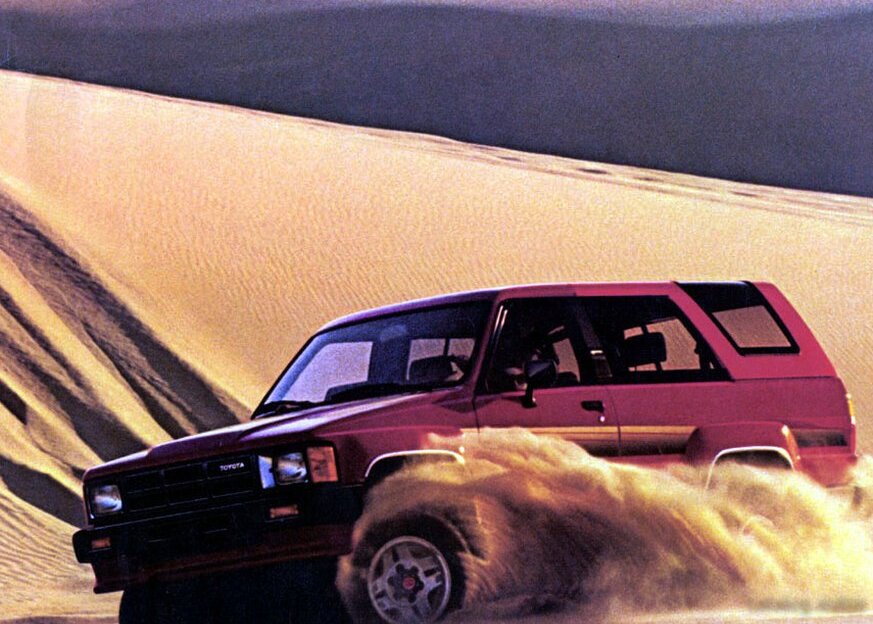
The Toyota 4Runner I 2.4i 4×4, produced between 1987 and 1989, represents the initial offering in Toyota’s long-running 4Runner series. This first generation (codenamed V20, though often referred to as the first generation) was based on the Toyota Hilux pickup truck chassis, offering a blend of off-road capability and relatively compact dimensions. Positioned as an entry-level 4×4 SUV, the 2.4i variant served as the base model, appealing to buyers seeking a rugged and affordable vehicle for both daily driving and recreational pursuits. It was a key model in establishing the 4Runner’s reputation for durability and off-road prowess, particularly in markets outside of North America where smaller SUVs were more popular.
Technical Specifications
| Brand | Toyota |
| Model | 4Runner |
| Generation | 4Runner I |
| Type (Engine) | 2.4i (116 Hp) 4×4 |
| Start of production | 1987 |
| End of production | 1989 |
| Powertrain Architecture | Internal Combustion engine |
| Body type | SUV |
| Seats | 5 |
| Doors | 3 |
| Fuel consumption (urban) | 11.7 l/100 km (20.1 US mpg) |
| Fuel consumption (extra urban) | 10.2 l/100 km (23.1 US mpg) |
| Fuel Type | Petrol (Gasoline) |
| Power | 116 Hp @ 4800 rpm |
| Torque | 190 Nm @ 3600 rpm (140.14 lb.-ft. @ 3600 rpm) |
| Engine layout | Front, Longitudinal |
| Engine Model/Code | 22R-E |
| Engine displacement | 2366 cm3 (144.38 cu. in.) |
| Number of cylinders | 4 |
| Engine configuration | Inline |
| Cylinder Bore | 92 mm (3.62 in.) |
| Piston Stroke | 89 mm (3.5 in.) |
| Compression ratio | 9.3:1 |
| Number of valves per cylinder | 2 |
| Fuel injection system | Multi-port manifold injection |
| Engine aspiration | Naturally aspirated engine |
| Valvetrain | SOHC |
| Engine oil capacity | 4.3 l (4.54 US qt | 3.78 UK qt) |
| Coolant | 8.5 l (8.98 US qt | 7.48 UK qt) |
| Max. weight | 2304 kg (5079.45 lbs.) |
| Trunk (boot) space – minimum | 1200 l (42.38 cu. ft.) |
| Trunk (boot) space – maximum | 2100 l (74.16 cu. ft.) |
| Fuel tank capacity | 65 l (17.17 US gal | 14.3 UK gal) |
| Length | 4435 mm (174.61 in.) |
| Width | 1689 mm (66.5 in.) |
| Height | 1679 mm (66.1 in.) |
| Wheelbase | 2625 mm (103.35 in.) |
| Front track | 1430 mm (56.3 in.) |
| Rear (Back) track | 1425 mm (56.1 in.) |
| Ride height (ground clearance) | 269 mm (10.59 in.) |
| Minimum turning circle (turning diameter) | 11.3 m (37.07 ft.) |
| Approach angle | 37° |
| Departure angle | 22.5° |
| Drive wheel | All wheel drive (4×4) |
| Number of gears and type of gearbox | 5 gears, manual transmission |
| Front suspension | Independent torsion bar, double wishbone |
| Rear suspension | Leaf spring |
| Front brakes | Ventilated discs |
| Rear brakes | Drum |
| Steering type | Worm-reduction unit |
| Power steering | Hydraulic Steering |
| Tires size | 225/75 R15 |
| Wheel rims size | 15 |
Powertrain & Engine Architecture
The 2.4i 4Runner utilized Toyota’s 22R-E inline-four cylinder engine. This 2.4-liter (2366 cc) engine featured a single overhead camshaft (SOHC) valvetrain with two valves per cylinder. It employed multi-port fuel injection, a significant upgrade over earlier carbureted Toyota engines, contributing to improved fuel efficiency and smoother operation. The 22R-E was known for its reliability and relatively simple design. The engine produced 116 horsepower at 4800 rpm and 190 Nm (140 lb-ft) of torque at 3600 rpm. This power was delivered through a standard five-speed manual transmission. The engine was mounted longitudinally in the chassis, a configuration common for four-wheel-drive vehicles. The 22R-E was a robust engine, but its power output was modest, especially when paired with the 4Runner’s weight and four-wheel-drive system.
Driving Characteristics
The 2.4i 4Runner with the five-speed manual transmission offered adequate, though not exhilarating, performance. Acceleration was leisurely, and highway passing required careful planning. The engine’s torque peak at 3600 rpm meant that it felt most responsive in the mid-range. The five-speed manual allowed drivers to keep the engine in its optimal power band, but it still wasn’t a particularly quick vehicle. Compared to later 4Runner models with larger engines (like the 3.0-liter V6), the 2.4i felt underpowered, especially when fully loaded or tackling steep inclines. The manual transmission provided more control and engagement than an automatic would have, but it also demanded more driver involvement. The 4Runner’s suspension, featuring independent torsion bars in the front and leaf springs in the rear, provided a comfortable ride on paved roads, while still offering sufficient articulation for off-road driving.
Equipment & Trim Levels
The 2.4i 4Runner was typically equipped with basic, functional features. Standard equipment included cloth upholstery, a simple dashboard layout, and manual windows and locks. Air conditioning was often an optional extra, as were features like a rear heater and upgraded audio systems. The interior was designed with durability in mind, featuring hard-wearing plastics and relatively simple controls. Trim levels were limited; the 2.4i served as the base model, with few options for significant upgrades. The focus was on providing a capable and affordable 4×4 vehicle rather than luxury or refinement.
Chassis & Braking
The 4Runner’s chassis was based on the Toyota Hilux pickup truck, providing a strong and durable foundation. The front suspension utilized independent torsion bars and double wishbones, offering a good balance of ride comfort and off-road capability. The rear suspension employed leaf springs, which were well-suited for carrying loads and providing stability. Braking duties were handled by ventilated discs in the front and drum brakes in the rear. The braking system was adequate for the vehicle’s weight and performance, but it lacked the sophistication of more modern braking systems. The 4Runner’s high ground clearance (269 mm / 10.59 inches) and robust suspension allowed it to navigate challenging terrain with relative ease.
Market Reception & Comparison
The 2.4i 4Runner was generally well-received as an affordable and capable 4×4 SUV. Critics praised its durability, off-road prowess, and relatively low price point. However, some reviewers noted its modest power output and basic interior. Compared to other SUVs of the time, such as the Suzuki Samurai or the Jeep Cherokee, the 4Runner offered a good balance of features and performance. The Samurai was more affordable and nimble, but less refined and comfortable. The Cherokee offered more power and a more luxurious interior, but it was also more expensive. Fuel economy was reasonable for the time, but not exceptional. The 2.4i 4Runner’s reliability was a major selling point, contributing to its strong reputation in the used car market.
Legacy
The 2.4i 4Runner, while the entry-level model of the first generation, played a crucial role in establishing the 4Runner’s identity as a rugged and reliable SUV. The 22R-E engine, while not known for its power, proved to be exceptionally durable and long-lasting. Today, well-maintained examples of the 2.4i 4Runner are sought after by enthusiasts and collectors. The simplicity of the engine and drivetrain makes it relatively easy to maintain and repair. The 4Runner’s robust construction and four-wheel-drive system continue to make it a capable off-road vehicle, even by modern standards. The first-generation 4Runner, including the 2.4i variant, remains a popular choice for those seeking a classic and dependable SUV.