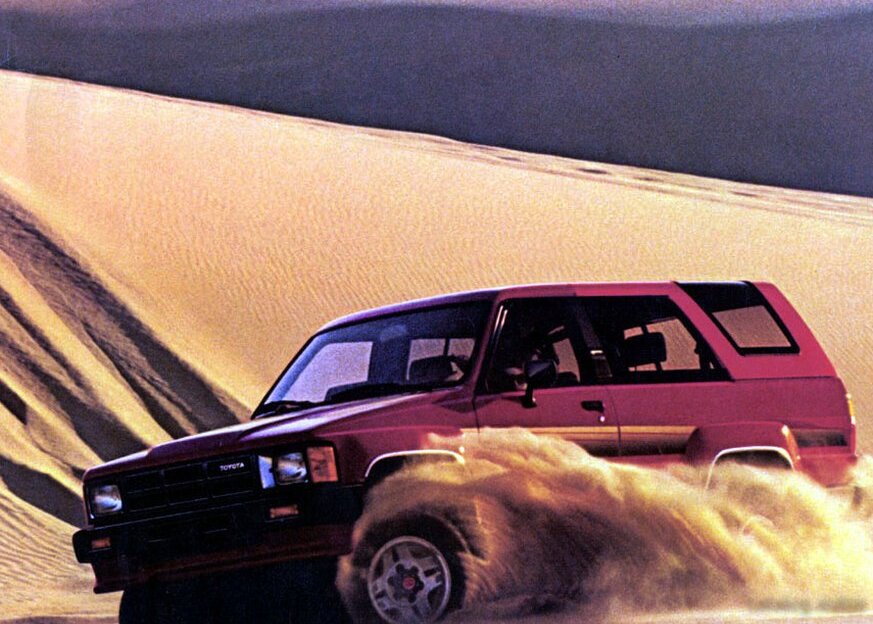
The Toyota 4Runner I 2.4i 4×4, produced between 1984 and 1989, represents the first generation of Toyota’s popular SUV. Built upon the Hilux chassis, the 4Runner was initially conceived as a compact, rugged vehicle aimed at buyers seeking a blend of on-road comfort and off-road capability. This first generation, internally designated as the V10/V20 series, was a significant departure for Toyota, moving beyond traditional car-based SUVs and embracing a body-on-frame construction. The 2.4i variant, powered by the 22R engine producing 97 horsepower, served as the entry point to the 4Runner lineup in many markets, offering a balance of affordability and functionality. It was primarily sold in North America, Australia, and parts of Asia, where demand for a smaller, more manageable 4×4 vehicle was growing.
Technical Specifications
| Brand | Toyota |
| Model | 4Runner |
| Generation | 4Runner I |
| Type | 2.4i (97 Hp) 4×4 |
| Start of production | 1984 |
| End of production | 1989 |
| Powertrain Architecture | Internal Combustion engine |
| Body type | SUV |
| Seats | 5 |
| Doors | 3 |
| Fuel Type | Petrol (Gasoline) |
| Power | 97 Hp @ 4800 rpm |
| Power per litre | 41 Hp/l |
| Torque | 174 Nm @ 2800 rpm / 128.34 lb.-ft. @ 2800 rpm |
| Engine layout | Front, Longitudinal |
| Engine Model/Code | 22R |
| Engine displacement | 2366 cm3 / 144.38 cu. in. |
| Number of cylinders | 4 |
| Engine configuration | Inline |
| Cylinder Bore | 91.9 mm / 3.62 in. |
| Piston Stroke | 88.9 mm / 3.5 in. |
| Number of valves per cylinder | 2 |
| Fuel injection system | Carburettor |
| Engine aspiration | Naturally aspirated engine |
| Valvetrain | SOHC |
| Engine oil capacity | 4.3 l / 4.54 US qt | 3.78 UK qt |
| Coolant | 8.5 l / 8.98 US qt | 7.48 UK qt |
| Trunk (boot) space – minimum | 1200 l / 42.38 cu. ft. |
| Trunk (boot) space – maximum | 2100 l / 74.16 cu. ft. |
| Fuel tank capacity | 65 l / 17.17 US gal | 14.3 UK gal |
| Length | 4435 mm / 174.61 in. |
| Width | 1689 mm / 66.5 in. |
| Height | 1679 mm / 66.1 in. |
| Wheelbase | 2625 mm / 103.35 in. |
| Front track | 1430 mm / 56.3 in. |
| Rear (Back) track | 1425 mm / 56.1 in. |
| Ride height (ground clearance) | 210 mm / 8.27 in. |
| Drive wheel | All wheel drive (4×4) |
| Number of gears and type of gearbox | 5 gears, manual transmission |
| Front suspension | Double wishbone |
| Rear suspension | Rigid axle suspension |
| Front brakes | Ventilated discs |
| Rear brakes | Drum |
| Assisting systems | ABS (Anti-lock braking system) |
| Steering type | Worm-reduction unit |
| Power steering | Hydraulic Steering |
Powertrain & Engine Architecture
The heart of the 4Runner 2.4i is the Toyota 22R inline-four cylinder engine. This 2.4-liter (2366 cc) engine, a staple of Toyota’s lineup in the 1980s, is known for its durability and relative simplicity. It utilizes a single overhead camshaft (SOHC) valvetrain with two valves per cylinder. Fuel delivery is managed by a carburetor, a common feature for the time, rather than fuel injection. This carburetor setup, while less efficient than modern fuel injection systems, contributed to the engine’s straightforward maintenance requirements. The 22R engine produces 97 horsepower at 4800 rpm and 174 Nm (128.34 lb-ft) of torque at 2800 rpm. The engine is longitudinally mounted in the engine bay. The 4Runner 2.4i was exclusively offered with a five-speed manual transmission, designed to maximize the engine’s limited power output and provide adequate gearing for both on-road and off-road driving.
Driving Characteristics
The 4Runner 2.4i 4×4, with its 97 horsepower and five-speed manual transmission, offered a driving experience focused on practicality and capability rather than outright speed. Acceleration was modest, and highway passing required careful planning. The engine’s torque curve, while not particularly broad, provided sufficient pulling power for moderate off-road conditions. The manual transmission allowed drivers to maintain control and select appropriate gears for varying terrain. Compared to later 4Runner models with larger engines (like the V6 options), the 2.4i felt underpowered, especially when fully loaded or tackling steep inclines. However, its lighter weight and simpler mechanicals made it more nimble and easier to maneuver in tight spaces. The gearing was optimized for low-end torque, making it a capable crawler, but it meant higher engine speeds at highway cruising.
Equipment & Trim Levels
The 4Runner 2.4i 4×4 was generally offered with a fairly basic level of equipment, reflecting its position as the entry-level model. Standard features typically included cloth upholstery, a basic AM/FM radio, and manual windows and locks. Air conditioning was often an optional extra. The interior was functional and durable, designed to withstand the rigors of off-road use. Trim levels were relatively limited; most 4Runners were equipped with a standard package, with options for adding features like upgraded sound systems or a sunroof. The dashboard layout was simple and straightforward, prioritizing functionality over aesthetics.
Chassis & Braking
The 4Runner I utilized a robust body-on-frame construction, providing a solid foundation for off-road driving. The front suspension featured a double wishbone design, while the rear suspension employed a rigid axle setup with leaf springs. This combination offered a good balance of ride comfort and off-road articulation. Braking duties were handled by ventilated discs at the front and drum brakes at the rear. While adequate for the vehicle’s weight and performance, the braking system lacked the sophistication of later models. Power steering was standard, making the 4Runner easier to maneuver at low speeds. The 4×4 system featured a part-time four-wheel drive setup with a manually selectable transfer case, allowing drivers to switch between 2WD and 4WD modes as needed.
Market Reception & Comparison
The 4Runner 2.4i 4×4 was generally well-received by critics and consumers alike. It was praised for its ruggedness, reliability, and off-road capability. However, its relatively low power output and basic interior were points of criticism. Compared to other SUVs of the time, such as the Chevrolet Blazer or Ford Bronco, the 4Runner offered a more refined driving experience and a reputation for Toyota’s legendary reliability. Within the 4Runner lineup, the 2.4i served as the most affordable option, appealing to buyers who prioritized functionality and value over performance and luxury. The later introduction of V6 engines and more luxurious trim levels broadened the 4Runner’s appeal, but the 2.4i remained a popular choice for those seeking a simple, dependable 4×4.
Legacy
The first-generation Toyota 4Runner, and particularly the 2.4i variant, has earned a loyal following among enthusiasts. The 22R engine is renowned for its longevity and ease of maintenance, and many examples are still on the road today. The 4Runner’s simple mechanicals and robust construction make it a relatively easy vehicle to repair and maintain, even for amateur mechanics. In the used car market, well-maintained 4Runner 2.4i models command a premium, particularly those with low mileage and minimal modifications. The 4Runner I laid the foundation for the 4Runner’s enduring success, establishing it as a benchmark for compact, capable SUVs. Its blend of off-road prowess, reliability, and affordability continues to resonate with buyers today, making it a classic vehicle with a lasting legacy.