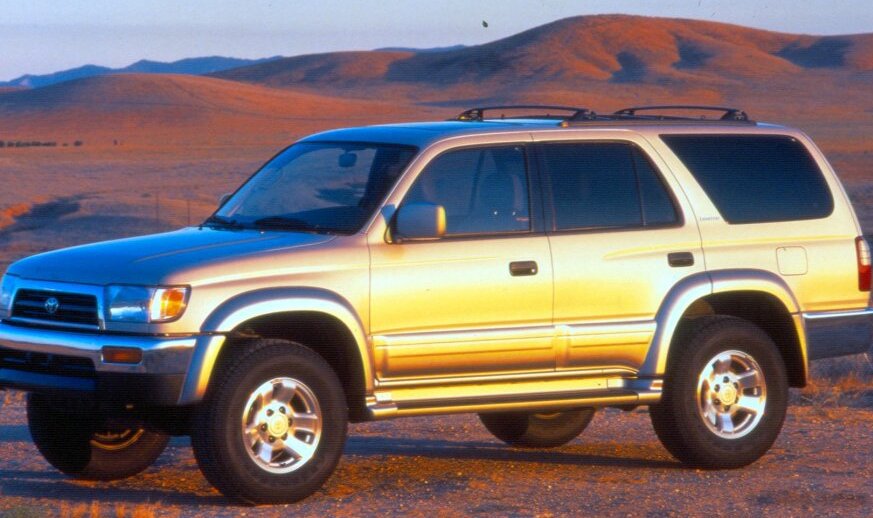
The Toyota 4Runner III, produced between 1995 and 1999, represented a significant evolution of Toyota’s popular mid-size SUV. This generation, internally designated as the 180 series, continued the 4Runner’s reputation for ruggedness and off-road capability while introducing increased refinement and comfort. Within the 4Runner III lineup, the 2.7 16V (150 hp) variant occupied the entry-level position, offering a more affordable option for buyers prioritizing practicality and fuel efficiency over outright performance. It served as a gateway into the 4Runner family, appealing to those who didn’t require the power of the V6 options or the more specialized features of the higher trims.
Technical Specifications
| Brand | Toyota |
| Model | 4Runner |
| Generation | 4Runner III |
| Type (Engine) | 2.7 16V (150 Hp) |
| Start of production | 1995 |
| End of production | 1999 |
| Powertrain Architecture | Internal Combustion engine |
| Body type | SUV |
| Seats | 5 |
| Doors | 5 |
| Fuel Type | Petrol (Gasoline) |
| Acceleration 0 – 100 km/h | 13 sec |
| Acceleration 0 – 62 mph | 13 sec |
| Acceleration 0 – 60 mph | 12.4 sec |
| Maximum speed | 165 km/h (102.53 mph) |
| Weight-to-power ratio | 10.1 kg/Hp, 99 Hp/tonne |
| Weight-to-torque ratio | 6.3 kg/Nm, 158.4 Nm/tonne |
| Power | 150 Hp @ 4800 rpm |
| Power per litre | 55.7 Hp/l |
| Torque | 240 Nm @ 4000 rpm (177.01 lb.-ft. @ 4000 rpm) |
| Engine layout | Front, Longitudinal |
| Engine Model/Code | 3RZ-FE |
| Engine displacement | 2694 cm3 (164.4 cu. in.) |
| Number of cylinders | 4 |
| Engine configuration | Inline |
| Cylinder Bore | 95 mm (3.74 in.) |
| Piston Stroke | 95 mm (3.74 in.) |
| Compression ratio | 9.5:1 |
| Number of valves per cylinder | 4 |
| Fuel injection system | Multi-port manifold injection |
| Engine aspiration | Naturally aspirated engine |
| Valvetrain | DOHC |
| Engine oil capacity | 5.4 l (5.71 US qt | 4.75 UK qt) |
| Coolant | 10 l (10.57 US qt | 8.8 UK qt) |
| Kerb Weight | 1515 kg (3340 lbs.) |
| Max. weight | 2381 kg (5249.21 lbs.) |
| Max load | 866 kg (1909.2 lbs.) |
| Trunk (boot) space – minimum | 1263 l (44.6 cu. ft.) |
| Trunk (boot) space – maximum | 2257 l (79.71 cu. ft.) |
| Fuel tank capacity | 70 l (18.49 US gal | 15.4 UK gal) |
| Permitted trailer load with brakes (12%) | 1587 kg (3498.74 lbs.) |
| Length | 4539 mm (178.7 in.) |
| Width | 1689 mm (66.5 in.) |
| Height | 1689-1745 mm (66.5 – 68.7 in.) |
| Wheelbase | 2675 mm (105.31 in.) |
| Front track | 1506 mm (59.29 in.) |
| Rear (Back) track | 1496-1509 mm (58.9 – 59.41 in.) |
| Minimum turning circle | 11.4 m (37.4 ft.) |
| Approach angle | 32-36° |
| Departure angle | 26-29° |
| Drivetrain Architecture | The Internal combustion engine (ICE) drives the rear wheels of the vehicle. |
| Drive wheel | Rear wheel drive |
| Number of gears and type of gearbox | 5 gears, manual transmission |
| Front suspension | Double wishbone |
| Rear suspension | Independent multi-link suspension |
| Front brakes | Ventilated discs |
| Rear brakes | Drum |
| Assisting systems | ABS (Anti-lock braking system) |
| Steering type | Steering rack and pinion |
| Power steering | Hydraulic Steering |
| Tires size | 225/75 R15; 265/70 R16 |
| Wheel rims size | 7J x 15; 7J x 16 |
INTRODUCTION
The 4Runner III, launched in 1995, represented a move towards a more comfortable and refined SUV experience while retaining the off-road prowess that defined the model. Built on the robust 180 platform, it offered a blend of practicality, durability, and a more car-like driving experience compared to its predecessors. The 2.7-liter 16V engine, designated the 3RZ-FE, was the base engine option for the North American market, offering a balance between fuel economy and adequate power for everyday driving. This variant was primarily aimed at buyers who didn’t require the extra performance of the 3.4-liter V6 engines available in higher trim levels.
Powertrain & Engine Architecture
The heart of the 4Runner III 2.7 16V is the 3RZ-FE inline-four cylinder engine. This 2.7-liter powerplant features a cast iron block and an aluminum cylinder head, incorporating a double overhead camshaft (DOHC) valvetrain with four valves per cylinder. This configuration allowed for improved breathing and increased efficiency. Fuel delivery is managed by a multi-port fuel injection system, ensuring precise fuel metering for optimal combustion. The engine produces 150 horsepower at 4800 rpm and 177 lb-ft of torque at 4000 rpm. The 3RZ-FE is known for its reliability and durability, a hallmark of Toyota engineering. The engine is longitudinally mounted, driving the rear wheels through a five-speed manual transmission. While an automatic transmission was available, the 2.7L engine was often paired with the manual to maximize fuel efficiency and provide a more engaging driving experience.
Driving Characteristics
The 4Runner III 2.7 16V, with its 150 hp and 177 lb-ft of torque, offered adequate, but not exhilarating, performance. Acceleration from 0-60 mph took around 12.4 seconds, and top speed was limited to around 102.53 mph. Compared to the V6-powered 4Runners, the 2.7L felt noticeably slower, particularly when fully loaded or tackling steep inclines. However, the engine’s torque curve provided sufficient power for everyday driving situations. The five-speed manual transmission allowed drivers to keep the engine in its optimal power band, while the automatic transmission, though convenient, resulted in some power loss. The 4Runner’s suspension, featuring double wishbones in the front and an independent multi-link setup in the rear, provided a comfortable ride, even on rough terrain. The rear drum brakes, standard on this trim, offered adequate stopping power for normal driving conditions.
Equipment & Trim Levels
The 2.7 16V 4Runner typically came with a relatively basic set of standard features. These included cloth upholstery, air conditioning, power steering, and an AM/FM radio. Optional extras, such as power windows and locks, a CD player, and alloy wheels, were available, but often added significantly to the vehicle’s price. The interior was functional and durable, designed to withstand the rigors of off-road use. Trim levels varied slightly depending on the market, but generally, the 2.7L model was positioned as the entry-level offering, lacking the luxury features found in the higher-spec V6 trims.
Chassis & Braking
The 4Runner III utilized a body-on-frame construction, providing a robust and durable chassis. The suspension system was designed to balance on-road comfort with off-road capability. The front suspension featured double wishbones, while the rear employed an independent multi-link setup. This configuration allowed for good wheel articulation and a relatively smooth ride. Braking duties were handled by ventilated discs in the front and drum brakes in the rear. ABS (Anti-lock Braking System) was standard, enhancing safety and control during emergency braking situations. The steering system utilized a rack and pinion setup with hydraulic power assistance, providing precise and responsive steering feel.
Market Reception & Comparison
The 4Runner III 2.7 16V was generally well-received by critics as a practical and reliable SUV. While its performance wasn’t groundbreaking, it offered a good value for buyers seeking a capable and affordable vehicle. Compared to the V6 models, the 2.7L version offered better fuel economy, making it an attractive option for those who prioritized efficiency. However, the V6 models were favored by those who needed more power for towing or off-road adventures. The 2.7L’s simplicity also translated to lower maintenance costs, making it a popular choice for budget-conscious buyers.
Legacy
The 3RZ-FE engine, found in the 4Runner III 2.7 16V, has earned a reputation for exceptional reliability and longevity. Many examples of this engine are still running strong today, even with high mileage. The 4Runner III, in general, is known for its durability and ability to withstand years of use. In the used car market, the 2.7L 4Runner remains a popular choice for those seeking a dependable and affordable SUV. While it may not offer the same level of performance or luxury as some of its competitors, its simplicity, reliability, and off-road capability continue to make it a desirable vehicle.