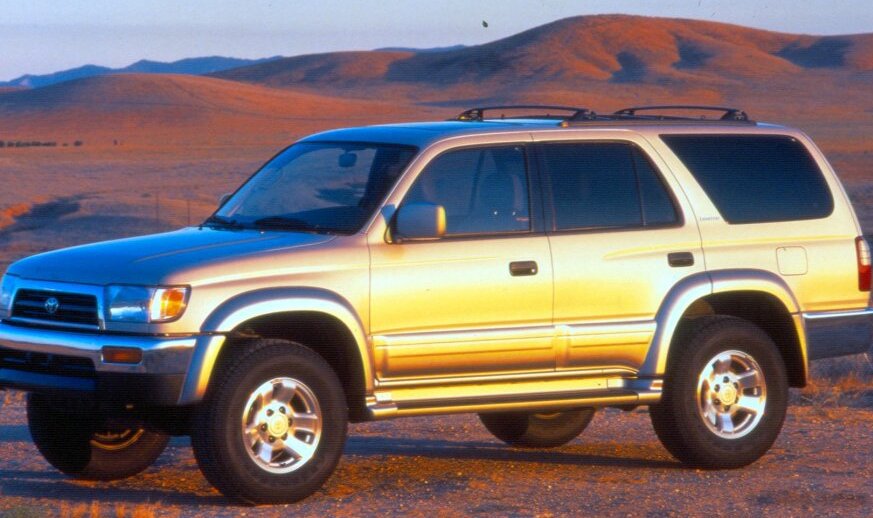
The Toyota 4Runner III, specifically the 2.7-liter 16V (150 hp) variant with an automatic transmission, was produced between 1995 and 1999. This iteration of the 4Runner, belonging to the third generation (designated as the 180 series), represented a significant shift towards a more comfortable and family-oriented SUV, while still retaining the ruggedness expected of the 4Runner nameplate. Positioned as the entry-level engine option in many markets, it offered a more affordable alternative to the more powerful 3.4-liter V6 models. The 4Runner III was primarily sold in North America, Australia, and select Asian markets, becoming a popular choice for those seeking a reliable and capable SUV for both on and off-road adventures.
Technical Specifications
| Brand | Toyota |
| Model | 4Runner |
| Generation | 4Runner III |
| Type (Engine) | 2.7 16V (150 Hp) Automatic |
| Start of production | 1995 |
| End of production | 1999 |
| Powertrain Architecture | Internal Combustion engine |
| Body type | SUV |
| Seats | 5 |
| Doors | 5 |
| Fuel consumption (urban) | 11.7 l/100 km (20.1 US mpg) |
| Fuel consumption (extra urban) | 9.8 l/100 km (24 US mpg) |
| Fuel Type | Petrol (Gasoline) |
| Weight-to-power ratio | 10.1 kg/Hp |
| Weight-to-torque ratio | 6.3 kg/Nm |
| Power | 150 Hp @ 4800 rpm |
| Power per litre | 55.7 Hp/l |
| Torque | 240 Nm @ 4000 rpm (177.01 lb.-ft. @ 4000 rpm) |
| Engine layout | Front, Longitudinal |
| Engine Model/Code | 3RZ-FE |
| Engine displacement | 2694 cm3 (164.4 cu. in.) |
| Number of cylinders | 4 |
| Engine configuration | Inline |
| Cylinder Bore | 95 mm (3.74 in.) |
| Piston Stroke | 95 mm (3.74 in.) |
| Compression ratio | 9.5:1 |
| Number of valves per cylinder | 4 |
| Fuel injection system | Multi-port manifold injection |
| Engine aspiration | Naturally aspirated engine |
| Valvetrain | DOHC |
| Engine oil capacity | 5.4 l (5.71 US qt | 4.75 UK qt) |
| Coolant capacity | 10 l (10.57 US qt | 8.8 UK qt) |
| Kerb Weight | 1521 kg (3353.23 lbs.) |
| Max. weight | 2381 kg (5249.21 lbs.) |
| Max load | 860 kg (1895.98 lbs.) |
| Trunk (boot) space – minimum | 1263 l (44.6 cu. ft.) |
| Trunk (boot) space – maximum | 2257 l (79.71 cu. ft.) |
| Fuel tank capacity | 70 l (18.49 US gal | 15.4 UK gal) |
| Permitted trailer load with brakes (12%) | 1587 kg (3498.74 lbs.) |
| Length | 4539 mm (178.7 in.) |
| Width | 1689 mm (66.5 in.) |
| Height | 1689-1745 mm (66.5 – 68.7 in.) |
| Wheelbase | 2675 mm (105.31 in.) |
| Front track | 1506 mm (59.29 in.) |
| Rear (Back) track | 1496-1509 mm (58.9 – 59.41 in.) |
| Ride height (ground clearance) | 216-241 mm (8.5 – 9.49 in.) |
| Minimum turning circle (turning diameter) | 11.4 m (37.4 ft.) |
| Approach angle | 32-36° |
| Departure angle | 26-29° |
| Drivetrain Architecture | Rear wheel drive |
| Number of gears and type of gearbox | 4 gears, automatic transmission |
| Front suspension | Double wishbone |
| Rear suspension | Independent multi-link suspension |
| Front brakes | Ventilated discs |
| Rear brakes | Drum |
| Assisting systems | ABS (Anti-lock braking system) |
| Steering type | Steering rack and pinion |
| Power steering | Hydraulic Steering |
| Tires size | 225/75 R15; 265/70 R16 |
| Wheel rims size | 7J x 15; 7J x 16 |
Powertrain & Engine Architecture
The heart of this 4Runner variant is the 3RZ-FE engine, a 2.7-liter inline-four cylinder gasoline engine. This engine is a naturally aspirated, dual overhead camshaft (DOHC) design featuring multi-port fuel injection. The 3RZ-FE was known for its durability and relatively simple design, contributing to its reputation for reliability. It produced 150 horsepower at 4800 rpm and 240 Nm (177 lb-ft) of torque at 4000 rpm. The automatic transmission paired with this engine was typically a four-speed unit, designed for smooth operation and ease of use. While not offering the performance of the V6 options, the 3RZ-FE provided adequate power for everyday driving and light off-road use.
Driving Characteristics
The 2.7-liter 4Runner Automatic offered a comfortable, albeit not particularly sporty, driving experience. Acceleration was adequate for merging and highway cruising, but it lacked the punch of the 3.4L V6. The four-speed automatic transmission was tuned for fuel efficiency and smooth shifts, rather than aggressive performance. The gear ratios were optimized for everyday driving conditions, prioritizing usability over outright speed. Compared to the manual transmission versions of the 2.7L, the automatic offered greater convenience, especially in urban environments, but at the cost of some responsiveness. The rear-wheel drive configuration provided a more traditional driving feel, although four-wheel drive was available as an option.
Equipment & Trim Levels
The 2.7-liter automatic 4Runner typically came with a standard equipment list that included air conditioning, power windows and locks, and an AM/FM stereo. Interior upholstery was usually cloth, with options for upgraded materials available on higher trim levels. Common optional extras included a sunroof, upgraded sound system, and alloy wheels. The specific trim levels varied by market, but generally, the 2.7L automatic represented the base or mid-range offering, positioned below the more luxurious V6 models. Safety features included standard anti-lock brakes (ABS).
Chassis & Braking
The 4Runner III utilized a body-on-frame construction, providing a robust and durable platform. The front suspension featured a double wishbone design, while the rear employed an independent multi-link setup. This suspension configuration aimed to balance ride comfort with off-road capability. Braking duties were handled by ventilated discs at the front and drum brakes at the rear. The rear drum brakes were a cost-saving measure on the base models, while higher trims often featured rear discs. Hydraulic power steering provided ease of maneuverability.
Market Reception & Comparison
The 2.7-liter 4Runner Automatic was generally well-received as a practical and reliable SUV. Critics praised its comfortable ride and spacious interior, but noted its lack of performance compared to the V6 models. Fuel economy was considered reasonable for its class, although not exceptional. Compared to the 3.4L V6 versions, the 2.7L offered a lower purchase price and potentially lower maintenance costs, making it an attractive option for budget-conscious buyers. However, the V6 models were favored by those who prioritized performance and towing capacity. The 2.7L also faced competition from other SUVs in its segment, such as the Nissan Pathfinder and Jeep Cherokee.
Legacy
The 3RZ-FE engine, found in this 4Runner variant, has earned a reputation for exceptional longevity and reliability. Many examples are still on the road today with high mileage, a testament to its robust design. The 4Runner III, in general, is considered a highly dependable vehicle, and the 2.7-liter automatic version remains a popular choice in the used car market. While not the fastest or most feature-rich SUV of its time, its combination of practicality, reliability, and affordability has ensured its enduring appeal. Maintenance is generally straightforward, and parts availability remains good, making it a relatively easy vehicle to own and maintain.