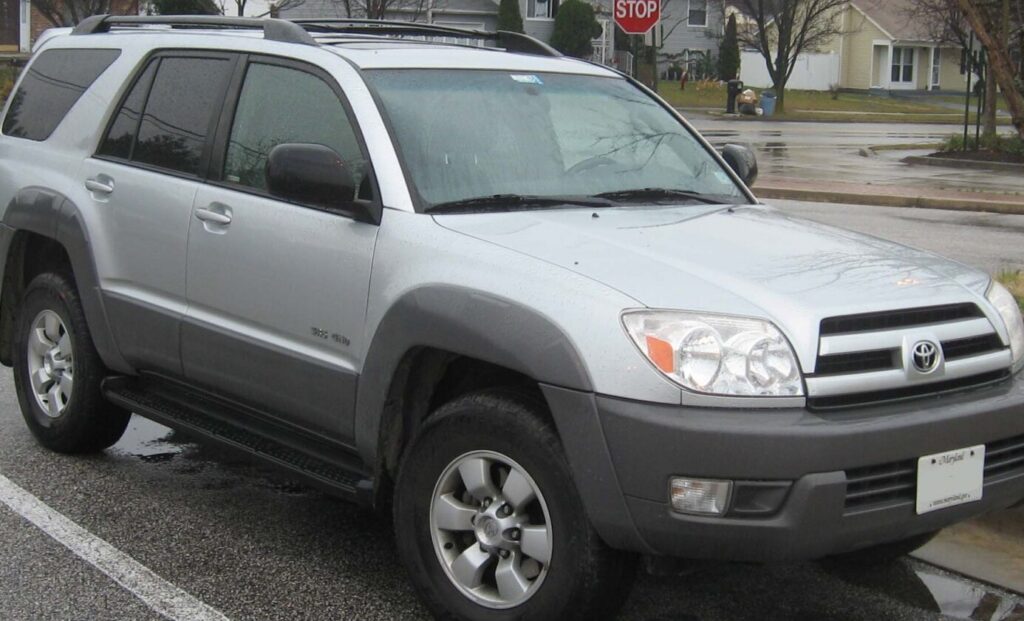
The Toyota 4Runner IV, specifically the 4.7i V8 32V variant with an automatic transmission, was produced from 2002 to 2005. This model represented the fourth generation of the 4Runner, a mid-size SUV known for its body-on-frame construction and off-road capability. Within the fourth generation (designated as J120), the 4.7i V8 served as the premium engine option, positioned above the 2.7-liter inline-four and the 3.4-liter V6 models. It was primarily marketed towards buyers seeking a more powerful and refined SUV experience, particularly those who frequently towed or ventured off paved roads. The 4Runner held a strong position in the North American SUV market, competing with vehicles like the Jeep Grand Cherokee and the Ford Explorer.
Technical Specifications
| Brand | Toyota |
| Model | 4Runner |
| Generation | 4Runner IV |
| Type (Engine) | 4.7i V8 32V (235 Hp) Automatic |
| Start of production | 2002 |
| End of production | 2005 |
| Powertrain Architecture | Internal Combustion engine |
| Body type | SUV |
| Seats | 5 |
| Doors | 5 |
| Fuel consumption (urban) | 14.7 l/100 km (16 US mpg, 19.2 UK mpg) |
| Fuel consumption (extra urban) | 11.7 l/100 km (20.1 US mpg, 24.1 UK mpg) |
| Fuel Type | Petrol (Gasoline) |
| Weight-to-power ratio | 8 kg/Hp, 124.7 Hp/tonne |
| Weight-to-torque ratio | 4.3 kg/Nm, 230.2 Nm/tonne |
| Power | 235 Hp @ 4800 rpm |
| Power per litre | 50.4 Hp/l |
| Torque | 434 Nm @ 3400 rpm (320.1 lb.-ft. @ 3400 rpm) |
| Engine layout | Front, Longitudinal |
| Engine Model/Code | 2UZ-FE |
| Engine displacement | 4664 cm3 (284.61 cu. in.) |
| Number of cylinders | 8 |
| Engine configuration | V-engine |
| Cylinder Bore | 94 mm (3.7 in.) |
| Piston Stroke | 84 mm (3.31 in.) |
| Compression ratio | 9.6:1 |
| Number of valves per cylinder | 4 |
| Fuel injection system | Multi-port manifold injection |
| Engine aspiration | Naturally aspirated engine |
| Valvetrain | DOHC |
| Engine oil capacity | 6.2 l (6.55 US qt | 5.46 UK qt) |
| Coolant capacity | 12.3 l (13 US qt | 10.82 UK qt) |
| Kerb Weight | 1885 kg (4155.71 lbs.) |
| Max. weight | 2382 kg (5251.41 lbs.) |
| Max load | 497 kg (1095.7 lbs.) |
| Trunk (boot) space – minimum | 1195 l (42.2 cu. ft.) |
| Trunk (boot) space – maximum | 2050 l (72.4 cu. ft.) |
| Fuel tank capacity | 87 l (22.98 US gal | 19.14 UK gal) |
| Permitted trailer load with brakes (12%) | 2268 kg (5000.08 lbs.) |
| Length | 4800 mm (188.98 in.) |
| Width | 1875 mm (73.82 in.) |
| Height | 1755 mm (69.09 in.) |
| Wheelbase | 2790 mm (109.84 in.) |
| Front track | 1575 mm (62.01 in.) |
| Rear (Back) track | 1575 mm (62.01 in.) |
| Ride height (ground clearance) | 226 mm (8.9 in.) |
| Minimum turning circle (turning diameter) | 11.1 m (36.42 ft.) |
| Approach angle | 31° |
| Departure angle | 24° |
| Ramp-over (brakeover) angle | 22° |
| Drivetrain Architecture | Rear wheel drive |
| Number of gears and type of gearbox | 5 gears, automatic transmission |
| Front suspension | Double wishbone |
| Rear suspension | Independent multi-link suspension |
| Front brakes | Ventilated discs |
| Rear brakes | Ventilated discs |
| Assisting systems | ABS (Anti-lock braking system) |
| Steering type | Steering rack and pinion |
| Tires size | 265/70 R16; 265/65 R17 |
| Wheel rims size | 7.0J x 16; 7.5J x 17 |
Powertrain & Engine Architecture
The heart of the 4Runner 4.7i was the 2UZ-FE 4.7-liter V8 engine. This engine, a member of Toyota’s UZ engine family, was renowned for its durability and smooth operation. It featured a cast-iron block and aluminum cylinder heads, incorporating dual overhead camshafts (DOHC) and four valves per cylinder. The 2UZ-FE utilized a multi-port fuel injection system, delivering fuel directly to each intake port. The engine’s 9.6:1 compression ratio contributed to its balance of power and efficiency. The automatic transmission paired with this engine was a five-speed unit, designed to handle the V8’s substantial torque. This transmission was electronically controlled, offering smooth shifts and adaptive learning capabilities.
Driving Characteristics
The 4.7i V8 automatic 4Runner offered a noticeably different driving experience compared to the lower-trim models. The increased horsepower and torque provided strong acceleration and effortless highway cruising. While not a sports car, the V8 delivered ample power for merging and overtaking. The automatic transmission, while smooth, wasn’t particularly sporty; it prioritized comfort and ease of use over aggressive shifting. Compared to the manual transmission options, the automatic traded some responsiveness for convenience. The gear ratios were tuned for towing and off-road performance, providing sufficient low-end torque for navigating challenging terrain.
Equipment & Trim Levels
The 4.7i V8 typically came with a higher level of standard equipment than the base 4Runner models. Standard features generally included power windows, power locks, air conditioning, a CD player, and cloth upholstery. Leather upholstery, a sunroof, and upgraded audio systems were commonly available as options. The 4Runner also offered features like multi-zone climate control and navigation systems on higher trim levels. The interior design was functional and durable, prioritizing practicality over luxury.
Chassis & Braking
The 4Runner IV maintained the traditional body-on-frame construction, providing robust durability and off-road capability. The suspension system consisted of a double wishbone setup at the front and an independent multi-link suspension at the rear. This configuration aimed to balance ride comfort with off-road performance. Braking duties were handled by ventilated disc brakes on all four wheels, providing adequate stopping power for the vehicle’s weight. An Anti-lock Braking System (ABS) was standard, enhancing safety during emergency braking situations.
Market Reception & Comparison
The 4.7i V8 4Runner was generally well-received by automotive critics. It was praised for its powerful engine, comfortable ride, and rugged durability. However, its fuel economy was a common criticism, as the V8 engine consumed significantly more fuel than the four-cylinder or V6 options. Compared to the 3.4-liter V6, the 4.7i offered a substantial power increase, but at the cost of increased fuel consumption and a higher purchase price. The 4.7i appealed to buyers who prioritized power and towing capacity over fuel efficiency.
Legacy
The 2UZ-FE engine, found in the 4.7i 4Runner, has earned a reputation for exceptional reliability. Many examples have surpassed 200,000 miles with proper maintenance. The fourth-generation 4Runner, including the 4.7i V8 variant, remains a popular choice in the used car market due to its durability, off-road capability, and relatively simple mechanical design. While fuel economy isn’t its strong suit, the 4.7i 4Runner continues to be a sought-after SUV for those seeking a reliable and capable vehicle.