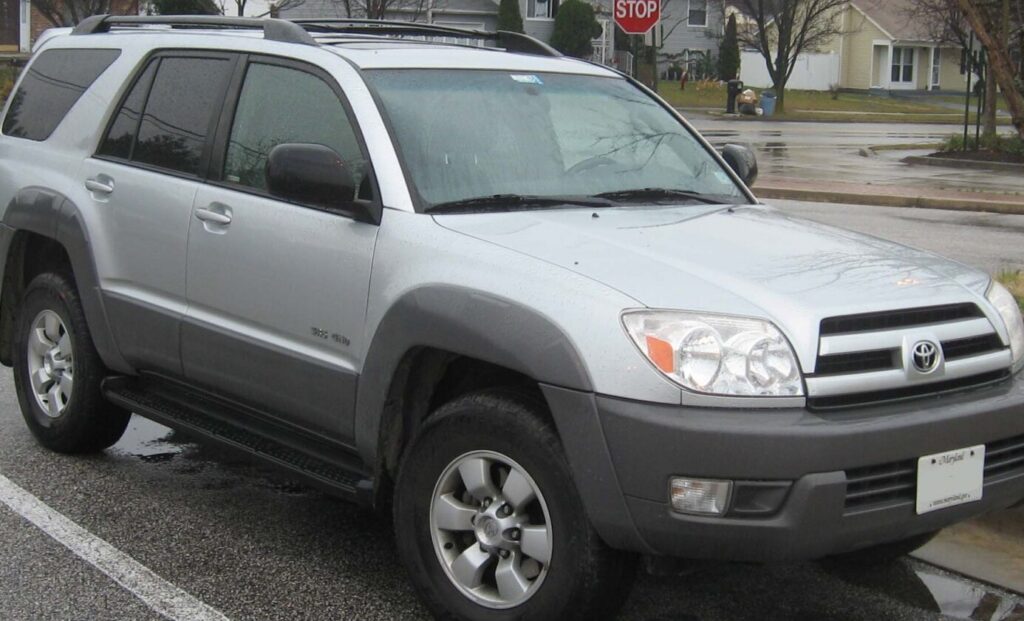
The Toyota 4Runner IV 4.7i V8, produced primarily for the 2005 model year, represented a significant step up in refinement and power for Toyota’s popular mid-size SUV. Falling within the fourth generation (2003-2009) of the 4Runner, this variant was positioned as the premium offering, catering to buyers seeking a robust, capable vehicle with V8 performance. While the 4Runner had established itself as a reliable and rugged body-on-frame SUV, the 4.7i model aimed to broaden its appeal by offering a more luxurious and powerful experience. It was primarily sold in the North American market, where larger engines and increased towing capacity were highly valued.
Technical Specifications
| Brand | Toyota |
| Model | 4Runner |
| Generation | 4Runner IV |
| Type (Engine) | 4.7i V8 32V (270 Hp) 4×4 Automatic |
| Start of production | 2005 |
| End of production | 2005 |
| Powertrain Architecture | Internal Combustion engine |
| Body type | SUV |
| Seats | 5 |
| Doors | 5 |
| Fuel consumption (urban) | 15.7 l/100 km (15 US mpg, 18 UK mpg, 6.4 km/l) |
| Fuel consumption (extra urban) | 12.4 l/100 km (19 US mpg, 22.8 UK mpg, 8.1 km/l) |
| Fuel Type | Petrol (Gasoline) |
| Weight-to-power ratio | 7.6 kg/Hp, 132.2 Hp/tonne |
| Weight-to-torque ratio | 4.6 kg/Nm, 215.4 Nm/tonne |
| Power | 270 Hp @ 5400 rpm |
| Power per litre | 57.9 Hp/l |
| Torque | 440 Nm @ 3400 rpm (324.53 lb.-ft. @ 3400 rpm) |
| Engine layout | Front, Longitudinal |
| Engine Model/Code | 2UZ-FE |
| Engine displacement | 4664 cm3 (284.61 cu. in.) |
| Number of cylinders | 8 |
| Engine configuration | V-engine |
| Cylinder Bore | 94 mm (3.7 in.) |
| Piston Stroke | 84 mm (3.31 in.) |
| Compression ratio | 9.6:1 |
| Number of valves per cylinder | 4 |
| Fuel injection system | Multi-port manifold injection |
| Engine aspiration | Naturally aspirated engine |
| Valvetrain | DOHC, VVT-i |
| Engine oil capacity | 6.2 l (6.55 US qt | 5.46 UK qt) |
| Coolant | 12.3 l (13 US qt | 10.82 UK qt) |
| Kerb Weight | 2043 kg (4504.04 lbs.) |
| Max. weight | 2724 kg (6005.39 lbs.) |
| Max load | 681 kg (1501.35 lbs.) |
| Trunk (boot) space – minimum | 1195 l (42.2 cu. ft.) |
| Trunk (boot) space – maximum | 2050 l (72.4 cu. ft.) |
| Fuel tank capacity | 87 l (22.98 US gal | 19.14 UK gal) |
| Permitted trailer load with brakes (12%) | 3311 kg (7299.51 lbs.) |
| Length | 4800 mm (188.98 in.) |
| Width | 1875 mm (73.82 in.) |
| Height | 1750 mm (68.9 in.) |
| Wheelbase | 2790 mm (109.84 in.) |
| Front track | 1575 mm (62.01 in.) |
| Rear (Back) track | 1575 mm (62.01 in.) |
| Ride height (ground clearance) | 231 mm (9.09 in.) |
| Minimum turning circle (turning diameter) | 11.1 m (36.42 ft.) |
| Approach angle | 32° |
| Departure angle | 24° |
| Ramp-over (brakeover) angle | 22° |
| Drive wheel | All wheel drive (4×4) |
| Number of gears and type of gearbox | 5 gears, automatic transmission |
| Front suspension | Double wishbone |
| Rear suspension | Independent multi-link suspension |
| Front brakes | Ventilated discs |
| Rear brakes | Ventilated discs |
| Assisting systems | ABS (Anti-lock braking system) |
| Steering type | Steering rack and pinion |
| Tires size | 265/70 R16; 265/65 R17 |
| Wheel rims size | 7.0J x 16; 7.5J x 17 |
INTRODUCTION
The 2005 Toyota 4Runner 4.7i V8 represented the pinnacle of the fourth-generation 4Runner lineup. Built on the robust 1HX0 platform (shared with the Lexus GX 470), this model offered a significant upgrade in power and refinement compared to the standard 4.0-liter inline-six engine. The 4.7i was designed to appeal to buyers who needed a capable off-road vehicle but also desired a comfortable and well-equipped daily driver. It was typically offered in Limited trim, signifying a higher level of luxury features. Production of this specific configuration was limited to the 2005 model year, making it a relatively rare find today.
Powertrain & Engine Architecture
The heart of the 4Runner 4.7i is the 2UZ-FE 4.7-liter V8 engine. This engine, a member of Toyota’s highly regarded UZ engine family, is known for its durability and smooth power delivery. It features a 90-degree V-angle, dual overhead camshafts (DOHC), and Toyota’s Variable Valve Timing-intelligent (VVT-i) system. The VVT-i system optimizes valve timing based on engine speed and load, improving both performance and fuel efficiency. Fuel delivery is handled by a multi-port fuel injection system. The engine produces 270 horsepower at 5,400 rpm and 324.53 lb-ft of torque at 3,400 rpm. Paired with the engine is a five-speed automatic transmission (A750F), chosen for its smooth shifting and ability to handle the V8’s torque output. This transmission features overdrive for improved highway fuel economy. The drivetrain is a full-time four-wheel drive system with a selectable low-range transfer case, providing excellent off-road capability.
Driving Characteristics
The 4Runner 4.7i Automatic offers a noticeably different driving experience compared to the base 4.0-liter inline-six models. The V8 provides significantly more power, resulting in quicker acceleration and more effortless highway cruising. While not a sports car, the 4.7i feels surprisingly responsive for a vehicle of its size and weight. The automatic transmission shifts smoothly, although it can sometimes feel a bit hesitant when downshifting for passing maneuvers. The gear ratios are tuned for a balance of acceleration and fuel economy. Compared to a manual transmission equipped 4Runner, the automatic sacrifices some driver engagement but offers greater convenience, especially in off-road situations. The full-time 4WD system provides excellent traction in various conditions, and the low-range transfer case allows for serious off-road exploration.
Equipment & Trim Levels
The 4.7i V8 was almost exclusively offered in the Limited trim level. Standard features included leather upholstery, heated front seats, a power driver’s seat, an upgraded audio system (often with a CD changer), automatic climate control, and alloy wheels. Optional extras included a sunroof, navigation system, and rear air conditioning. The interior design was generally considered comfortable and well-appointed for its time, although it lacked some of the more modern features found in contemporary SUVs. The Limited trim also included exterior enhancements such as chrome accents and color-matched bumpers.
Chassis & Braking
The 4Runner IV utilizes a traditional body-on-frame construction, providing a robust and durable platform. The front suspension features a double wishbone design, while the rear suspension employs an independent multi-link setup. This suspension configuration provides a comfortable ride quality both on and off-road. Braking duties are handled by ventilated disc brakes on all four wheels, providing ample stopping power. An Anti-lock Braking System (ABS) is standard. The 4.7i models typically featured slightly thicker stabilizer bars compared to the base models to help reduce body roll during cornering.
Market Reception & Comparison
The 4Runner 4.7i V8 was generally well-received by automotive critics. Reviewers praised its powerful engine, comfortable ride, and capable off-road performance. However, some criticized its fuel economy, which was significantly lower than that of the 4.0-liter inline-six models. Compared to the 4.0-liter 4Runner, the 4.7i offered a substantial performance upgrade but came at a higher price point. The 4.7i also differed significantly from the diesel-powered 4Runners available in other markets, offering a different driving experience and maintenance requirements. The Lexus GX 470, which shared the same platform and engine, was often seen as a more luxurious alternative, but at a higher cost.
Legacy
The 2UZ-FE engine in the 4Runner 4.7i has proven to be exceptionally reliable over the long term. With proper maintenance, these engines can easily exceed 200,000 miles. The 4Runner IV 4.7i has developed a strong following among enthusiasts who appreciate its combination of power, durability, and off-road capability. In the used car market, these models command a premium compared to the 4.0-liter versions, reflecting their rarity and desirability. While fuel economy remains a concern, the 4Runner 4.7i continues to be a popular choice for those seeking a rugged and dependable SUV.