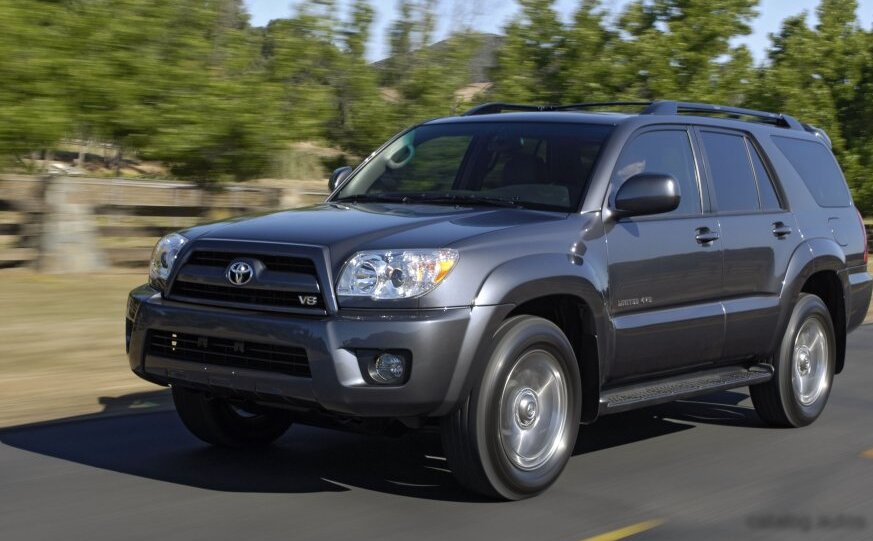
The Toyota 4Runner IV, specifically the facelifted version produced from 2005 to 2009, represented a significant evolution of Toyota’s popular mid-size SUV. This generation, internally designated as the J120 series, continued the 4Runner’s reputation for rugged capability and reliability, while adding a greater degree of refinement and comfort. The 4.7i V8 model, equipped with the 2UZ-FE engine and a five-speed automatic transmission, occupied the premium end of the 4Runner lineup, offering substantial power and towing capacity. It was positioned above the 4-cylinder and V6 models, appealing to buyers needing a robust vehicle for both on-road driving and moderate off-road adventures. This variant was primarily sold in North America, where larger engines and automatic transmissions were highly preferred.
Technical Specifications
| Brand | Toyota |
| Model | 4Runner |
| Generation | 4Runner IV (facelift 2005) |
| Type (Engine) | 4.7i V8 32V (260 Hp) Automatic |
| Start of production | 2005 |
| End of production | 2009 |
| Powertrain Architecture | Internal Combustion engine |
| Body type | SUV |
| Seats | 7 |
| Doors | 5 |
| Fuel consumption (urban) | 14.7 l/100 km (16 US mpg, 19.2 UK mpg) |
| Fuel consumption (extra urban) | 11.7 l/100 km (20.1 US mpg, 24.1 UK mpg) |
| Fuel Type | Petrol (Gasoline) |
| Weight-to-power ratio | 7.4 kg/Hp, 135.7 Hp/tonne |
| Weight-to-torque ratio | 4.6 kg/Nm, 216.1 Nm/tonne |
| Power | 260 Hp @ 5400 rpm |
| Power per litre | 55.7 Hp/l |
| Torque | 414 Nm @ 3400 rpm (305.35 lb.-ft. @ 3400 rpm) |
| Engine layout | Front, Longitudinal |
| Engine Model/Code | 2UZ-FE |
| Engine displacement | 4664 cm3 (284.61 cu. in.) |
| Number of cylinders | 8 |
| Engine configuration | V-engine |
| Cylinder Bore | 94 mm (3.7 in.) |
| Piston Stroke | 84 mm (3.31 in.) |
| Compression ratio | 10:1 |
| Number of valves per cylinder | 4 |
| Fuel injection system | Multi-port manifold injection |
| Engine aspiration | Naturally aspirated engine |
| Valvetrain | DOHC |
| Engine oil capacity | 6.2 l (6.55 US qt | 5.46 UK qt) |
| Coolant capacity | 12.3 l (13 US qt | 10.82 UK qt) |
| Kerb Weight | 1916 kg (4224.06 lbs.) |
| Max. weight | 2490 kg (5489.51 lbs.) |
| Max load | 574 kg (1265.45 lbs.) |
| Trunk (boot) space – minimum | 343 l (12.11 cu. ft.) |
| Trunk (boot) space – maximum | 1036 l (36.59 cu. ft.) |
| Fuel tank capacity | 87 l (22.98 US gal | 19.14 UK gal) |
| Permitted trailer load with brakes (12%) | 3311 kg (7299.51 lbs.) |
| Length | 4805 mm (189.17 in.) |
| Width | 1910 mm (75.2 in.) |
| Height | 1760-1805 mm (69.29 – 71.06 in.) |
| Wheelbase | 2790 mm (109.84 in.) |
| Front track | 1575 mm (62.01 in.) |
| Rear (Back) track | 1575 mm (62.01 in.) |
| Ride height (ground clearance) | 221 mm (8.7 in.) |
| Minimum turning circle (turning diameter) | 11.3 m (37.07 ft.) |
| Approach angle | 30° |
| Departure angle | 24-26° |
| Ramp-over (brakeover) angle | 24° |
| Drivetrain Architecture | Rear wheel drive |
| Number of gears and type of gearbox | 5 gears, automatic transmission |
| Front suspension | Double wishbone |
| Rear suspension | Independent multi-link suspension |
| Front brakes | Ventilated discs |
| Rear brakes | Ventilated discs |
| Assisting systems | ABS (Anti-lock braking system) |
| Steering type | Steering rack and pinion |
| Tires size | 265/70 R16; 265/65 R17; 265/60 R18 |
| Wheel rims size | 7.0J x 16; 7.5J x 17; 7.5J x 18 |
Powertrain & Engine Architecture
The heart of the 4.7i 4Runner is the 2UZ-FE 4.7-liter V8 engine. This engine, a member of Toyota’s UZ engine family, is renowned for its durability and smooth operation. It features a cast-iron block and aluminum cylinder heads, incorporating dual overhead camshafts (DOHC) and four valves per cylinder. The multi-port fuel injection system delivers fuel directly to each intake port, optimizing combustion efficiency. The 2UZ-FE is a naturally aspirated engine, meaning it doesn’t rely on turbocharging or supercharging for increased power. The five-speed automatic transmission (A750F) was specifically chosen for its ability to handle the V8’s torque output and provide relatively smooth shifts. This transmission features electronically controlled torque converter lock-up for improved fuel economy at highway speeds. The transmission’s gear ratios were tuned for a balance between acceleration and cruising efficiency, prioritizing comfortable highway driving over outright performance.
Driving Characteristics
The 4.7i 4Runner delivers a noticeably different driving experience compared to the 4-cylinder or V6 models. The V8 provides ample low-end torque, making it easy to accelerate from a standstill or maintain speed on inclines. While not a sports car, the 4Runner V8 offers confident passing power. The automatic transmission, while smooth, isn’t particularly quick to downshift, so drivers may need to anticipate passing maneuvers. Compared to the manual transmission options available on lower trims, the automatic prioritizes convenience over driver engagement. Fuel economy is considerably lower than the smaller engine options, reflecting the V8’s larger displacement and increased power output. The weight distribution, while not ideal, is manageable, and the suspension does a good job of absorbing bumps and providing a comfortable ride.
Equipment & Trim Levels
The 4.7i 4Runner typically came well-equipped, reflecting its position as the premium trim level. Standard features generally included power windows, power locks, air conditioning, a CD player, and cloth upholstery. Higher-end versions often added leather upholstery, a sunroof, heated seats, and a premium sound system. Optional extras included a navigation system, rear-seat entertainment system, and upgraded wheels. The interior design was functional and durable, prioritizing practicality over luxury. The 4Runner’s spacious interior comfortably accommodated up to seven passengers, making it a popular choice for families.
Chassis & Braking
The 4Runner IV utilizes a body-on-frame construction, providing a robust and durable platform for off-road driving. The front suspension features a double wishbone design, while the rear utilizes an independent multi-link suspension. This setup provides a good balance of ride comfort and off-road capability. The 4.7i models were equipped with ventilated disc brakes on all four wheels, providing ample stopping power. An Anti-lock Braking System (ABS) was standard, enhancing safety during emergency braking situations. The 4Runner’s relatively high ground clearance (8.7 inches) allows it to navigate moderately challenging terrain.
Market Reception & Comparison
The 4.7i 4Runner was generally well-received by automotive critics, who praised its powerful engine, comfortable ride, and spacious interior. However, its fuel economy was often criticized, especially compared to the V6 models. Compared to competitors like the Jeep Grand Cherokee and the Ford Explorer, the 4Runner offered a reputation for superior reliability and off-road capability. The V8 4Runner appealed to buyers who prioritized power and towing capacity over fuel efficiency. The 4-cylinder and V6 models were more popular with budget-conscious buyers who didn’t require the extra power of the V8.
Legacy
The 2UZ-FE engine, found in the 4.7i 4Runner, has earned a reputation as one of Toyota’s most durable and reliable engines. With proper maintenance, these engines can easily exceed 200,000 miles. The 4Runner IV, particularly the V8 models, hold their value well in the used car market, due to their reputation for reliability and capability. While fuel economy remains a concern, the 4.7i 4Runner continues to be a popular choice for buyers seeking a rugged and dependable SUV. Parts availability is generally good, and the 4Runner’s simple design makes it relatively easy to maintain and repair.