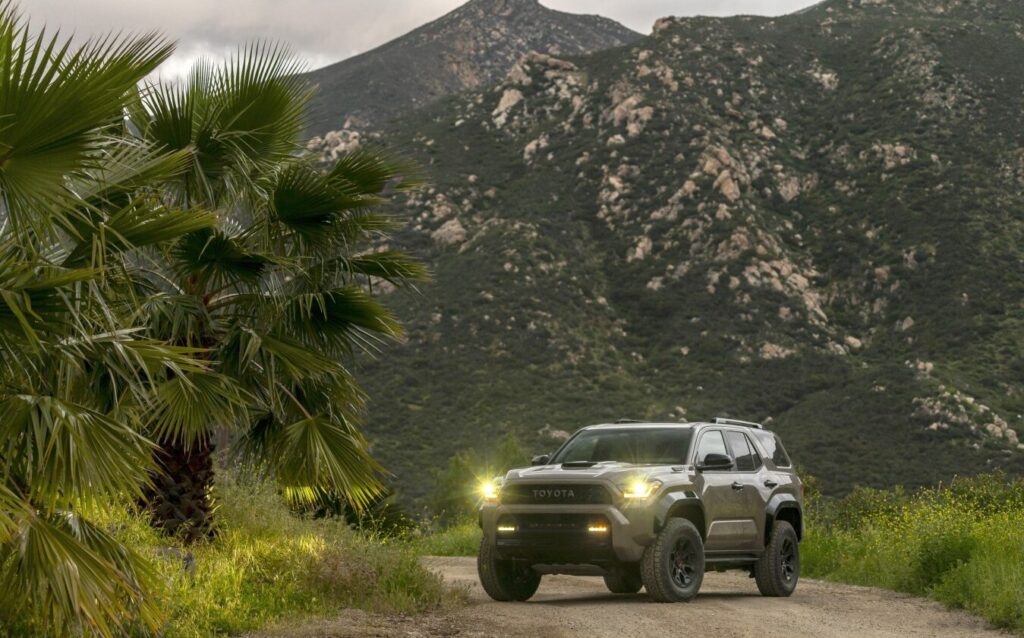
The Toyota 4Runner VI TRD Pro 2.4 i-FORCE MAX, introduced in December 2024, represents the latest iteration of Toyota’s iconic off-road SUV. This variant is a significant departure for the 4Runner line, incorporating a full hybrid electric vehicle (FHEV) powertrain for increased efficiency and performance. Positioned as the top-tier, performance-focused trim of the sixth-generation 4Runner, the TRD Pro i-FORCE MAX aims to deliver both robust off-road capability and a more refined on-road driving experience. It builds upon the 4Runner’s longstanding reputation for durability and reliability, while addressing criticisms regarding fuel economy and power delivery.
Technical Specifications
| Brand | Toyota |
| Model | 4Runner |
| Generation | 4Runner VI |
| Type | TRD Pro 2.4 i-FORCE MAX (326 Hp) Hybrid 4WD ECT-i |
| Start of production | December, 2024 |
| Powertrain Architecture | FHEV (Full Hybrid Electric Vehicle) |
| Body type | SUV |
| Seats | 5 |
| Doors | 5 |
| Fuel consumption (urban) | 10.2 l/100 km (23.1 US mpg, 27.7 UK mpg, 9.8 km/l) |
| Fuel consumption (extra urban) | 9.8 l/100 km (24 US mpg, 28.8 UK mpg, 10.2 km/l) |
| Fuel consumption (combined) | 10.2 l/100 km (23.1 US mpg, 27.7 UK mpg, 9.8 km/l) |
| Fuel Type | Petrol (Gasoline) |
| Weight-to-power ratio | 7.6 kg/Hp, 131.8 Hp/tonne |
| Weight-to-torque ratio | 3.9 kg/Nm, 254.6 Nm/tonne |
| Gross battery capacity | 1.87 kWh |
| Battery voltage | 288 V |
| Battery technology | Nickel-metal hydride (NiMH) |
| Battery location | Under the trunk |
| Electric motor power | 48 Hp |
| Electric motor Torque | 250 Nm (184.39 lb.-ft.) |
| Electric motor type | Synchronous |
| System power | 326 Hp @ 6000 rpm |
| System torque | 630 Nm @ 1700 rpm (464.66 lb.-ft. @ 1700 rpm) |
| Internal combustion engine power | 278 Hp @ 6000 rpm |
| Power per litre | 116.2 Hp/l |
| Internal combustion engine torque | 430 Nm @ 1700 rpm (317.15 lb.-ft. @ 1700 rpm) |
| Engine layout | Front, Longitudinal |
| Engine Model/Code | Dynamic Force / T24A-FTS |
| Engine displacement | 2393 cm3 (146.03 cu. in.) |
| Number of cylinders | 4 |
| Engine configuration | Inline |
| Cylinder Bore | 87.5 mm (3.44 in.) |
| Piston Stroke | 99.5 mm (3.92 in.) |
| Compression ratio | 11:1 |
| Number of valves per cylinder | 4 |
| Fuel injection system | Direct injection and Multi-port manifold injection |
| Engine aspiration | Twin-scroll turbo, Intercooler |
| Valvetrain | DOHC, Dual VVT-i |
| Engine oil capacity | 5.6 l (5.92 US qt | 4.93 UK qt) |
| Kerb Weight | 2474 kg (5454.24 lbs.) |
| Max. weight | 2951 kg (6505.84 lbs.) |
| Max load | 477 kg (1051.6 lbs.) |
| Trunk (boot) space – minimum | 1206 l (42.59 cu. ft.) |
| Trunk (boot) space – maximum | 2339 l (82.6 cu. ft.) |
| Fuel tank capacity | 72 l (19.02 US gal | 15.84 UK gal) |
| Permitted trailer load with brakes (12%) | 2631 kg (5800.36 lbs.) |
| Length | 4950 mm (194.88 in.) |
| Width | 2029 mm (79.88 in.) |
| Height | 1880 mm (74.02 in.) |
| Wheelbase | 2850 mm (112.2 in.) |
| Front track | 1748 mm (68.82 in.) |
| Rear (Back) track | 1748 mm (68.82 in.) |
| Ride height (ground clearance) | 257 mm (10.12 in.) |
| Minimum turning circle (turning diameter) | 12 m (39.37 ft.) |
| Approach angle | 33° |
| Departure angle | 24° |
| Ramp-over (brakeover) angle | 24° |
| Drivetrain Architecture | The Internal combustion engine (ICE) and the electric motor permanently drive the rear wheels of the vehicle, capable of running in full electric or mixed mode, and if necessary through the electrically or mechanically controlled clutch, the front wheels are driven. |
| Drive wheel | All wheel drive (4×4) |
| Number of gears and type of gearbox | 8 gears, automatic transmission ECT-i |
| Front suspension | Coil spring, Double wishbone, Transverse stabilizer |
| Rear suspension | Rigid axle suspension, Transverse stabilizer, Coil spring |
| Front brakes | Ventilated discs, 340 mm |
| Rear brakes | Ventilated discs, 335 mm |
| Assisting systems | ABS (Anti-lock braking system) |
| Steering type | Steering rack and pinion |
| Power steering | Electric Steering |
| Tires size | 265/70 R18 |
| Wheel rims size | 18 |
INTRODUCTION
The 2024 Toyota 4Runner VI TRD Pro 2.4 i-FORCE MAX represents a significant evolution for the 4Runner, a model renowned for its body-on-frame construction and off-road prowess. The sixth generation, launched in late 2024, marks the first complete redesign of the 4Runner in over a decade. This TRD Pro variant, equipped with the new 2.4-liter i-FORCE MAX hybrid powertrain, is positioned as the flagship model, offering a blend of increased power, improved fuel efficiency, and enhanced off-road capabilities. It’s built on the 5AX platform, shared with the Tacoma pickup truck, and aims to appeal to buyers seeking a capable and modern SUV with a focus on performance and technology.
Powertrain & Engine Architecture
At the heart of the TRD Pro i-FORCE MAX lies Toyota’s 2.4-liter turbocharged four-cylinder engine (T24A-FTS), coupled with a 48-horsepower electric motor integrated into the eight-speed automatic transmission. This configuration delivers a combined system output of 326 horsepower and 630 lb-ft of torque. The engine utilizes direct injection and a multi-port manifold injection system, along with a twin-scroll turbocharger and intercooler, to optimize performance and efficiency. The electric motor draws power from a 1.87 kWh nickel-metal hydride (NiMH) battery pack located under the trunk floor. The powertrain operates in various modes, including EV mode for short-distance, low-speed driving, and a hybrid mode that seamlessly blends power from the engine and motor. The ECT-i (Electronically Controlled Transmission – intelligent) automatic transmission is specifically tuned for the hybrid system, providing smooth and responsive shifting.
Driving Characteristics
The i-FORCE MAX powertrain transforms the driving experience of the 4Runner. The substantial increase in torque, particularly at low RPMs, provides effortless acceleration and improved towing capacity. The hybrid system allows for quicker responses and a more refined feel compared to previous 4Runner generations. While the 4Runner remains a body-on-frame SUV, the hybrid powertrain contributes to a more composed ride quality. The eight-speed automatic transmission is well-matched to the engine’s powerband, offering smooth gear changes and efficient operation. Off-road, the combination of the hybrid system’s instant torque and the 4Runner’s robust four-wheel-drive system delivers exceptional traction and control. Compared to the standard 2.4-liter turbocharged engine without the hybrid assist, the i-FORCE MAX offers a noticeable improvement in both power and responsiveness.
Equipment & Trim Levels
The TRD Pro trim comes standard with a comprehensive suite of features designed for both comfort and off-road capability. Interior appointments include unique TRD Pro upholstery, heated and ventilated front seats, and a premium audio system. Standard technology features include a 12.3-inch touchscreen infotainment system with wireless Apple CarPlay and Android Auto compatibility, a digital instrument cluster, and Toyota Safety Sense 3.0, a suite of advanced driver-assistance systems. Optional extras include a panoramic sunroof, upgraded wheels and tires, and various off-road accessories such as a roof rack and rock sliders. The TRD Pro also features distinctive exterior styling cues, including a unique front grille, TRD-branded wheels, and a functional roof rack.
Chassis & Braking
The 4Runner VI TRD Pro utilizes a robust body-on-frame construction, providing a solid foundation for off-road adventures. The suspension features coil springs, double wishbones at the front, and a rigid axle setup with a transverse stabilizer bar at the rear. The TRD Pro benefits from upgraded Fox shocks and springs, providing enhanced damping and articulation for improved off-road performance. Braking duties are handled by ventilated discs at all four corners, measuring 340mm at the front and 335mm at the rear. The anti-lock braking system (ABS) and electronic brake-force distribution (EBD) contribute to safe and controlled stopping performance.
Market Reception & Comparison
The introduction of the i-FORCE MAX hybrid powertrain has been largely well-received by automotive critics. The increased power and improved fuel economy are seen as significant upgrades over previous 4Runner models. While the 4Runner’s body-on-frame construction results in a less refined on-road ride compared to some unibody competitors, its off-road capability remains a key selling point. Compared to other trims in the 4Runner lineup, the TRD Pro i-FORCE MAX represents the premium offering, commanding a higher price point but delivering superior performance and features. Competitors such as the Jeep Grand Cherokee Trailhawk and Ford Bronco offer similar levels of off-road capability, but the 4Runner’s reputation for reliability and resale value remains a strong advantage.
Legacy
The 4Runner has a long-standing reputation for durability and reliability, and the i-FORCE MAX powertrain is expected to continue this legacy. Toyota’s hybrid technology has proven to be exceptionally reliable in other models, and the 4Runner’s robust construction should ensure long-term dependability. In the used car market, the sixth-generation 4Runner TRD Pro i-FORCE MAX is anticipated to hold its value well, due to its combination of performance, capability, and Toyota’s strong brand reputation. The introduction of the hybrid powertrain marks a significant step forward for the 4Runner, positioning it as a modern and competitive SUV in a rapidly evolving market.