
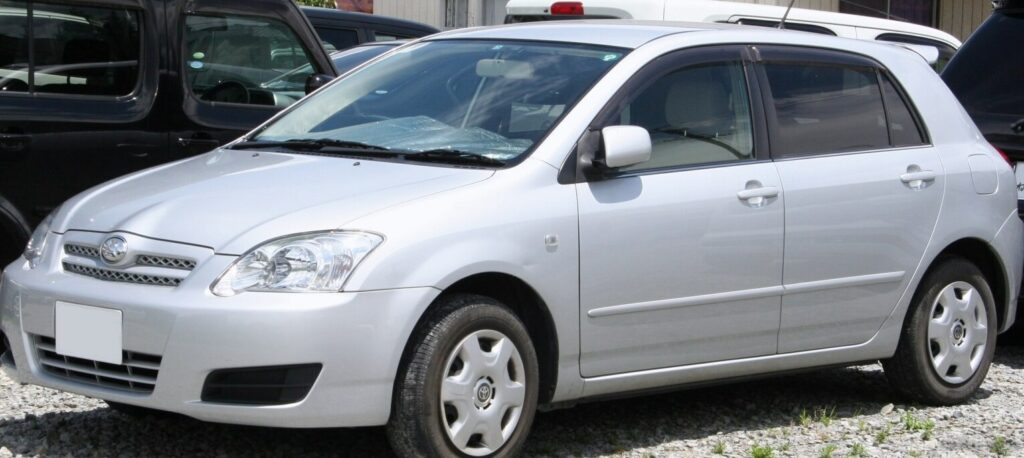
Technical Specifications
| Brand | Toyota |
| Model | Allex |
| Generation | Allex |
| Type (Engine) | 1.5 i (110 Hp) ECT |
| Start of production | 2001 |
| End of production | 2006 |
| Powertrain Architecture | Internal Combustion engine |
| Body type | Hatchback |
| Seats | 5 |
| Doors | 5 |
| Fuel Type | Petrol (Gasoline) |
| Weight-to-power ratio | 9.7 kg/Hp, 102.8 Hp/tonne |
| Weight-to-torque ratio | 7.5 kg/Nm, 133.6 Nm/tonne |
| Power | 110 Hp @ 6000 rpm |
| Power per litre | 73.5 Hp/l |
| Torque | 143 Nm @ 4200 rpm (105.47 lb.-ft. @ 4200 rpm) |
| Engine layout | Front, Transverse |
| Engine Model/Code | 1NZ-FE |
| Engine displacement | 1496 cm3 (91.29 cu. in.) |
| Number of cylinders | 4 |
| Engine configuration | Inline |
| Cylinder Bore | 75 mm (2.95 in.) |
| Piston Stroke | 84.7 mm (3.33 in.) |
| Compression ratio | 10.5:1 |
| Number of valves per cylinder | 4 |
| Fuel injection system | Multi-port manifold injection |
| Engine aspiration | Naturally aspirated engine |
| Valvetrain | DOHC |
| Engine oil capacity | 3.7 l (3.91 US qt | 3.26 UK qt) |
| Coolant | 5.9 l (6.23 US qt | 5.19 UK qt) |
| Kerb Weight | 1070-1080 kg (2358.95 – 2380.99 lbs.) |
| Max. weight | 1355 kg (2987.26 lbs.) |
| Max load | 275-285 kg (606.27 – 628.32 lbs.) |
| Fuel tank capacity | 50 l (13.21 US gal | 11 UK gal) |
| Length | 4175 mm (164.37 in.) |
| Width | 1695 mm (66.73 in.) |
| Height | 1470 mm (57.87 in.) |
| Wheelbase | 2600 mm (102.36 in.) |
| Front track | 1490 mm (58.66 in.) |
| Rear (Back) track | 1470 mm (57.87 in.) |
| Ride height (ground clearance) | 160 mm (6.3 in.) |
| Minimum turning circle (turning diameter) | 9.8 m (32.15 ft.) |
| Drivetrain Architecture | The Internal combustion engine (ICE) drives the front wheels of the vehicle. |
| Drive wheel | Front wheel drive |
| Number of gears and type of gearbox | 4 gears, automatic transmission ECT |
| Front suspension | Independent type McPherson |
| Rear suspension | Coil spring, Torsion |
| Front brakes | Ventilated discs |
| Rear brakes | Drum |
| Assisting systems | ABS (Anti-lock braking system) |
| Steering type | Steering rack and pinion |
| Tires size | 175/70 R14 |
| Wheel rims size | 5.5J x 14 |
The Toyota Allex 1.5 i (110 Hp) ECT, produced between 2001 and 2006, was a compact hatchback primarily aimed at the Japanese domestic market (JDM). Positioned as a practical and affordable option within the Allex range (which also included the Corolla-based Allex), the 1.5 i offered a balance between fuel efficiency and adequate performance for everyday driving. It was part of the first generation of the Allex, designated as the E120 series, sharing its platform with the Toyota Corolla. The “ECT” designation signifies the electronically controlled transmission – a four-speed automatic – that was a key feature of this variant. This model filled the entry-level to mid-range position in the Allex lineup, offering a more accessible price point than the higher-powered or more feature-rich trims.
Powertrain & Engine Architecture
The heart of the Allex 1.5 i ECT is the 1NZ-FE engine, a 1.5-liter inline-four cylinder gasoline engine. This engine is a member of Toyota’s NZ engine family, known for its reliability and fuel efficiency. The 1NZ-FE utilizes a multi-port fuel injection system, delivering fuel directly to each intake port for optimized combustion. It features a double overhead camshaft (DOHC) valvetrain, enhancing volumetric efficiency and contributing to the engine’s power output. The engine produces 110 horsepower at 6000 rpm and 143 Nm (105.47 lb-ft) of torque at 4200 rpm. Paired with this engine is a four-speed electronically controlled automatic transmission (ECT). This transmission was designed to provide smooth shifts and contribute to the vehicle’s overall ease of driving. The ECT system adapts shift patterns based on driving conditions and throttle input.
Driving Characteristics
The 1.5L engine and four-speed automatic combination in the Allex delivers adequate, but not particularly sporty, performance. Acceleration is best described as leisurely, with a 0-60 mph time estimated around 11-12 seconds. The automatic transmission prioritizes fuel economy over rapid acceleration, resulting in relatively conservative gear ratios. Compared to the manual transmission versions of the Allex 1.5, the automatic suffers a slight performance penalty. Higher-trim Allex models equipped with larger engines, such as the 1.8L, offered significantly more responsive acceleration. However, the automatic transmission provides a comfortable and convenient driving experience, particularly in urban environments. The power delivery is linear, making it predictable and easy to modulate.
Equipment & Trim Levels
The Allex 1.5 i ECT typically came equipped with a reasonable level of standard features. These included power windows, power door locks, and air conditioning. Interior upholstery was generally cloth, with a simple and functional dashboard layout. Optional extras available for this trim level often included alloy wheels, a CD player, and upgraded audio systems. Higher trim levels offered features like a sunroof, woodgrain interior trim, and more advanced audio systems. The focus of the 1.5 i trim was on providing essential features at an affordable price point.
Chassis & Braking
The Allex 1.5 i ECT utilizes a front-wheel-drive layout with an independent McPherson strut suspension in the front and a coil spring torsion beam suspension in the rear. This suspension setup provides a comfortable ride quality, absorbing bumps and irregularities in the road surface effectively. Braking duties are handled by ventilated discs in the front and drum brakes in the rear. An Anti-lock Braking System (ABS) was standard, enhancing braking performance and stability, particularly in slippery conditions. The chassis is relatively lightweight, contributing to the vehicle’s fuel efficiency and handling characteristics. Stabilizer bars were included to reduce body roll during cornering.
Market Reception & Comparison
The Toyota Allex 1.5 i ECT was generally well-received in the Japanese market as a practical and reliable compact hatchback. Critics praised its fuel efficiency and comfortable ride. However, some reviewers noted that the 1.5-liter engine and automatic transmission combination lacked the performance of higher-trim models. Compared to other compact hatchbacks available in Japan at the time, the Allex offered a competitive combination of features, reliability, and affordability. The 1.8L variants were favored by drivers seeking more power, while the 1.5L appealed to those prioritizing fuel economy and ease of use. Reliability reports generally indicate that the 1NZ-FE engine is exceptionally durable, with many examples exceeding 200,000 kilometers without major issues.
Legacy
The Toyota Allex 1.5 i ECT, while not a performance icon, has proven to be a durable and dependable vehicle. In the used car market, these models are often sought after for their affordability and Toyota’s reputation for reliability. The 1NZ-FE engine is known for its longevity and relatively low maintenance costs. Common issues are typically limited to routine maintenance items such as spark plugs, air filters, and oil changes. The availability of spare parts remains good, making it relatively easy and inexpensive to keep these vehicles on the road. The Allex 1.5 i ECT represents a practical and economical choice for those seeking a reliable and fuel-efficient compact hatchback.
