
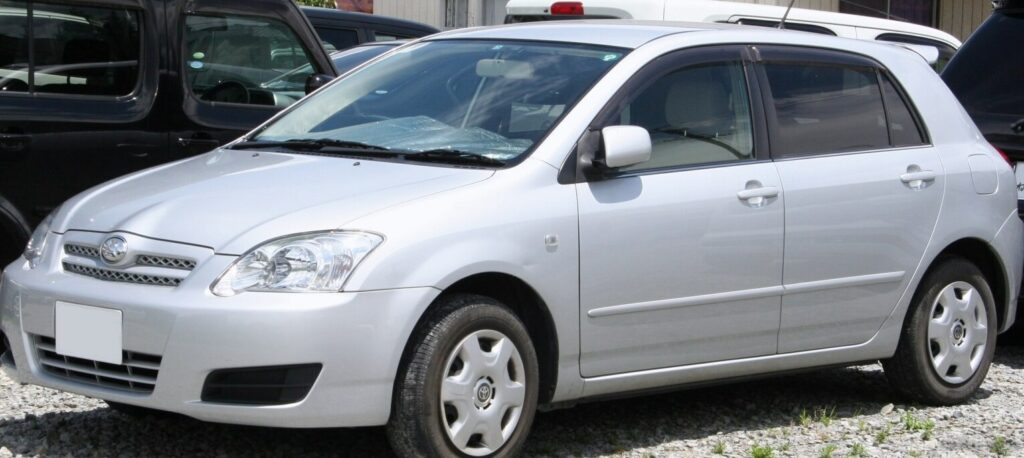
The Toyota Allex 1.8 i (190 Hp) ECT, produced between 2001 and 2006, was a compact hatchback marketed primarily in Japan. It represented a more sporty and upscale offering within Toyota’s lineup, positioned above the more basic Yaris/Echo models but below the Corolla. The Allex, along with its nearly identical twin the Toyota Caldina, aimed to provide a blend of practicality, performance, and a slightly more premium feel than traditionally associated with Toyota’s entry-level vehicles. It was built on the Toyota MC platform, shared with other models like the Corolla and Celica, offering a relatively sophisticated chassis for its class. The “ECT” designation signifies the electronically controlled transmission, a four-speed automatic in this variant.
Technical Specifications
| Brand | Toyota |
| Model | Allex |
| Generation | Allex |
| Type (Engine) | 1.8 i (190 Hp) ECT |
| Start of production | 2001 |
| End of production | 2006 |
| Body type | Hatchback |
| Seats | 5 |
| Doors | 5 |
| Fuel Type | Petrol (Gasoline) |
| Weight-to-power ratio | 6.2 kg/Hp, 161 Hp/tonne |
| Weight-to-torque ratio | 6.6 kg/Nm, 152.5 Nm/tonne |
| Power | 190 Hp @ 7600 rpm |
| Power per litre | 105.8 Hp/l |
| Torque | 180 Nm @ 6800 rpm (132.76 lb.-ft. @ 6800 rpm) |
| Engine layout | Front, Transverse |
| Engine Model/Code | 2ZZ-GE |
| Engine displacement | 1795 cm3 (109.54 cu. in.) |
| Number of cylinders | 4 |
| Engine configuration | Inline |
| Cylinder Bore | 82 mm (3.23 in.) |
| Piston Stroke | 85 mm (3.35 in.) |
| Compression ratio | 11.5:1 |
| Number of valves per cylinder | 4 |
| Fuel injection system | Multi-port manifold injection |
| Engine aspiration | Naturally aspirated engine |
| Valvetrain | DOHC, VVTL-i |
| Engine oil capacity | 3.7 l (3.91 US qt | 3.26 UK qt) |
| Coolant | 6.5 l (6.87 US qt | 5.72 UK qt) |
| Kerb Weight | 1180-1190 kg (2601.45 – 2623.5 lbs.) |
| Max. weight | 1465 kg (3229.77 lbs.) |
| Max load | 275-285 kg (606.27 – 628.32 lbs.) |
| Fuel tank capacity | 50 l (13.21 US gal | 11 UK gal) |
| Length | 4175 mm (164.37 in.) |
| Width | 1695 mm (66.73 in.) |
| Height | 1470 mm (57.87 in.) |
| Wheelbase | 2600 mm (102.36 in.) |
| Front track | 1480 mm (58.27 in.) |
| Rear (Back) track | 1460 mm (57.48 in.) |
| Ride height (ground clearance) | 160 mm (6.3 in.) |
| Minimum turning circle (turning diameter) | 10.2 m (33.46 ft.) |
| Drivetrain Architecture | The Internal combustion engine (ICE) drives the front wheels of the vehicle. |
| Drive wheel | Front wheel drive |
| Number of gears and type of gearbox | 4 gears, automatic transmission ECT |
| Front suspension | Independent type McPherson |
| Rear suspension | Coil spring, Torsion |
| Front brakes | Ventilated discs |
| Rear brakes | Disc |
| Assisting systems | ABS (Anti-lock braking system) |
| Steering type | Steering rack and pinion |
| Tires size | 185/70 R14 |
| Wheel rims size | 6J x 14 |
Powertrain & Engine Architecture
The heart of the Allex 1.8 i ECT is the 2ZZ-GE engine, a 1.8-liter (1795 cc) inline-four cylinder powerplant. This engine is notable for its use of Toyota’s VVTL-i (Variable Valve Timing and Lift – intelligent) technology. VVTL-i is a more advanced system than traditional VVT, allowing for not only changes in valve timing but also valve lift, effectively altering the engine’s cam profile for improved performance at higher RPMs. The 2ZZ-GE utilizes multi-port fuel injection and a compression ratio of 11.5:1, contributing to its relatively high output for a naturally aspirated engine of its size. The four-speed automatic transmission, designated “ECT,” is electronically controlled, offering smoother shifts and adaptive learning capabilities compared to older automatic designs. While not a particularly modern transmission by today’s standards, it was well-regarded for its reliability and responsiveness within its intended application.
Driving Characteristics
The 190 horsepower and 180 Nm (132.76 lb-ft) of torque delivered by the 2ZZ-GE engine, coupled with the four-speed automatic, resulted in a reasonably brisk driving experience. Acceleration was adequate for everyday driving, but the automatic transmission did slightly diminish the engine’s potential compared to the available manual transmission. The ECT transmission’s gear ratios were tuned for a balance of fuel economy and performance, prioritizing smooth cruising over aggressive acceleration. Compared to lower-spec Allex models with smaller engines, the 1.8 i offered a noticeable improvement in responsiveness and highway passing power. However, it didn’t quite match the performance of the more focused sports models available at the time, like the Celica GT-S which also used the 2ZZ-GE but with a more performance-oriented tune and a closer-ratio manual gearbox.
Equipment & Trim Levels
The Allex 1.8 i ECT typically came equipped with a reasonable level of standard features. These included power windows, power locks, air conditioning, and a basic audio system. Higher trim levels offered options such as alloy wheels, a sunroof, upgraded interior upholstery (often cloth or a combination of cloth and vinyl), and a more sophisticated audio system. The interior design was functional and relatively modern for its time, with a focus on practicality and ease of use. The dashboard layout was straightforward, and the materials used were of decent quality, though not luxurious.
Chassis & Braking
The Allex utilized an independent McPherson strut suspension in the front and a coil spring torsion beam suspension in the rear. This setup provided a comfortable ride quality while maintaining reasonable handling characteristics. The front brakes were ventilated discs, offering good stopping power, while the rear brakes were solid discs. Anti-lock Braking System (ABS) was standard, enhancing safety. The chassis was relatively lightweight, contributing to the car’s agility. Stabilizer bars were fitted to both the front and rear axles to reduce body roll during cornering.
Market Reception & Comparison
The Toyota Allex 1.8 i ECT was generally well-received in the Japanese market. Critics praised its sporty styling, responsive engine, and comfortable ride. However, some noted that the automatic transmission held the engine back from reaching its full potential. Compared to other compact hatchbacks of the time, the Allex offered a compelling combination of performance, practicality, and reliability. Fuel economy was respectable, averaging around 7-8 liters per 100 kilometers (30-35 mpg) in mixed driving conditions. The 1.8 i variant was positioned as a step up from the base models, appealing to buyers who wanted more power and a slightly more premium experience.
Legacy
The Toyota Allex, and its Caldina sibling, have developed a modest following among enthusiasts. The 2ZZ-GE engine is known for its durability and potential for modification, making it a popular choice for engine swaps and performance upgrades. While not as iconic as some other Toyota models, the Allex represents a unique and interesting chapter in the company’s history. Today, well-maintained examples are becoming increasingly rare, and prices for clean, low-mileage cars are steadily rising. The 1.8 i ECT variant, while not the most sought-after version, remains a reliable and enjoyable compact hatchback for those seeking a blend of practicality and performance.
