
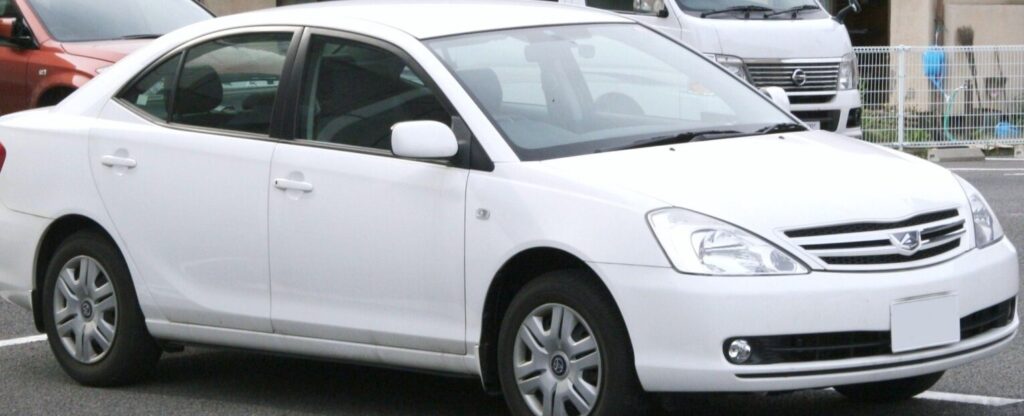
The Toyota Allion 1.8 16V (125 Hp) 4WD ECT was a compact sedan produced by Toyota from 2001 to 2004. Positioned as a slightly more upscale offering than the Corolla, the Allion aimed to provide a comfortable and practical vehicle for families and commuters. This particular variant, equipped with the 1ZZ-FE engine and a four-speed automatic transmission coupled with all-wheel drive, represented a mid-range option within the Allion lineup, offering a balance between performance, fuel efficiency, and all-weather capability. It was primarily marketed in Japan and select Asian markets.
Technical Specifications
| Brand | Toyota |
| Model | Allion |
| Generation | Allion |
| Type | 1.8 16V (125 Hp) 4WD ECT |
| Start of production | 2001 |
| End of production | 2004 |
| Powertrain Architecture | Internal Combustion engine |
| Body type | Sedan |
| Seats | 5 |
| Doors | 4 |
| Fuel consumption (urban) | 10.5 l/100 km (22.4 US mpg) |
| Fuel consumption (extra urban) | 6.5 l/100 km (36.2 US mpg) |
| Fuel Type | Petrol (Gasoline) |
| Maximum speed | 200 km/h (124.27 mph) |
| Weight-to-power ratio | 10.2 kg/Hp |
| Weight-to-torque ratio | 8 kg/Nm |
| Power | 125 Hp @ 6000 rpm |
| Power per litre | 69.7 Hp/l |
| Torque | 161 Nm @ 4200 rpm (118.75 lb.-ft. @ 4200 rpm) |
| Engine layout | Front, Transverse |
| Engine Model/Code | 1ZZ-FE |
| Engine displacement | 1794 cm3 (109.48 cu. in.) |
| Number of cylinders | 4 |
| Engine configuration | Inline |
| Cylinder Bore | 79 mm (3.11 in.) |
| Piston Stroke | 91.5 mm (3.6 in.) |
| Compression ratio | 10:1 |
| Number of valves per cylinder | 4 |
| Fuel injection system | Multi-port manifold injection |
| Engine aspiration | Naturally aspirated |
| Engine oil capacity | 3.7 l (3.91 US qt | 3.26 UK qt) |
| Coolant capacity | 6.5 l (6.87 US qt | 5.72 UK qt) |
| Kerb Weight | 1280 kg (2821.92 lbs.) |
| Max. weight | 1555 kg (3428.19 lbs.) |
| Max load | 275 kg (606.27 lbs.) |
| Fuel tank capacity | 60 l (15.85 US gal | 13.2 UK gal) |
| Length | 4600 mm (181.1 in.) |
| Width | 1695 mm (66.73 in.) |
| Height | 1470 mm (57.87 in.) |
| Wheelbase | 2700 mm (106.3 in.) |
| Front track | 1480 mm (58.27 in.) |
| Rear track | 1460 mm (57.48 in.) |
| Ride height (ground clearance) | 165 mm (6.5 in.) |
| Minimum turning circle | 10.8 m (35.43 ft.) |
| Drivetrain Architecture | All wheel drive (4×4) |
| Number of gears | 4 |
| Gearbox type | Automatic transmission ECT |
| Front suspension | Spring Strut |
| Rear suspension | Double wishbone |
| Front brakes | Ventilated discs |
| Rear brakes | Drum |
| Assisting systems | ABS (Anti-lock braking system) |
| Steering type | Steering rack and pinion |
| Power steering | Hydraulic |
| Tires size | 185/70 R14 |
| Wheel rims size | 6J x 14 |
Powertrain & Engine Architecture
The heart of the Allion 1.8 4WD was the 1ZZ-FE engine, a 1.8-liter (1794 cc) inline-four cylinder gasoline engine. This engine was a member of Toyota’s ZZ engine family, known for its lightweight aluminum block and cylinder head, and its use of multi-port fuel injection. The 1ZZ-FE featured a double overhead camshaft (DOHC) valvetrain with four valves per cylinder, contributing to its relatively high output for its displacement. The engine produced 125 horsepower at 6000 rpm and 161 Nm (118.75 lb-ft) of torque at 4200 rpm. The four-speed automatic transmission, designated ECT (Electronically Controlled Transmission), was chosen for its smooth operation and ease of use, catering to the target demographic who prioritized comfort over sporty driving dynamics. The 4WD system employed a viscous coupling to distribute power to the rear wheels when front wheel slippage was detected, enhancing traction in adverse weather conditions.
Driving Characteristics
The Allion 1.8 4WD Automatic offered a comfortable and predictable driving experience. The 125 hp engine, while not particularly powerful, provided adequate acceleration for everyday driving situations. The automatic transmission, with its four gears, was tuned for fuel efficiency and smooth shifts rather than aggressive performance. Compared to the manual transmission versions of the Allion, or those equipped with the larger 2.0-liter engine, this variant felt noticeably less responsive. However, the all-wheel drive system provided enhanced stability and grip, particularly on slippery surfaces. The gear ratios were optimized for cruising, making it a suitable vehicle for highway driving, though passing maneuvers required careful planning. The power delivery was linear, without any significant torque peaks, making it easy to modulate the throttle.
Equipment & Trim Levels
The Allion 1.8 4WD ECT typically came standard with features such as air conditioning, power windows, power door locks, and a basic audio system. Interior upholstery was usually cloth, with a relatively simple dashboard layout. Optional extras included alloy wheels, a sunroof, upgraded audio systems, and woodgrain interior trim. The trim level of this specific variant generally fell into the mid-range of the Allion lineup, offering a step up in features and refinement compared to the base models, but lacking the luxury appointments found in the higher-end trims.
Chassis & Braking
The Allion 1.8 4WD utilized a conventional suspension setup, with MacPherson strut front suspension and a double wishbone rear suspension. This configuration provided a comfortable ride quality, absorbing bumps and irregularities in the road surface effectively. The front brakes were ventilated discs, offering good stopping power, while the rear brakes were drums, a cost-saving measure common in this class of vehicle. An Anti-lock Braking System (ABS) was standard, enhancing safety by preventing wheel lockup during hard braking. The steering was rack and pinion with hydraulic power assistance, providing light and easy steering feel.
Market Reception & Comparison
The Toyota Allion 1.8 4WD ECT was generally well-received by consumers in its target markets. Critics praised its comfortable ride, practical interior, and the added security of all-wheel drive. However, some reviewers noted that the engine lacked outright power, and the automatic transmission could feel sluggish at times. Compared to other trims in the Allion lineup, the 1.8 4WD Automatic offered a good balance between performance and fuel economy. The 2.0-liter versions provided more power but consumed more fuel, while the smaller 1.5-liter engine offered better fuel economy but lacked the same level of performance. Reliability was a strong point, as with most Toyota products of this era.
Legacy
The Toyota Allion 1.8 4WD ECT has proven to be a relatively reliable vehicle over the long term. The 1ZZ-FE engine, while known for occasional oil consumption issues, is generally durable and capable of high mileage with proper maintenance. The automatic transmission is also known for its robustness. In the used car market, these Allions are often sought after for their affordability, practicality, and all-weather capability. They represent a sensible and dependable choice for buyers looking for a compact sedan with a proven track record. Parts availability remains good, making maintenance and repairs relatively straightforward.
